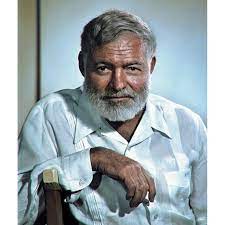
Ernest Miller Hemingway was an American writer and journalist, winner of the Nobel Prize in Literature in 1954 and of the Pulitzer Prize in 1953. He was born on 21 July 1899 in Oak Park, Illinois, a privileged suburb of Chicago. His father, Clarence Edmonds Hemingway, was a physician; his mother, Grace Hall, devoted her life to raising the children. From the boy's earliest years his father tried to pass on to him a love of nature, hoping Ernest would follow him into medicine and natural science. When Ernie was three, Clarence gave him his first fishing rod and took him along on a fishing trip; by the age of eight the future writer knew by heart the name of every tree, flower, bird, fish and animal of the Midwest.
Books were his other passion. He would sit for hours over whatever the family library offered, with a particular taste for Darwin and for works of history. Mrs. Hemingway, however, dreamed of a different future for her son: she made him sing in the church choir and play the cello. Many years later, an old man by then, Hemingway would recall: "My mother kept me out of school for a whole year so that I could study music. She thought I had ability, but I had no talent at all." His resistance was overruled all the same — the daily music practice went on.
Besides the winter house in Oak Park the family kept a cottage, Windemere, on Walloon Lake, and every summer Hemingway went out to those quiet parts with his parents, brothers and sisters. For the boy, Windemere meant complete freedom: no one made him play the cello, and he could do as he pleased — sit on the shore with a rod, roam the woods, play with the children of the Indian settlement.
In 1911, when Ernest turned twelve, his grandfather Hemingway gave him a single-shot 20-gauge shotgun. The gift sealed the friendship between grandfather and grandson: the boy loved the old man's stories, kept fond memories of him all his life, and would often carry them into his later work. Hunting became his ruling passion. Clarence taught his son to handle a gun and to track game, and some of Hemingway's earliest stories about Nick Adams, his alter ego, would be devoted precisely to hunting and to the figure of the father — a man whose character, life and tragic end (Clarence would take his own life) never ceased to trouble the writer.
Naturally healthy and strong, Hemingway boxed and played football with enthusiasm. "Boxing taught me never to stay down," he later said, "always to be ready to attack again... fast and hard, like a bull."
In his school years he made his debut as a writer in the small school magazine Tabula: first "The Judgment of Manitou," a piece of northern exoticism, blood and Indian folklore, and in the next issue a new story, "A Matter of Colour," about the squalid commercial underside of boxing. In the summer of 1916, once classes were over, Ernest — eager to win his independence from his parents — set off with a friend on a journey of his own through Northern Michigan, storing up impressions that would later enter many of his works. Out of that summer came "Sepi Jingan," the story of an Ojibwe hunter's tale of blood vengeance. These first literary efforts cost him little labor, and he took to writing weekly for the school paper, The Trapeze — mostly reports on games and concerts, though his sardonic notes on the "society life" of Oak Park proved especially popular. By now Hemingway had firmly decided he would be a writer.
After school, instead of going to university as his parents demanded, he moved to Kansas City and joined the local paper, the Star. His beat was a small district that took in the main hospital, the railway station and the police precinct. The young reporter went out on every incident: he came to know the dives, ran into prostitutes, hired killers and swindlers, covered fires and jails. He watched, memorized, tried to grasp the motives behind human conduct, caught the way people talked, their gestures, their smells — all of it laid away in memory, later to become the plots, details and dialogue of his stories. It was here that his literary style took shape, along with the habit of always being at the center of events; the paper's editors drilled precision and clarity into his prose and cut off every wordiness and stylistic slackness.
Hemingway wanted to serve in the army, but his poor eyesight kept getting him turned away. He reached the Italian front of the First World War all the same, signing on as a volunteer ambulance driver with the Red Cross. On his very first day in Milan, he and the other recruits were sent straight from the train to clear the site of an exploded munitions factory — a first collision with war he would describe a few years later in Death in the Afternoon. The next day he was posted as an ambulance driver to a unit stationed at Schio, where life turned out to consist almost entirely of amusements: saloons, cards, baseball. Unable to bear it for long, he got himself transferred to the Piave, where he ran army canteens — and soon found a way to the front line as well, volunteering to carry food to the soldiers in the trenches themselves. On 8 July 1918, while rescuing a wounded Italian sniper, Hemingway came under Austrian machine-gun and mortar fire and survived: twenty-six fragments were taken out of him in the hospital, and his body bore more than two hundred wounds. Moved to Milan, he had his shot-through kneecap replaced by the doctors with an aluminum prosthesis. On 21 January 1919 he came home to America a hero — every major paper wrote him up as the first American wounded on the Italian front, and the King of Italy decorated him with the Silver Medal for Valor and the War Cross. His own verdict came later: "I was a big fool when I went off to that war. I thought we were a sporting team and the Austrians were the other team in the match."
He spent nearly a year in the family circle, healing his wounds and weighing his future. On 20 February 1920 he moved to Toronto to return to journalism. His new employer, the Toronto Star, let the young reporter write on any subject but paid only for what was printed. His first pieces — "A Circulating Picture Show" and "Try to Get a Free Shave" — mocked the snobbery of art lovers and the prejudices of Americans; later came more serious work, on the war, on veterans nobody wanted at home, on gangsters and foolish officials. In those same years his conflict with his mother, who refused to see a grown man in Ernest, flared into open quarrels, and in the end Hemingway packed everything he owned out of Oak Park and moved to Chicago, where he went on writing for the Toronto Star while doing editorial work at the magazine Cooperative Commonwealth. On 3 September 1921 he married the young pianist Hadley Richardson, and together they left for Paris — the city he had long dreamed of.
In Paris the young couple settled into a small flat on the rue du Cardinal Lemoine, near the Place de la Contrescarpe. "There was no hot water and no inside toilet," Hemingway would write in A Moveable Feast, "but the view from the window was good. A good spring mattress on the floor made us a comfortable bed. Pictures we liked hung on the walls. The flat seemed bright and cheerful." He had to work hard to make a living and to afford travel in the summer months, so he began sending weekly pieces to the Toronto Star. The editors wanted sketches of European life, the detail of its manners and habits — which left Ernest free to choose his own subjects and to sharpen his style on them. His first were sketches skewering the American tourists, the gilded youth and the idlers who had poured into postwar Europe in search of cheap amusement ("This Is Paris," "American Bohemians in Paris" and the like).
In 1922 he met Sylvia Beach, proprietor of the bookshop Shakespeare and Company, and a warm friendship grew up between them. Hemingway passed many hours in her shop, borrowed books, and came to know the Parisian bohemia — the writers and painters who were its regulars. Among the most interesting and significant of these acquaintances was Gertrude Stein. She became for him an older, more experienced companion: he consulted her about what he wrote and talked literature with her, while she, disdainful of newspaper work, kept insisting that his true calling was to be a writer. He watched James Joyce, another frequent guest at Sylvia Beach's, with great interest — and when Joyce's Ulysses was banned by the censors in the United States and England, Hemingway managed, through his friends in Chicago, to arrange the smuggling and distribution of copies.
His first real success as a writer came in 1926 with The Sun Also Rises — a pessimistic yet brilliant novel of the "lost generation" of young people adrift in the France and Spain of the 1920s. The story collections Men Without Women (1927) and Winner Take Nothing (1933) fixed his reputation once and for all as a singular master of the short story; "The Killers," "The Short Happy Life of Francis Macomber" and "The Snows of Kilimanjaro" are the most famous among them. Yet to most readers Hemingway is above all the author of A Farewell to Arms — the story of the doomed love of an American volunteer and an English nurse, set against the battles of the First World War. The book's success in America was unprecedented; not even the economic crisis could dent its sales.
Early in 1930 Hemingway returned to the United States and settled in Key West, Florida, where he took up fishing, sailed his boat to the Bahamas and Cuba, and wrote new stories. It was now, his biographers agree, that the fame of a major writer came to him: anything bearing his name was published quickly and sold in large printings. The house where he spent several of the best years of his life is now a museum, and the pilgrimage of his admirers to it does not stop for a single day. In the autumn of 1930 a serious car accident left him with fractures, a head injury and nearly half a year of recovery; for a time he gave up the pencils he usually worked with and typed instead. In 1932 he took up Death in the Afternoon, a precise account of the bullfight as ritual and test of courage — another bestseller, confirming his standing as America's number-one writer.
The proceeds of Winner Take Nothing, begun in 1933, were meant to pay for an old dream: a long safari in East Africa. The book succeeded again, and by the end of that year he was on his way. He reached the country around Lake Tanganyika, hired staff and guides from the local tribes, pitched camp and began to hunt. In January 1934, back from another safari, he came down with amoebic dysentery. His condition worsened by the day; he grew delirious and badly dehydrated, and a special plane sent from Dar es Salaam carried him to the capital of the territory, where a week of intensive treatment in an English hospital set him on the mend. Even so, the season ended well for him: three lions, twenty-seven antelope, a large buffalo and other African game. His impressions of Tanganyika went into Green Hills of Africa — in essence the diary of a hunter and traveler.
Early in 1937 he finished another book, To Have and Have Not — his verdict on the era of the Great Depression, seen through the eyes of a Florida man driven by want into smuggling. For the first time in many years a social theme entered his work, prompted in large part by the alarming situation in Spain. Civil war had broken out there, and it stirred Hemingway deeply. He took the side of the Republicans fighting General Franco and organized a collection of donations on their behalf; the money raised, he asked the North American Newspaper Alliance to send him to Madrid to cover the fighting. Before long a film crew was assembled under the director Joris Ivens to make the documentary The Spanish Earth, with Hemingway as screenwriter. Through the hardest days of the war he was in Madrid, besieged by the fascists, at the Hotel Florida — for a time the headquarters of the internationalists and a club for the correspondents. There, amid the bombing and shelling, he wrote his only play, The Fifth Column, about the work of counterintelligence; and there he met the American journalist Martha Gellhorn, who on her return home would become his third wife. From Madrid he traveled for a while to Catalonia, where the fighting around Barcelona was especially savage; in one of the trenches he met the French writer and aviator Antoine de Saint-Exupéry and Hans Kahle, commander of an international brigade. His impressions of the war went into one of his most famous novels, For Whom the Bell Tolls, which joins vivid scenes of the Republic's collapse, a reckoning with the history that led to such an end, and a faith that the individual can stand firm even in tragic times.
In 1941 Hemingway went to Baltimore, where at a local shipyard he bought a large seagoing boat, naming it Pilar. He brought the vessel to Cuba and gave himself over to deep-sea fishing. Then, on 7 December, Japan attacked the United States, striking the base at Pearl Harbor; America entered the war, and the Pacific became a theater of active combat. War had always been one of Hemingway's favorite themes, and with the outbreak of the Second World War he went back to journalism, moving to London as a correspondent. Before that, in 1941–1943, he had organized counterintelligence against fascist spies in Cuba and hunted German submarines in the Caribbean aboard the Pilar. In 1944 he flew combat missions with bombers over Germany and occupied France, and during the Allied landing in Normandy he obtained permission to take part in combat and reconnaissance operations. He put himself at the head of a band of some two hundred French partisans and fought in the battles for Paris, in Belgium and Alsace and in the breach of the Siegfried Line, often finding himself out ahead of the main forces.
In 1949 he moved to Cuba and returned to writing. There he produced the novella The Old Man and the Sea — a book about a heroic and doomed contest with the forces of nature, about a man alone in a world where he has nothing to rely on but his own stubbornness against the eternal injustice of fate. The allegorical tale of an old fisherman battling the sharks that tear apart the great fish he has caught bears all the marks of Hemingway the artist: a distaste for intellectual refinement, a preference for situations in which moral values show themselves plainly, a spare psychological line. In 1953 the novella brought him the Pulitzer Prize, and it weighed in the award of the Nobel Prize in Literature in 1954. In 1956 he began an autobiographical book about the Paris of the 1920s, A Moveable Feast, which would appear only after his death. He went on traveling; in 1953, in Africa, he survived a serious plane crash. In 1960 he left Cuba and returned to the United States.
Hemingway suffered from a series of grave physical illnesses, hypertension and diabetes among them, yet for "treatment" he was placed in the Mayo psychiatric clinic, where the psychiatrist ignored these obvious factors and dealt only with the "mental disorders" his colleagues had credited him with. He sank into deep depression and a paranoia of surveillance. It seemed to him that FBI agents followed him everywhere, that bugs were planted all around, his telephone tapped, his mail read, his bank account under constant review; he could take chance passersby for agents. He was treated according to the psychiatry of the day: electroconvulsive therapy. After twenty sessions of ECT Hemingway had lost his memory and the ability to put his thoughts down in writing — asked to compose a few words of formal greeting, he could not. His own words: "These doctors who gave me the electric shock don't understand writers... Let all the psychiatrists learn to write fiction, so they'd know what it means to be a writer... What was the sense of ruining my brain and erasing my memory, which is my capital, and throwing me onto the sidelines of life?" During the treatment he telephoned a friend from the phone in the clinic corridor to report that bugs had been planted in the clinic too. The same treatment was tried again later, to no result: he could not work, remained sunk in depression and paranoia, and spoke more and more often of suicide. There were attempts as well — a sudden lunge toward an airplane propeller, and the like — from which he was saved.
On 2 July 1961, at his home in Ketchum, a few days after his discharge from the Mayo psychiatric clinic, Hemingway shot himself with his favorite gun. He left no note.
Novels
1926 — The Torrents of Spring
1926 — The Sun Also Rises (Fiesta)
1929 — A Farewell to Arms
1937 — To Have and Have Not
1940 — For Whom the Bell Tolls
1950 — Across the River and Into the Trees
1952 — The Old Man and the Sea
Collections
1923 — Three Stories and Ten Poems
1925 — In Our Time
1927 — Men Without Women
1933 — Winner Take Nothing
1936 — The Snows of Kilimanjaro
1938 — The Fifth Column and the First Forty-Nine Stories
Nonfiction
1932 — Death in the Afternoon
1935 — Green Hills of Africa
Published after the author's death
Novels. 1970 — Islands in the Stream
1986 — The Garden of Eden
1999 — True at First Light
Collections. 1961 — The Snows of Kilimanjaro and Other Stories
1969 — The Fifth Column and Four Stories of the Spanish Civil War
1972 — The Nick Adams Stories
1979 — 88 Poems
1984 — The Short Stories of Ernest Hemingway
1987 — The Complete Short Stories of Ernest Hemingway
1995 — Everyman's Library: The Collected Stories
1999 — Hemingway on Writing
2000 — Hemingway on Fishing
2003 — Hemingway on Hunting
2003 — Hemingway on War
2008 — Hemingway on Paris
Nonfiction. 1962 — Hemingway, The Wild Years
1964 — A Moveable Feast
1967 — By-Line: Ernest Hemingway
1970 — Ernest Hemingway: Cub Reporter
1981 — Ernest Hemingway: Selected Letters 1917–1961
1985 — The Dangerous Summer
1985 — Dateline: Toronto
2005 — Under Kilimanjaro
Plays. 1961 — A Short Happy Life
1967 — The Hemingway Hero