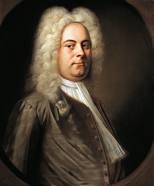
George Frideric Handel was born in Halle on 23 February 1685 and died in London on 11 April 1759.
By social origin he was the son of a "surgeon" — that is, a barber-surgeon. In 1703, drawn by the opera and concert life of Hamburg, he moved there from Halle, and his first opera, Almira (1705), was performed with great success. From 1707 to 1711 he lived in Italy — Florence, Venice, Rome, Naples — to learn Italian opera at first hand. There he staged several of his operas and grew close to the masters of Italian chamber music, above all Corelli and Domenico Scarlatti, with whom he competed at the harpsichord and organ. During his stay in Venice he received an invitation to Hanover through the mediation of Agostino Steffani (1654–1728), the then-famous Hanoverian Kapellmeister whose remarkable chamber duets influenced him deeply. In 1712 Handel moved to London, and England became his second homeland (he took British citizenship). He made his debut there with the opera Il pastor fido and a grand Te Deum for the celebration of the Peace of Utrecht, which closed the twenty-year War of the Spanish Succession. From 1717 to 1720 he was music director to the wealthy Duke of Chandos, who kept his own orchestra at his estate near London; there Handel wrote twelve English anthems — a kind of motet — and the oratorio Esther. In 1720 he took charge of the Italian opera in London, into which for twenty years he poured enormous energy and the whole of his creative genius. His work for the Italian opera lasted until 1740; the final twenty years of his life, from 1739 to 1759, he gave over entirely to composing and performing his oratorios. In all — by the count of the complete edition of the German Handel Society — he wrote 42 operas, 43 oratorios, 29 anthems, 5 psalms, 5 settings of the Te Deum, 100 solo cantatas, 14 organ concertos, 20 grand concertos for orchestra, 3 orchestral overtures, 37 trio sonatas, and a considerable body of keyboard music.
The first quarter of the eighteenth century, when Handel settled in England, was a time of great economic vitality for the country, on the eve of the great Industrial Revolution. England, which had carried out its bourgeois revolution back in the seventeenth century, was growing rapidly stronger, and its rising economic power showed itself, among other things, in the floating of joint-stock companies for every conceivable purpose. The climate proved favorable to the theatrical business and allowed Handel to mount opera on a grand scale. At the century's opening England had no opera of its own and, bound culturally and commercially to the rest of Europe, showed a broad appetite for this fashionable musical commodity. Yet in organizing his enterprise Handel counted on the drawing power of individual singers, and once their appeal began to wane, the financial fortunes of the opera company he had founded declined quickly.
In opera Handel followed Italian models, yet he cannot be called an eclectic. His arias are invariably strong and expressive in melody and rhythmic design. What sets him apart from the Neapolitan masters is his freedom from stock characterization, where other opera composers of his day sought to reduce the variety of human character to a few basic types. Handel knew superbly how to develop the action, deploy contrast, and supply musical and psychological motivation. His style is solemn and elevated, full of heroic pathos, monumental — perfectly matched to the demand for imposing music expressing the strength of a state on its way to becoming a great political power. His operatic orchestra, more complex and more contrapuntally worked than the Italian, fully sustained the grand architecture of his operas. The most significant among them are Rinaldo, Radamisto, Ottone, Xerxes, and Julius Caesar. Two magnificent melodies from Rinaldo and Xerxes, popular to this day, may stand as models of Handelian bel canto.
Alongside moments of heroic power, Handel is a master of the idyllic scene and one of the most sensitive painters of nature in music — qualities that keep him in the sharpened attention of the musical West even now. Remarkable, too, is his gift for setting collective pathos against the portrait of an individual. His melodies breathe broadly, and the beauty of their lines leaves a deep impression. In orchestration built on bold effects of light and shade, he handles the resources of the eighteenth century with complete assurance. Certain of his operas — Xerxes, Julius Caesar — still make the rounds of Europe's stages. Yet it was the Handelian oratorio, to which he devoted his final twenty years, that acted far more powerfully on the musical life of the West throughout the nineteenth century. All his biblical oratorios share the elevated, heroic character of his operas. That such an oratorio could arise at all is explained by a particular bent in the religious poetry of the eighteenth century, which developed with the growth of the Reformation. The "piously exalted attitude" of the English aristocracy and upper bourgeoisie toward the Old Testament — resting on the conviction of the English bourgeoisie, with its very strong aristocratic layer, that it was as much a people "chosen by God" for world dominion as the Jews of antiquity — likewise favored the use of such subjects for music. Handel's oratorios were originally intended for performance on stage and in costume; only the sanctimony of the English clergy, who succeeded in having such performances banned, drove him to the abstract, theatrically static oratorio form of sacred opera.