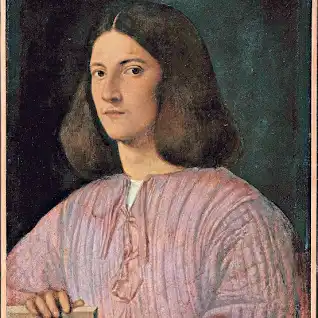
Giorgio Barbarelli da Castelfranco, who entered history under the name Giorgione, was born around 1477–1478 in the town of Castelfranco Veneto. Almost nothing is known for certain about his origins or childhood. In 1493 he entered as a pupil the workshop of Giovanni Bellini, the greatest painter of Venice at the time, and spent about seven years there — one of the few firmly established milestones of his short life.
Besides painting, his contemporaries knew him as a poet and musician — arts that demanded improvisation and mood rather than strict calculation. That same musicality he carried into his painting: Giorgione was one of the first to paint canvases without a clear subject, the so-called "poesie" — scenes in which what matters is not action but atmosphere. His Tempest — a man and a nude woman with an infant against a stormy landscape — still has no generally accepted interpretation; scholars propose dozens of readings, none acknowledged as final.
Fewer than a dozen paintings survive that are unquestionably from his hand — most attributions have been contested by art historians for centuries now, because the master himself did not sign his works, and almost no archival evidence of his commissions has survived. Even his own self-portrait, conventionally considered Giorgione's, has come down to us only in later copies.
In 1510 a plague epidemic came to Venice. Giorgione died on 17 September of that year, little more than thirty years old. Vasari, writing his biography half a century later, told the story that the artist caught the disease from his beloved and deliberately chose not to avoid her company, so as to die together with her — a beautiful tale in the spirit of his own "poesie." Checking the dates, however, does not bear this version out: the woman said to be his beloved died only a year later.
After his death several paintings were left unfinished in the workshop, and the patrons entrusted younger contemporaries — Titian in particular — to complete them. This very practice — entrusting the finishing to another hand — shows how highly Giorgione's conception was valued even in an unfinished state: his manner was regarded not as a secondary matter but as something worth preserving, even at the cost of the unity of execution.
The scarcity of documents about Giorgione is not an accident of the archive but part of his very reputation. Renaissance Venice prized masters about whom one could write ample biographies, full of commissions, pupils, and dated letters; Giorgione slipped out of that tradition almost immediately after his death, leaving art historians not a biography but a puzzle that is still being solved — painting by painting, dispute by dispute, with no hope of a final answer.
Giorgione's influence on the Venetian school proved disproportionately long for a man who worked less than twenty years. Titian, Sebastiano del Piombo, Lorenzo Lotto — all of them grew out of his discovery: that landscape and mood can be the main protagonist of a painting, not the backdrop to an event. He changed the history of art almost anonymously, leaving behind not a signature but a way of seeing.