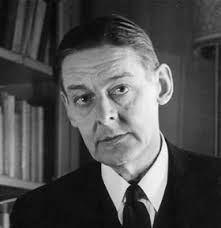
Thomas Stearns Eliot was born in 1888 in St. Louis, Missouri, into a family with deep New England roots. He studied at Harvard, then at the Sorbonne, then at Oxford — and in 1914 he settled in England. In London he was taken up by Ezra Pound, who assumed the role of promoter for the new American: it was Pound who pushed "Prufrock" into the magazine Poetry, and Pound who later radically edited the manuscript of "The Waste Land," cutting it almost in half. Eliot kept the dedication "il miglior fabbro" — "the better craftsman" — to him forever.
"The Love Song of J. Alfred Prufrock" (1915) opened a question that English poetry had never before known how to address: what happens inside a man who wants to say something and cannot. Prufrock goes to parties, thinks of peaches and mermaids, asks himself, "Do I dare?" — and dares nothing at all. Behind this inner muteness stood a whole civilisation that had lost confidence in its own words.
From 1917 Eliot worked at Lloyds Bank in London, handling settlements on foreign debts. In the evenings he wrote poetry and criticism. In 1922 "The Waste Land" appeared — written partly in a Swiss sanatorium in Lausanne, where Eliot had gone to be treated for a nervous breakdown brought on, among other things, by his difficult marriage to Vivien Haigh-Wood, who suffered from a mental disorder. The poem consists of fragments in several languages — English, German, French, Italian, Sanskrit — with an epigraph from Petronius and the author's own notes. It is a montage of the debris of Western culture, in which the First World War is felt not as an event but as an irreversible condition.
In 1927 Eliot took British citizenship and was baptised into the Anglican Church. This step disappointed many of his left-wing admirers: it seemed the author of "The Waste Land" had betrayed his own diagnosis. From that same year he worked as an editor at the publishing house Faber & Faber, championing texts he believed in. In 1930 "Ash Wednesday" appeared — his first great religious poem. In 1935 came the play "Murder in the Cathedral," about the martyrdom of Thomas Becket. This was a different life — quiet, institutional, Christian — but written with the same precision.
"Four Quartets" (1935–1942) are four poems about time, memory, prayer and the impossibility of the word. "Burnt Norton," "East Coker," "The Dry Salvages," "Little Gidding" — each is named after a place, each speaks of the same thing from a different angle. "In my beginning is my end" — so opens "East Coker," with a line from the will of a sixteenth-century ancestor of Eliot's. He received the Nobel Prize in Literature in 1948 — for this work, among others.
Alongside his austere work Eliot wrote texts of an entirely different kind. "Old Possum's Book of Practical Cats" (1939) is a set of cheerful verses about cats named Mungojerrie, Rumpelteazer and Skimbleshanks. Forty-three years later Andrew Lloyd Webber made them the basis of the musical "Cats," which ran on Broadway for twenty years. As for his first wife, Vivien Haigh-Wood — Eliot separated from her in 1933; in 1938 she was involuntarily committed to a psychiatric clinic, where she died in 1947.
In 1957, at the age of sixty-eight, Eliot married his secretary, Valerie Fletcher — barely past thirty. By the testimony of everyone who knew him in this period, the last years of his life were happy. He died on 4 January 1965 in London. His ashes are buried in the church of St. Michael in East Coker — the village in Somerset from which his ancestors had left for the New World in the seventeenth century. "In my beginning is my end. In my end is my beginning" — his words became his epitaph.