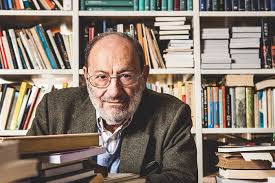
Umberto Eco was a medievalist, a semiotician, a professor — and a writer of detective novels. This is not a contradiction; it is a method. He spent his life studying how signs create meaning, and one day decided to test the theory on readers.
He was born in 1932 in Alessandria, in northern Italy. He studied medieval philosophy and wrote his dissertation on the aesthetics of Thomas Aquinas. Then came semiotics, communication theory, the analysis of mass culture. Eco could write a serious essay on James Bond and did not consider it slumming.
He wrote The Name of the Rose at fifty — a novel about a medieval monastery where monks are murdered for reading a forbidden book. Behind the detective plot lies a question: what happens when power is afraid of laughter? The book sold in the tens of millions. Eco himself said he had written it "for pleasure."
Foucault's Pendulum, The Island of the Day Before, Baudolino — into each novel he folded so many layers that they are still being deciphered. He died in 2016 in Milan, leaving a library of fifty thousand books. "A private library," he said, "is not a collection of books one has read. It is an instrument for thinking."