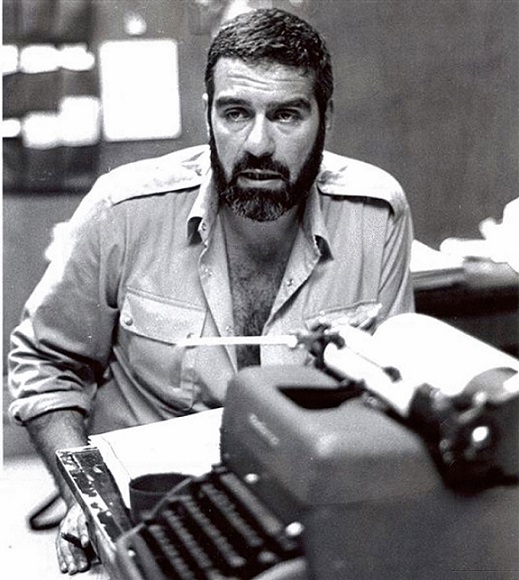
Sergei Dovlatov was born on 3 September 1941 in Ufa: the family had been evacuated from Leningrad. His father was a theatre director, his mother a proofreader. When Dovlatov was five, his parents separated. He grew up in a communal apartment with his mother in Leningrad. In 1959 he entered the Finno-Ugric department of the philology faculty of Leningrad University and was expelled two years later.
From 1962 to 1965 he served in the army as a guard in corrective labor camps in the Komi Republic. Three years on the other side of the bars — armed, under orders, obliged not to notice what was going on there. Later this experience became the basis of the novella "The Zone" (written in the 1960s, published in emigration in 1982). Dovlatov did not write a political pamphlet: he wrote portraits. The guards and the prisoners are strikingly alike — the same fates, the same dreams, the same weaknesses.
After the army he returned to Leningrad and began to write — stories that were accepted nowhere, and newspaper pieces that were accepted readily. In 1972 he moved to Tallinn and went to work for the local papers. The Estonian editorial world was a little freer than the Leningrad one — it took on more willingly those who felt cramped in the capital. The Tallinn period gave the material for "The Compromise" (1981): a chronicle of newspaper work in which every report is a story of how reality diverges from what has to be printed.
In the mid-1970s the KGB confiscated several manuscripts. By then Dovlatov had written several books, not one of which could appear in the USSR. His prose was apolitical — he did not denounce the system directly, did not write dissident texts. But the very tone, the very honesty of his gaze, made it unpublishable: Soviet literature demanded either a vindication of reality or its denunciation. A third option was not envisaged. He was not admitted to the Union of Writers; in 1977 several stories appeared in Russian-language publications abroad, after which his position in Leningrad became finally impossible.
In 1979 Dovlatov emigrated — through Vienna to New York. There he became one of the founders of the Russian-language weekly "The New American," which turned into a cultural center of the third wave of emigration. New York proved just as absurd as a Soviet editorial office — only without censorship, but with its own hierarchies, grievances, and pretensions. Dovlatov wrote about it with the same imperturbable precision as about Leningrad.
"The Suitcase" (1986) is a series of stories about the things he brought out of the USSR: each object becomes an occasion to recall an episode of his past life. "Ours" (1983) offers portraits of the family, from grandfather to nephew, without sentimentality. "The Reserve" (1983) is a summer at the Pushkin museum-estate of Mikhailovskoye, where staff and tourists live amid a canonical past to which they have no relation whatsoever. "A Foreign Woman" (1986) is émigré New York, where Soviet people reproduce Soviet relations in a free country. Dovlatov's style is precise and unpretentious: short sentences, concrete details, no note of the victim. Tragedy is set down in the same tone as everyday absurdity.
Sergei Dovlatov died on 24 August 1990 in New York of heart failure. In that same year his first publications appeared in the USSR. In eleven years of emigration he wrote twelve books. In the 1990s he became one of the most widely read Russian prose writers — the country read him almost posthumously, catching up on what had been unavailable during his lifetime.