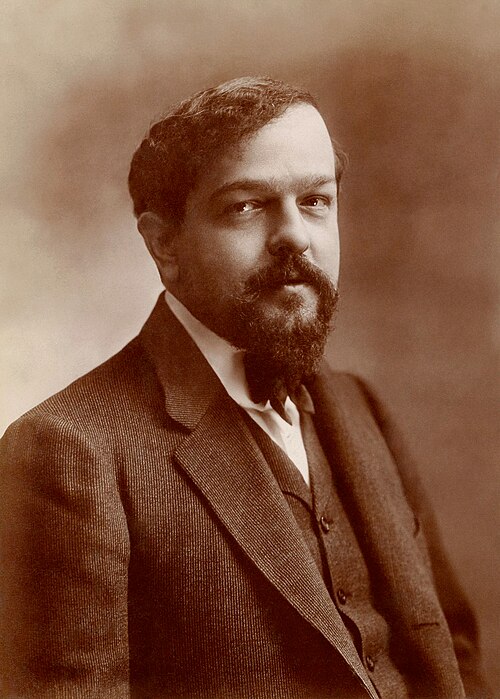
Claude Debussy (1862–1918) was a French composer, the father of musical Impressionism and one of the pivotal figures in the turn toward twentieth-century music. He studied at the Paris Conservatoire; in his youth he stayed in Russia with Nadezhda von Meck (the same patroness who supported Tchaikovsky); and at the World's Fair of 1889 he heard the Javanese gamelan — the chiming of that distant world stayed in his ears for the rest of his life.
Debussy deliberately renounced the Romantic logic of thematic development and the "correct" German way of working out material. He builds music as a chain of images: momentary impressions, gliding harmonies, shimmering timbres. His orchestral Prelude to the Afternoon of a Faun (1894), after Mallarmé, became the manifesto of a new sound; La Mer (1905) is perhaps the most vividly painted seascape in all orchestral music.
For the piano he wrote the Suite bergamasque, with its famous "Clair de lune," the Estampes, two books of Images, two books of Préludes ("The Sunken Cathedral," "The Girl with the Flaxen Hair," "Footprints in the Snow"), and the late cycle of Études. His only completed opera, Pelléas et Mélisande (1902), after Maeterlinck's play, is a quiet drama without showpiece arias — and it opened an entirely new kind of operatic writing.
In the late works — three sonatas for various forces, the ballet Jeux — Debussy moved beyond even his own Impressionism toward a drier, more graphic sound. His music became a point of departure for nearly every current of the twentieth century, from Ravel and Les Six to Bartók, Messiaen, Boulez, and the jazz harmony of Bill Evans.
To listen to Debussy is to let music be a landscape: not a story unfolding in time, but a moment that lasts, long and slowly.