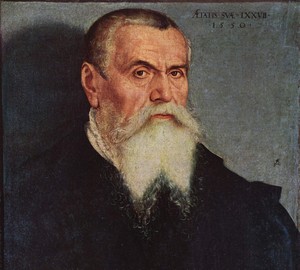
Lucas Cranach the Elder (Lucas Cranach der Altere; 4 October 1472, Kronach – October 1553, Weimar) was a German painter and graphic artist of the Renaissance, a court painter, and the author of numerous portraits of his contemporaries as well as pictures on biblical subjects and genre scenes. He took an active part in the formation of the Danube school, directed a large artistic workshop, supported the Reformation and was a friend of Martin Luther. He was the father of the painters Hans Cranach and Lucas Cranach the Younger.
The distinctive quality of his art lies in a happy union of the Gothic traditions that then governed German painting with the essential principles of the Renaissance, out of which Cranach forged a style of his own. In his pictures the figures are set harmoniously into the landscape, and this allowed him to convey the individual character of his sitters with unusual fullness. Though many of his patrons were members of the nobility, he painted them without needless idealization, preferring to show the rich inner world that opened before him as he worked.
His early paintings show a marked preference for unconventional colour — a device which, combined with asymmetry, was decidedly innovative for the age. The mature period is dominated by a poetic strain that lends his detail-laden subjects an air of fairy tale and idyll.
Among his famous pictures: Adam and Eve, The Crucifixion, Venus and Cupid, Madonna, The Nymph of the Spring, Melancholy, The Stag Hunt, The Judgment of Paris, Judith with the Head of Holofernes, and portraits of Martin Luther, the prince of Saxony, Frederick the Wise, Sibylle of Cleves and Anna Cuspinian.
Of his childhood no precise record survives. Some sources hold that his father is unknown and that the young man's surname was Sunder; according to others he was born into the family of the painter Hans Maler, who lived and worked at Kronach in Upper Franconia, and it is supposed that he learned the rudiments of painting in his father's workshop. His first drawings have not survived; the works that became public property date from about his thirtieth year.
In the early 1490s the young Cranach, then an entirely unknown beginner, set off on a journey through Germany. Palestine followed, and in 1501 Vienna, where he spent two years studying the work of Albrecht Durer. It was there that he painted his first surviving works bearing his recognizable signature — among them an Adam and Eve long attributed to Durer himself: Cranach was so absorbed in the great German's art that he took Durer's composition of that name as the basis for a version of his own.
The move to Wittenberg in 1504, at the invitation of Frederick the Wise, brought Cranach the title of court painter and brought him fame: he painted portraits of courtiers and other pictures, among them The Crucifixion. Showing the Saviour raised on the cross above an earth flooded with blood and spring meltwater, against dark storm clouds and bare branches, the artist conveyed the full tragedy of the scene while leaving hope of salvation after death and the forgiveness of sins.
In the early 1500s Cranach displays astonishing mastery, combining bright contrasting colours and employing devices unusual for the time. In Rest on the Flight into Egypt he paints Mary's ample garments in the form of a shell, as if sheltering their wearer; the calm pose of Joseph, resting against a tree, contrasts with the many small figures of bustling angels gathered round the infant Christ.
The year 1508 proved a turning point: he visited the Netherlands, and on his return to Wittenberg received a patent of nobility and the direction of a large workshop. Under him laboured ten young masters, who helped paint pictures, illustrate books and sell them. In time the workshop brought in a considerable income: Cranach grew so wealthy that the townspeople came to regard him as a man of standing and more than once elected him burgomaster of Wittenberg. To this period belong the portrait of Charles V, the painting Venus and Cupid, and the altarpiece of St Catherine.
An immense source of inspiration came from the works of Leonardo da Vinci, which Cranach encountered on a journey to Mechelen in 1508. He was the first painter of Northern Europe who dared to depict the goddess Venus naked — until then only Eve had been allowed to appear so on canvas. The boldness of the treatment met with no public censure: Cranach remained as popular as ever, taking commissions for portraits, pictures on classical and biblical themes, and idyllic landscapes.
His canvases adorned the palaces of the nobility and the houses of rich townsmen. The abundance of commissions allowed him to draw his sons into painting: his elder son Hans worked in the celebrated master's workshop, joined later by the younger, Lucas Cranach the Younger.
Cranach was not only a painter and a prosperous burgher. His acquaintance with Martin Luther made him a convinced supporter of the Reformation and an active participant in the movement. He drew illustrations for Protestant pamphlets and painted portraits of Luther, and he contributed a considerable sum toward the publication of the Bible in Luther's German translation.
Today the pictures of this artist of genius hang in the Hermitage, the Dresden gallery, the Leipzig museum, the gallery in Stuttgart, the Alte Pinakothek in Munich and elsewhere. In 2015 his painting The Mouth of Truth was sold at Sotheby's for 9,300,000 pounds.