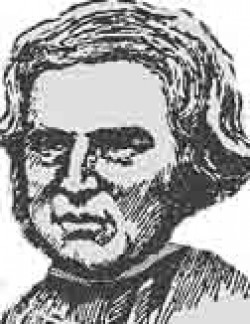
Chrétien de Troyes worked at the court of Marie de Champagne — daughter of Eleanor of Aquitaine and the French king Louis VII — roughly between 1160 and 1181, and afterwards at the court of Philip of Alsace, Count of Flanders. Of the poet's life almost nothing is known: his name points to the town of Troyes in Champagne, but there is no documentary evidence whatever. He wrote five great verse romances — "Erec and Enide," "Cligès," "Lancelot, or the Knight of the Cart," "Yvain, or the Knight with the Lion," and the unfinished "Perceval." That was enough to shape the destiny of the European romance for several centuries to come.
"Lancelot, or the Knight of the Cart" was written on the direct commission of Marie de Champagne. In the prologue Chrétien states honestly that both the subject and the design were set by his patroness — his part was merely to "apply his effort." Her condition proved severe: for love of Guinevere, Lancelot must break the knightly code of honour — climb into a cart used to carry criminals, because there is no other way to find the queen quickly. Before Chrétien no character named Lancelot existed in the Arthurian cycle. The author invented him — together with courtly love as a trial rather than a sin. This romance too Chrétien left unfinished: a certain Godefroi de Leigni wrote the ending, noting in the text that he did so with the author's permission.
"Perceval" was commissioned by Philip of Alsace and broke off at around the nine-thousandth line — far short of its intended close. A young knight comes to the castle of the Fisher King and sees a mysterious procession: a youth carries a bleeding lance, maidens carry a glowing golden vessel (graal) and a silver platter. Perceval has been raised on a rule: a good knight asks no unnecessary questions. He stays silent. In the morning the castle is empty. Later he learns that, had he asked "Whom does the Grail serve?", the Fisher King would have been healed. The question went unasked because etiquette proved stronger than compassion. This is the wound that Chrétien did not live to heal in the text.
In Chrétien's text there is no explanation of what the Grail is. It is described as a broad, shallow golden vessel studded with precious stones; in it is carried a single Eucharistic wafer — and that is enough to sustain the life of an infirm old man, the father of the Fisher King. Five authors took up the continuations after Chrétien's death. Wolfram von Eschenbach wrote his German "Parzival" around 1210 and turned the Grail into an angelic stone; Robert de Boron tied it to the chalice of the Last Supper and the story of Joseph of Arimathea. The more answers appeared, the more evident it became that the question mattered more than any explanation.
Through Chrétien the Breton folklore of Arthur became a common European cultural treasure. The "Matter of Britain" — Camelot, the Round Table, Lancelot, the Grail — became the foundation of the French prose romances of the thirteenth century, of Thomas Malory's "Le Morte d'Arthur" (1485), of Wagner's opera "Parsifal" (1882), and of T. H. White's "The Once and Future King" in the twentieth century. Almost everything the modern reader considers the "Arthurian legend" is Chrétien, or reworkings of Chrétien. He set the form; others filled it with meaning as they saw fit.
The paradox is this: of Chrétien himself almost nothing is known — neither the date of his birth, nor of his death, nor his appearance, nor his biography — while his characters live as though they had always existed. Lancelot and Guinevere, Perceval and the Grail were not legends before him. He invented them — or cut them from oral traditions that would otherwise have crumbled — and vanished without finishing his last romance. This too is a kind of answer: the maker of an image is not needed by the image in order to go on living.