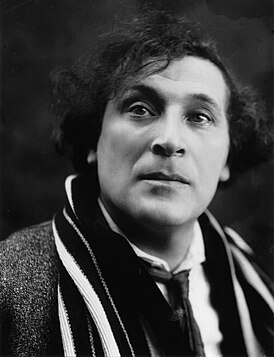
Marc Zakharovich Chagall (born Moishe Segal) was born on July 6, 1887, in a Jewish suburb of Vitebsk, into a poor family with many children: his father worked as a laborer in a herring shop, and there were nine children in the family. He began to draw on his own, and received a systematic education only in Saint Petersburg, where he moved in his youth and entered the art school of Elizaveta Zvantseva, where the theater designer Léon Bakst taught.
In May 1911, on a stipend from the lawyer and patron Maxim Vinaver, Chagall left for Paris — there he first began to sign his works with the name "Marc" instead of "Moishe." In Paris he found the ferment of the young avant-garde — Cubism, Futurism — but he dissolved into none of the movements: his own visual language — flying figures, upturned houses, fiddlers on rooftops — grew not out of a theoretical program but out of the memory of his native Vitebsk and its Jewish way of life.
On July 25, 1915, Chagall married Bella Rosenfeld, the daughter of a Vitebsk jeweler; over the following decades her image would appear on thousands of his canvases — as muse, bride, and companion in flight over the rooftops of their native city. After the Revolution, Chagall was made commissar for the arts of the Vitebsk province, and in 1919 founded an art school in the city, inviting, among others, Kazimir Malevich. The argument over what the new art should be turned into a conflict: the supporters of Malevich's Suprematism gradually crowded out Chagall's influence among the students, and in 1920 he left his own school.
Chagall left the USSR and settled in France, and with the beginning of the German occupation, being a Jew, he was forced to flee to the United States, where he spent the war years. After the war he returned to France and lived there to the end of his life, gradually widening the range of his work far beyond easel painting: he created stained-glass windows for cathedrals and synagogues in various countries, and in 1964 painted the ceiling of the Paris Grand Opéra — the Palais Garnier — bringing together on it scenes from the works of composers whose music had sounded there.
In 1977 France awarded Chagall the country's highest honor — the Grand Cross of the Legion of Honor — and in honor of his ninetieth birthday the Louvre held a solo exhibition of his work, an unprecedented event for a museum that by tradition did not show the work of living artists.
Marc Chagall died on March 28, 1985, in the town of Saint-Paul-de-Vence in the south of France, a little short of his ninety-eighth birthday. He had lived through two world wars, a revolution, emigration, and the loss of his native city as he had known it — and all his life he went on painting Vitebsk as he had seen it in childhood, as though time had no power over that city in his memory.
Over a long life that stretched across almost the whole twentieth century, Chagall never fully joined any single artistic camp: the Cubists thought him too literary and fairy-tale-like, the Surrealists too warm and free of anxiety, Socialist Realism too personal and remote from the great ideological themes. He remained aloof from all the manifestos precisely because he painted not a program but his own memory — and it seems that only thanks to this stubbornness did he manage to carry the image of prewar shtetl Vitebsk through the whole turbulent century and deliver it, almost unchanged, to canvases painted only a few years before his death.