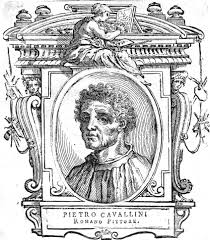
Thirteenth-century Italian painting knew how to pray, but not how to breathe. The figures on walls and panels stood flat, as if cut out of a golden ground: the folds of their garments fell as pattern rather than cloth, and the faces repeated the strict Byzantine formula. Beautiful — and motionless. Pietro Cavallini, who lived and worked in Rome, was the first of his generation to want the image to recover a body once again: volumetric plasticity, weight, shadow.
He grew up within the Byzantine tradition — it could not have been otherwise for a painter of his day. But he did not submit to its conventional mannerism. Instead of copying the familiar formula, Cavallini reached deeper — toward the most ancient and lofty forms, toward the great Roman medieval painting, and followed its path. He knew how, as it has been said of him, to pluck fruit from the mighty tree of Roman art — the fruit of the boldest experiments of his century.
The earliest of his surviving works is the mosaic in the apse of the church of Santa Maria in Trastevere (1291), which bears his name. Six episodes from the life of Mary, and a scene in which Saint Peter presents the donor Stefaneschi to the Mother of God. Soon afterward Cavallini painted the frescoes in the church of Santa Cecilia in Trastevere (around 1293). Of that ensemble only the monumental composition of the "Last Judgment," discovered in 1901 behind the choir, has survived — and it is the most significant, the most accomplished thing the master left behind.
It is precisely here that his breakthrough can be seen. In Cavallini's hands color lends each form its independence; a sharp, deep shadow models the relief and gives the figures a solemn, imperturbable gravity. The realism of the faces is able to express both religious ardor and simple human happiness. Set the dense, weighty forms of the Santa Cecilia frescoes against the earlier mosaic of Santa Maria in Trastevere — and the step forward is visible, a step toward the living, corporeal image.
His career was a long one. Cavallini worked in the most important churches of Rome and Naples, carrying out commissions for men of high standing — Pietro da Bartolo Stefaneschi, the dukes of Anjou. In Naples, from 1308, he worked for the Angevin court; his workshop is credited with the frescoes in the cathedral and in the church of Santa Maria Donnaregina, though later overpainting makes it impossible to isolate his hand with certainty. Much of the Roman period seen by Giorgio Vasari and Ghiberti has not come down to us — for example, the mosaic on the facade of the basilica of San Paolo.
For his devout life he was revered as almost a saint; according to legend, a crucifix of his making in the basilica of San Paolo fuori le Mura once spoke aloud. Legend is legend, but it betrays the essential thing: in his images people felt the presence of the living. Alongside Giotto, Cimabue, and Duccio, he occupies a place of the first importance at the turn from the Duecento to the Trecento. His art influenced Giotto and other young painters of Italy — and although the old label "Roman teacher of Giotto" is now disputed, comparing their work only shows more clearly the true greatness of Cavallini himself.
He restored volume and humanity to the image at the very moment in history when art was preparing to rediscover man. To the painting of fourteenth-century Rome, Naples, and Umbria he bequeathed a rare thing — a union of religious ardor and living warmth, that supreme poetry and expressive power for the sake of which it is worth stepping close to the wall and looking hard.