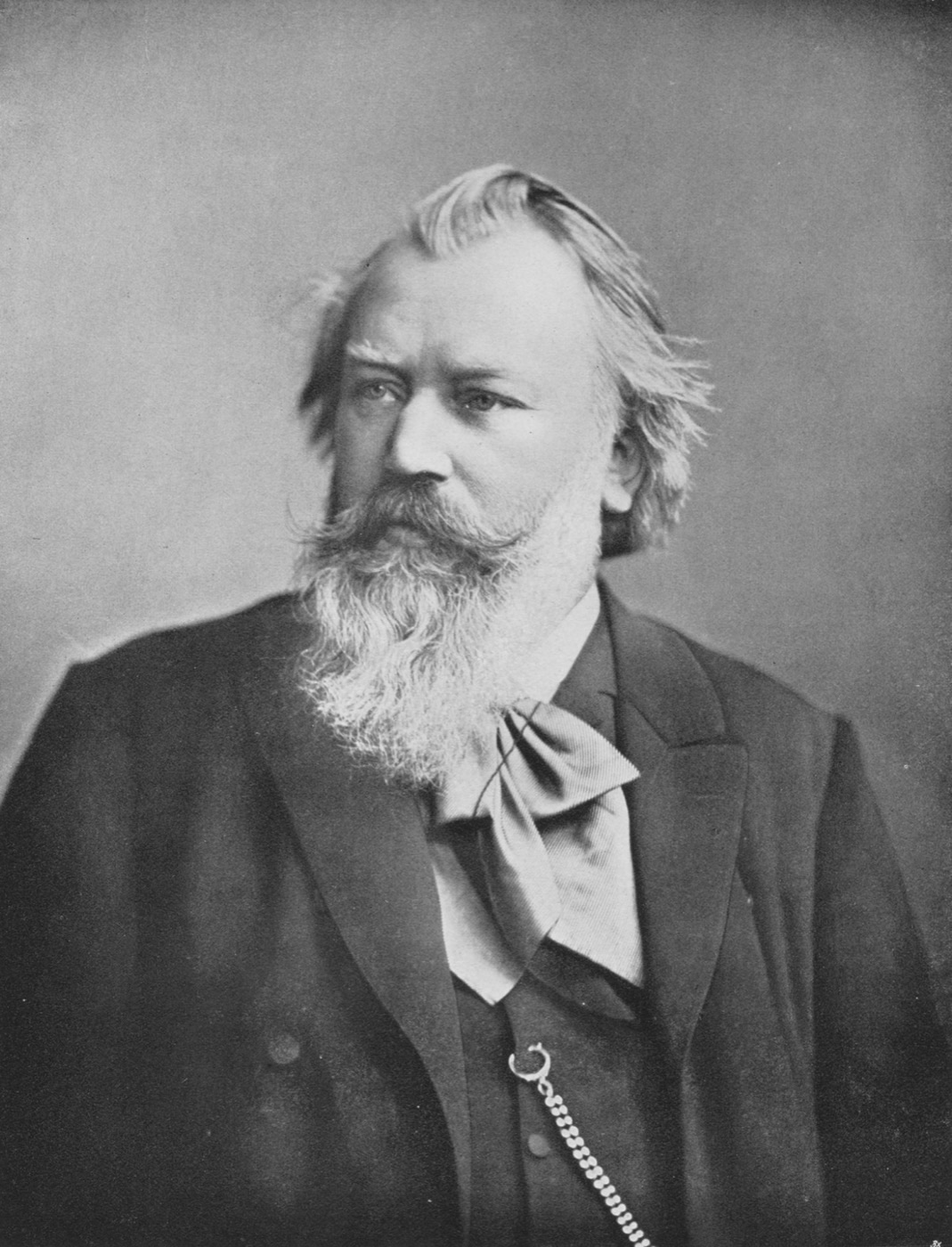
Johannes Brahms (1833–1897) was a German composer, one of Beethoven's chief heirs and the conscience of late musical Romanticism. He grew up in the port of Hamburg, in the modest household of a double-bass player; as a teenager he played in taverns, studied counterpoint, and read the Bible alongside Romantic poetry. The decisive encounter of his life was with Robert Schumann, who in 1853, in the article "New Paths," hailed the twenty-year-old Brahms as heir to the great German tradition — the beginning, too, of a lifelong friendship with Clara Schumann.
For years Brahms could not bring himself to write a symphony: the shadow of Beethoven's Ninth gave him no peace. Not until 1876 did his First appear, followed by the Second, Third and Fourth; and in that Fourth (1885), with its closing passacaglia, Beethovenian architecture and the composer's private grief converge. Beside the symphonies stand two piano concertos, the Violin Concerto in D major, and the Double Concerto for violin and cello — all of them pillars of the repertoire.
His chamber music carries no less weight: trios, quartets, quintets, piano sonatas, the late intermezzi of Opp. 117–119. Among the vocal works are "A German Requiem," set to texts from Luther's Bible, and nearly two hundred songs, in which Brahms proved the finest lyricist of late German poetry. The famous Hungarian Dances are a facet of the legacy all their own, one that opened the European ear to an East European colouring.
Brahms was a passionate collector of scores: his library held autographs of Bach, Mozart and Schubert; he edited other composers' works and guarded the German tradition as a living inheritance.
To listen to Brahms is to hear a Romantic reining himself in with classical rigour: the feeling is there, but it is always set in a lucid form.