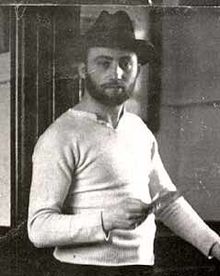
David Bomberg was born on December 5, 1890, in Birmingham, into a family of Polish Jewish émigrés; in 1895 the family moved to Whitechapel in London's East End, a district where the poor settled. At fifteen he was apprenticed to a lithographer — a trade, not an art, was the first rung of his education.
In 1908–1910 Bomberg studied the history of art at the Westminster School of Art under Walter Sickert, and at the same time worked as an assistant in the studio of John Singer Sargent, the celebrated society portraitist. It was Sargent who advised the young artist to continue his education at the far more progressive Slade School; having received a scholarship from a Jewish charitable society, Bomberg studied there in 1911–1913.
He became one of the founders of Vorticism — the English offshoot of the avant-garde, which sought in painting a sharp, machine-like geometry in place of the softness of Impressionism. In 1913, together with the sculptor Jacob Epstein, he traveled to Paris, where he met André Derain, Amedeo Modigliani, and Pablo Picasso — an acquaintance that left its mark on his later manner of painting, which inclined toward sharp planes and an almost crystalline form of the body.
The First World War was a turning point. Bomberg served on the Western Front in 1915–1918, and after the war received a commission from the Canadian War Memorials Fund for a painting devoted to the tunneling sappers. The first, emphatically abstract and geometric version the committee rejected as incomprehensible and disrespectful to the subject; the artist had to paint a second, far more realistic version. The episode proved prophetic: the critics and the market turned away from Bomberg's sharp prewar style, while the softer, more expressive manner to which he later turned brought him no recognition either.
The following decades he spent traveling and almost without any settled position: he lived in Palestine in 1923–1927, visited Morocco and Greece in 1930, the USSR in 1933, and Spain in 1934–1935 — everywhere painting landscapes in a dense, heavy stroke, far from the London art establishment, which took practically no notice of him.
Recognition Bomberg found not as a painter but as a teacher: from 1945 to 1953 he taught at the Borough Polytechnic in London, and among his pupils were Frank Auerbach, Leon Kossoff, and Denise Hurst — artists who later formed the core of the so-called London School of painting. Bomberg himself died in 1957, almost forgotten; the real reappraisal of his legacy came only after his death, when it became clear that it was precisely through his pupils that the sharp, passionate manner of painting rejected by his contemporaries entered the history of English art after all.
In his lifetime he had almost no steady income from the sale of paintings, and teaching at a modest polytechnic, rather than at a prestigious academy, was not a choice but a necessity. It was precisely this forced position — to teach students in evening classes rather than the stars of the art schools — that turned out to be his chief contribution to British painting: freedom of the brushstroke and trust in one's own, unpolished vision he passed on to his pupils directly, without the mediation of the success or fashion that he himself did not have.