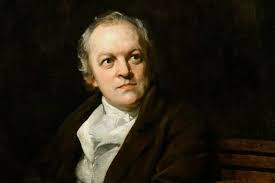
Blake was born on 28 November 1757 in London, the son of a shopkeeper — the third of seven children, two of whom died in infancy. He never went to school; his mother taught him at home. His parents were devout Protestants, and the Bible shaped his outlook from the start, remaining his chief source of inspiration for the rest of his life. As a boy he took to copying Greek subjects from prints his father bought for him; the work of Raphael, Michelangelo, Maarten van Heemskerck and Albrecht Duerer instilled in him a love of classical form, and the pastime gradually deepened into a passion for painting. His parents, mindful of the boy's fiery temperament and regretting that he had missed schooling, sent him to drawing lessons — though even there Blake studied only what interested him. His early work shows a familiarity with Ben Jonson and Edmund Spenser, and it was in these years that poetry, too, took hold of him.
In 1772 Blake was apprenticed for seven years to the engraver James Basire. There is no record of any serious quarrel or conflict between master and pupil during those years, and by the end of his apprenticeship, at twenty-one, Blake was a professional engraver. In 1778 he entered the Royal Academy of Arts, where he showed himself an adherent of the classical style of the High Renaissance.
In 1782 Blake married Catherine Boucher, an uneducated but very sweet-natured girl who had fallen in love with him at first sight. They stayed together until Blake's death — after which Catherine insisted that her late husband's spirit visited her regularly. She died in 1831. They had no children. Blake's first collection of verse, Poetical Sketches, appeared in 1783; thereafter the poet produced a series of "illuminated manuscripts," engraving his poems and designs with his own hand on copper plates.