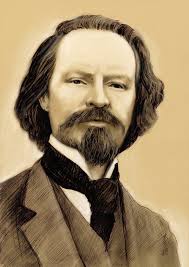
Konstantin Dmitrievich Balmont was a Russian Symbolist poet and translator, one of the foremost figures of Silver Age poetry, and the author of autobiographical prose, memoirs, philological treatises, studies in literary history, and critical essays. He is usually said to have come from a noble family with, according to family legend, Scandinavian — by some accounts Scottish — roots. There is, however, another version of the surname’s origin: some scholars note that the poet’s great-grandfather, a cavalry sergeant in one of Catherine the Great’s Life Guards regiments, may have borne the name Balamut — “troublemaker” — later dignified by being “recast in a foreign manner.” All of the poet’s relatives stressed the first syllable of the name; only later did Balmont himself, “on the whim of a certain woman,” as he put it, move the stress to the second.
He was born on 15 June 1867 in the hamlet of Gumnishchi, in the Shuya district of Vladimir province. His father, Dmitry Konstantinovich Balmont (1835–1907), served in the Shuya district court and the zemstvo; his mother, Vera Nikolaevna, née Lebedeva, came from a colonel’s family in which literature was loved and pursued professionally. She wrote for the local press and organized literary evenings and amateur theatricals, and she shaped the future poet’s outlook profoundly, opening to him the worlds of music, letters, and history and teaching him to perceive “the beauty of a woman’s soul.”
Konstantin was the third of seven boys. He taught himself to read at five, watching his mother teach his elder brother his letters; his father, touched, marked the occasion with the gift of a first book. In 1876 he entered the Shuya gymnasium, only to be expelled before long for belonging to a clandestine circle — schoolboys, visiting students, and teachers — that printed and distributed in Shuya the proclamations of the executive committee of the People’s Will party.
His literary debut came at the end of 1885, when three of his poems appeared in the popular St. Petersburg journal Zhivopisnoe Obozrenie. No one noticed except his mentor, who forbade him to publish again until he had finished the gymnasium; the crestfallen poet destroyed the entire print run.
To the end of his life Balmont thought of himself as a revolutionary and a rebel. He was expelled from Moscow University as well, and even spent three days in Butyrka prison. Poetry won out among his interests only later; in his youth he yearned to become an agitator and “go to the people.”
At thirteen he came upon the English word “self-help,” and from that moment he fell in love with inquiry and “mental work,” laboring without stint to the end of his days.
In 1894 came the collection that marked his true starting point, “Under the Northern Sky.” In 1899 he was elected to the Society of Lovers of Russian Letters, and with the 1900 collection “Burning Buildings” he won fame across Russia and emerged as one of the leaders of Symbolism.
Balmont was the first Symbolist poet to achieve nationwide renown, and among the most prolific of the Silver Age: thirty-five published collections of verse and twenty books of prose. He wrote in every genre without exception — poems, prose, autobiography, memoirs, philological treatises, studies in literary history, critical essays.
He was also a translator of rare range, rendering Spanish songs; Yugoslav, Bulgarian, Lithuanian, Mexican, and Japanese poetry; the Slovak and Georgian epics. His contemporaries prized “Fairy Tales” (1905), a collection of stylized children’s fairy-song verse dedicated to his daughter Nina.
His closest friend was Valery Bryusov, whom he met in September 1894 at the student Circle of Lovers of Western European Literature; Bryusov wrote of the “exceptional” impression made on him by the poet’s personality and his “frenzied love of poetry.” The revolution, oddly enough, Balmont could not accept — its methods were too bloody — and in 1920 he left his homeland for good, living thereafter either in Paris or in small villages on the Atlantic coast. His literary work in these years was intense: articles and essays on Russian, Slavic, and French poets. The separation from Russia pained him deeply; he followed events at home closely and strove to understand and make sense of what was changing.
In 1923, alongside Maxim Gorky and Ivan Bunin, he was nominated by Romain Rolland for the Nobel Prize in Literature.
He set a record of sorts: more than a hundred and fifty of his poems were set to music. Taneyev and Rachmaninoff, Prokofiev and Stravinsky, Glière and Myaskovsky all wrote songs to Balmont’s words.
Balmont’s poetry resembles nothing else. Bryusov called it the poetry of “captured moments”: the instant, the fleeting thing, is the philosophical principle of his verse. The moment is a symbol of eternity — that is what the poet tells us — and, tearing the moment out of eternity, he fixes it forever in the word.
Many of his biographers consider 42 his fateful number. In 1942 his first wife, Liza Garelina, died; at forty-two Balmont visited Egypt, of which he had dreamed since childhood; at forty-two he suffered a creative crisis; and he was born forty-two years after the Decembrist uprising, regretting all his life that he had not stood with them on Senate Square.
In his memory, the Balmont Literary and Local History Museum stands on Lenin Avenue in the town of Shuya — the first museum in Russia devoted to the life, work, and legacy of the Silver Age poet and to the history of his native Shuya country. Its literary collection includes unique items that belonged to Balmont, among them his library, documents, and all of his published editions.
At the entrance to the village of Gumnishchi, set back from the road on the site of a former park, a memorial marker has been raised. Every year in mid-June the Balmont Readings convene in Shuya, drawing scholars of the poet’s life and work from cities across Russia along with relatives scattered around the globe. Shuya itself is still home to many Balmonts, among them a grand-nephew, Mikhail Yuryevich Balmont, who at his own expense placed memorial plaques on School No. 2 (the former gymnasium) and on the Balmont house on Sadovaya Street, and who publishes the literary almanac “Sunny Yarn.”
On 12 May 2011 a monument to Konstantin Balmont was unveiled in Vilnius, Lithuania — paid for by private donations, with the Lithuanian branch of his descendants taking part. It stands in a small park near the Russian embassy, in one of the loveliest quarters of the city.