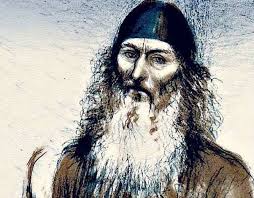
Avvakum Petrovich was born around 1620–1621 in the village of Grigorovo in the Nizhny Novgorod land, into a priest's family. At twenty-one he became a priest himself, and by thirty an archpriest (a senior priest) in Yuryevets-Povolzhsky. In the 1640s he found himself in Moscow, in the circle of the "zealots of piety" — men who wished to cleanse church life of everyday impiety, of the drunkenness and ignorance of the clergy. Among them was the future patriarch Nikon. Avvakum had access to the young Tsar Alexei Mikhailovich. He seemed to be on the right side.
In 1653 Patriarch Nikon carried out a church reform: he brought the Russian liturgical books and rites into conformity with the Greek originals. Making the sign of the cross with two fingers was replaced by three. The number of prostrations changed, as did the spelling of the name "Jesus" and the number of "alleluias." For Avvakum this was sacrilege: he held the old Russian books to be more trustworthy than the new Greek translations. He refused to accept the reform, and in that same year, 1653, he was exiled to Siberia — to Tobolsk.
Eleven years of exile. From Tobolsk he was attached to the military expedition of the voivode Pashkov — a campaign to Lake Baikal and into Dauria, beyond Baikal. The conditions were brutal: they hauled boats through the rapids, went hungry, froze. Avvakum's wife Anastasia — he called her "the archpriest's wife" — walked beside him the whole way. So did the children. In the "Life" Avvakum describes these years exactly and without sentimentality: "How much longer of this suffering, Avvakum?" his wife asks after yet another march. "Markovna, until our very death," he answers. She sighs and walks on. The scene takes three lines and stays in the memory forever.
In 1664 Avvakum was brought back to Moscow — he nursed the hope that Nikon, by then in disgrace and departed from the patriarchate, meant the end of the reforms. It did not. The church council of 1666 anathematized Avvakum, stripped him of his rank, and sent him to Pustozersk — a stockade at the mouth of the Pechora River, near the Arctic Ocean. There an earthen prison was dug for him and three of his fellow believers — a narrow pit with a covering of logs.
He sat in that pit for fifteen years. He wrote without cease: letters to his spiritual children, theological polemics against the Nikonians, petitions addressed to the tsar. And the "Life" — an autobiography, the first in Russian literature. Avvakum wrote not in Church Slavonic but in the living spoken language of his time. Anger, tenderness, humor — all of it is there. He describes how he is beaten, how he is starved, how he argues with the voivodes and how he refuses to exchange his cross for the correct one. Not once did he ask forgiveness for anything.
On 14 April 1682 Avvakum, together with three fellow prisoners, was burned in a log frame at Pustozersk. He had spent fifteen years in the pit — and the state never managed to obtain from him either recantation or silence. The schism he embodied did not heal. The Old Believers — communities of people who preserved the pre-reform rite — outlived the Petrine reforms, resettled in Siberia and abroad, and survived the Soviet era. They exist to this day. For them Avvakum is a martyr and a saint.
"The Life of Archpriest Avvakum, Written by Himself" is one of the most vivid texts of the Russian seventeenth century. Literary historians call it the first Russian autobiography — but the point is not the genre. The point is that a man whom they tried to break with the whole arsenal of power at their disposal wrote about it without pathos, with the precision of a chronicler and the humor of a man wholly certain of his rightness.