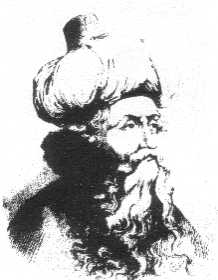
He was born in Murcia (Muslim Spain) in 1165. When he was eight the family moved to Seville, and there he began to study under Sufi masters. In his youth, by his own account, in a state of meditation he met three prophets — Jesus, Moses and Muhammad. In the Sufi tradition this is not a metaphor but a precise way of pointing to the source of knowledge: not a book and not a teacher, but direct unveiling.
His key idea is waḥdat al-wujūd, the unity of being. God is not a separate entity "somewhere out there," but the sole reality: everything that exists is his self-disclosure. Stone, human being, angel — different degrees of a single manifestation of the Absolute. This is not pantheism in the European sense (the world is not equal to God), but the world does not exist apart from God. Orthodox theologians condemned this thought as heresy; Sufi masters made him their chief authority.
At the center of his anthropology stands the image of the "Perfect Man" (al-insān al-kāmil). If Adam was created "in the image" of God, that image is not physical: the human being is called to be a mirror in which the Absolute sees itself in the full array of its names and attributes. Each prophet is a reflection of one of the names of God. The chief book on this theme is the Bezels of Wisdom (Fuṣūṣ al-Ḥikam, 1229): twenty-seven prophets, twenty-seven facets of a single mirror.
The Fuṣūṣ, he said, he wrote because the Prophet Muhammad appeared to him in a dream with a charge: to hand the book on to humankind. Ibn Arabi received it — he did not compose it. This is Sufi logic: wisdom is not generated by the intellect but received by those able to hear. The duty of the one who receives is to pass it further on. The book became the most commented-upon text of the Sufi tradition — and the most contested.
In Mecca he met Ibn Rushd (Averroes) — the famous Arab commentator on Aristotle. The young mystic and the old rationalist sat facing each other. Ibn Rushd asked: does what is unveiled to the Sufi coincide with what the philosopher arrives at? Ibn Arabi nodded — and at once shook his head. "Yes — and no." That "and no" contains the whole of Sufism: rational knowledge describes God but does not reach him.
His influence crossed cultural and religious borders. The Spanish Christian mystics of the sixteenth century — John of the Cross, Teresa of Ávila — developed themes structurally close to his system: the night of the soul, union with God, love as a path. Direct transmission may not have taken place, yet it cannot be called mere coincidence either: fifteenth- and sixteenth-century Andalusia was a space where Sufi and Christian mysticism breathed the same air.
He died in Damascus in 1240. His tomb in the Salihiyya quarter, at the foot of Mount Qasioun, remains a place of pilgrimage. In the twentieth century he is read not only by theologians: philosophers, psychologists and ecologists seek in him an alternative to the European dualism of subject and object. The unity of being — the phrase is now spoken in the most varied contexts. Each time, it strikes home.