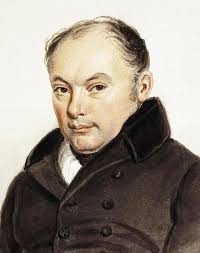
Vasily Zhukovsky opened German and English Romanticism to Russian literature — and did it so well that Pushkin called him his teacher. He translated in such a way that the translations became originals.
He was born in 1783, the illegitimate son of the landowner Bunin and a captive Turkish woman. His surname came from his godfather. His mother was near him, but his status was that of an outsider — and that early sense of not quite belonging stayed in his lyric poetry: the longing, the elegy, the dream of the unattainable.
"Lyudmila" and "Svetlana" were ballads translated from Bürger that became Russian. "The Erl-King" came from Goethe, "The Prisoner of Chillon" from Byron. The "Odyssey" — a complete translation — was the great labor of his life.
He served as tutor to the heir to the throne, the future Alexander II. He died in 1852 in Baden-Baden. Pushkin had died before him — and it was Zhukovsky who arranged the funeral, sorted through the papers, and secured a pension for the widow.