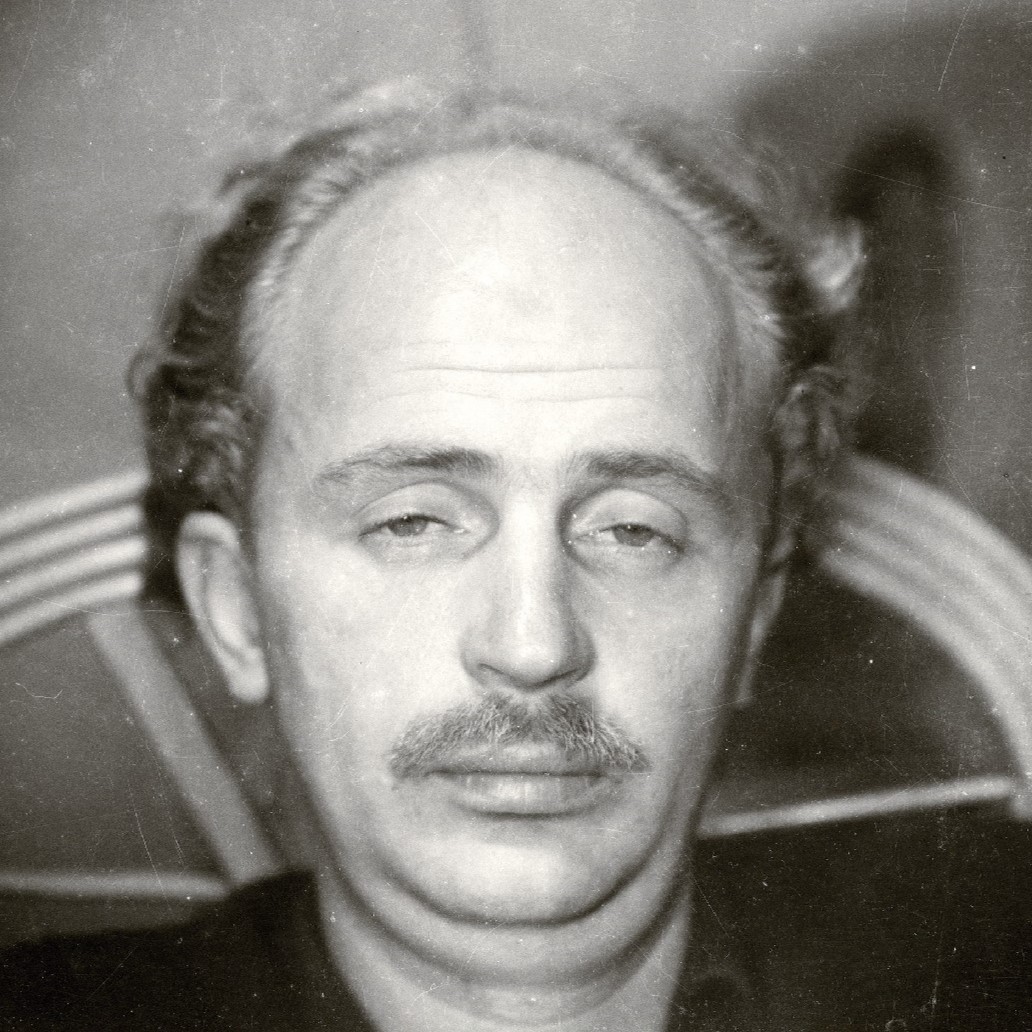
Scholars have hitherto begun with the facts of Wols's biography and sought to bring life and work into alignment. He has been placed among the peintres maudits, artists whose existence was defined by conflict with bourgeois norms; more than that, he has been counted a member of the "lost generation" — those whose lives, it is commonly held, were darkened by the loss of traditional moral and human values, and for whom the formative experience was the war, with its horrors and its inhumanity.
His art was accordingly read, without much difficulty, as a kind of diary of sorrow and want — notes on the degradation and destruction of the human personality and its inner world. The most emphatic statement in this vein came from Jean-Paul Sartre, in the essay "Fingers and Non-Fingers" published in 1963.
In truth the facts of the biography tell us nothing about Wols's art. His mother's diary entries on his childhood and youth, like the occasional remarks of Gréty, offer no key to the master's development or to the character of his work; if anything they hinder perception and draw attention away from what really matters. These sources now and then mention encounters with other artists, but everything remains at the level of obscure hints, and we learn nothing of how long such contacts lasted or what they meant. Wols, it seems, avoided making his private life public. With few exceptions he did not date his photographs, drawings, watercolours or paintings. From the known biographical facts, the path of Wols the artist cannot be reconstructed.
In 1940, to his application for an American entry visa, Wols attached an autobiography in which he wrote that in 1932, in Paris, he had begun to practise abstract and surrealist painting. In this connection he named Max Ernst and André Masson.
He also mentioned that some of his works were held by Kurt Seligmann, who had belonged to surrealist circles before leaving for the United States. Gréty often related that Wols was on friendly terms with the painter Wolfgang Paalen, a native of Vienna who had likewise joined the surrealists at the end of the twenties. Paalen emigrated to Mexico at the beginning of the war, so the years of their friendship must fall in the prewar period.
Of the intensity of these contacts, however, the biographical record says nothing. More concrete information lies in the drawings and watercolours themselves. Only a few works are known that are signed — marked, rather — with the monogram W.S.; they were evidently made before 1937, when the artist adopted the pseudonym "Wols". From these early pieces it can no longer be established which impulses proved fruitful for his creative development.
Only the watercolours and drawings made shortly before the war, and in the first months in the internment camps, permit some conjectures. Wols was apparently inspired by the fantastic painting and graphic work of Yves Tanguy from the late twenties. He quotes many details almost literally — biomorphic objects, threads and fibres, cut lengths of pipe, star-shaped rotating bodies. Like Tanguy he uses stereometric solids to convey the idea of volumetric space; and his drawings are purely contour, in this too following Tanguy's example.
Impulses of the same kind may also have reached him from Miró, Picasso and Masson. The composition of his works bears a resemblance to Picasso's drawings of the thirties and Masson's of 1937–38. Masson may likewise have influenced the figure-like images in which, through the joining of mutually contradictory and heterogeneous objects, a new image arises.
Beyond these affinities with other masters, what matters is the surrealist principle of playing upon chance and unexpected combination. Contradiction and incompatibility Wols, after Tanguy and Masson, deploys deliberately, in order to pass from reality to fantasy or back again — to present the fruit of imagination as something authentic, yet belonging to another reality. In his aphorisms Wols says that people who dream with open eyes see more than those who dream in their sleep. The remark is telling: the artist had formulated his aim — to step beyond reality and yet remain convincing enough for memories to arise, for his images to connect with other, real images familiar to the viewer. Wols worked out his own language of figures and objects, used to produce ever new "texts". In the repetition of motifs one might suspect a leaning toward symbolism or allegory; but each time, new conditions and a new arrangement substantially alter the meaning of the recurring elements. Wols does not narrate, does not depict actions. He creates image-worlds that let us apprehend moods and states of soul directly, because in thought we sink into his worlds and live in them. These are stage sets without light or shadow, before which everything seems weightless, floating, bodiless. The imaginings never overstep the bounds of the drawings. The composition is oriented on an imaginary central axis; the eye travels to the centre by several routes. At first Wols favoured the horizontal format; in time the works stretch upward, and the central axis grows more palpable.
A catalyst for Wols's development in this first period was probably the great international surrealist exhibition held in 1938 at the Galerie des Beaux-Arts in Paris. Whether he saw it is unknown, but it was precisely this exhibition that could have shown him that potential still existed for surrealism's further development. When the movement in its pure form had exhausted itself — the end came with the quarrel over the artist's creative and political tasks — Wols absorbed the surrealists' ideas individually and altogether undogmatically. Arrest and the camp cut him off from direct acquaintance with the work of other artists. Thrown back on himself, he moved forward step by step, consistently, almost methodically.
In the last months of his confinement, in 1940, Wols renounces the reproduction of reality; the works grow ever more abstract. The tendency had announced itself earlier, when in drawing he began sharply to distinguish the principal from the secondary, giving the line autonomy and an expressiveness of its own. The contour is built from a structure-forming weave of lines; opposed structures now take the place of confronted objects.
In November 1940 the artist's eye turns to natural objects. It is not grand panoramas and landscapes that attract him, but particulars — animals and plants, stones, or parts of such things. Observing, and reflecting on his own creative intentions, Wols arrives at structures which he renders as something parallel to natural objects. Existing actuality is widened and supplemented. The tie to reality allows his artistic discoveries to be understood as reality itself, even where reminiscence and comparison with the life we know are absent.
Here too Wols worked out a language of his own — forms whose combinations express manifold content, exactly as we use the same words in different utterances. His drawings and watercolours are self-enclosed unities. The margins remain unfilled; the gaze presses toward the centre. Vertically extended compositions predominate, founded on axes — vertical, horizontal or diagonal; hidden ovals and circles likewise give the image its wholeness. On either side of the compositional axis the forms unfold freely and asymmetrically — in this, again, Wols followed the structures of natural things.
From individual compositions the artist extracts parts and develops them further into independent images — as in nature the system of a tree's trunk and branches finds its miniature likeness in the stalk and veins of its leaf. First Wols lays down a watercolour ground; then the same intonation is repeated and elaborated in pen. At the moment of fixing, the intonation is final and admits no correction. Stroke by stroke the composition accretes: new lines and points attach themselves to the lines already there. Direction, depth and length are differentiated by various means. The viewer is invited to retrace the drawing's progress step by step — to take in the character of the lines, to grasp with the eye tension and harmony, knot and resolution, motion and stillness, and in all this to discern moods. It is precisely moods, on a scale running from drama to lyricism, from menace to idyll, that constitute the content of the image.
The drawings of the forties invite comparison with the "automatic drawing" of Max Ernst and André Masson — a notation not subject to the artist's direct intervention, to his controlling consciousness. Yet that surrealist method drew, with time, ever closer to realistic depiction: even in his frottages Max Ernst teased realistic images from the grain of wood — landscapes, animals, plants, leaves. Wols shunned such concretization. His works are themselves akin to natural objects and tolerate no direct analogies. Probably alive to the danger of identification, he consistently left his works untitled. The titles they received after his death do indeed only mislead, obstructing the immediate, living impression.
The townscapes made at Dieulefit lead from the topography of an illusion-filled, imagined world to the structure of urban sketches that in the end refuse any reality at all; they characterize architectural constructions only in the most general, higher sense. In 1947, on the advice of the Paris dealer René Drouin, Wols took up oil painting and presented a first series of canvases, entering territory wholly new and unfamiliar to him. Before, in watercolour and drawing, the spontaneous fixing of the image had been the work of the hand at the wrist; the large format of painting demands the sweep of the whole arm from the shoulder. This, together with the handling of oil — more viscous than watercolour or ink — slowed the tempo at which a conception could be realized. The graphic artist always has his whole sheet in view; the painter, to see what he has painted, must step back from the canvas. Wols begins his pictures, as he does his graphic work, by laying in the ground. But now, unlike the earlier watercolours with their ink drawing, he uses not black alone but the most varied colours. With the hard butt of the brush rather than its tip he scores lines narrow and broad, which yield effects of their own; through these furrows, and through the impasto stroke, the surface of the picture becomes dynamic.
The devices won in painting Wols then carries back into watercolour. Their coloured ground now bears the drawing; the black ink lines retreat more and more, losing themselves in it. As in the paintings, ground and graphic element are more firmly bound together. The surface becomes "mobile" — we feel our way across it with the eye. Alongside the structures woven of lines, patches of colour appear in watercolour and painting alike, lending the surface greater variety; the composition of the watercolours gains in freedom, mobility and sweep.
But the paintings and watercolours do not serve as the arena of certain formal events — they are themselves events of form. No bridge can any longer be thrown across to reality. These pictures open themselves to the viewer only if he mentally re-enacts the process of their making, living through their rhythm and dynamism as immediate experience. They are formations of the highest individuality which at the same time, through the originality of their formal means, take on a universal character — one for which no adequate verbal metaphors or comparisons exist. Casting off reminiscence and every other tie to reality, Wols moves toward concretization, creating original, innovative forms whose mastery demands the viewer's direct participation.
Turn once more to surrealism — its principle of holding contradictions together, its method of joining the unjoinable. Wols collides opposites at the level of form. Against the soft watercolour ground stands the precise, hard pen drawing: definition confronting diffuseness. The long line embracing one or several forms contrasts with short strokes and points. The general impression of compositional complexity is contradicted by its dissolution into separate details; the perception of a unified whole, by the necessity of following, step by step, the picture's coming into being. Against tradition, it is not colour that fills out and continues the drawing: the drawing is "erected" on foundations of colour. The fantasy of Wols's early period, bound to actual reality, is transformed in the course of his artistic development into a new reality whose source is fantasy. From the scenic and imaginative Wols moves steadily toward the concrete. His works cannot be taken in as fixed emotional impulses without summoning the impressions stored in our own memory.
In discussing an artist in whose output graphic work and drawing predominate, particular attention is due to his prints. Wols left 53 etchings and one lithograph, the latter printed only after his death. Among the etchings are 25 illustrations to texts by Camille Bryen, René de Solier, Jean-Paul Sartre, Antonin Artaud, Jean Paulhan, Franz Kafka and Georges Lambrichs, and to one book by Iliazd. The remaining prints appeared in his lifetime in small editions. Whether Wols made prints before 1945 is unknown — probably not, since in provincial Dieulefit there was nowhere to obtain the necessary copper plates, and evidently no printing press at his disposal either. In 1945 came the first book, Bryen's Balenville, printed at the author's expense and today a great rarity. In 1947 followed Solier's Characters, in 1948 Sartre's Faces — the one book published in a fairly large edition. All the other books Wols illustrated appeared in 1949; in 1948 and 1949, it seems, he occupied himself chiefly with printmaking.
The small copper plates Wols worked in the simplest way, scoring the lines into the metal with a sharp steel needle. Drypoint, like pen drawing, allows no later correction; and as in pen drawing the pressure of the hand determines the width of the line — here, the depth of the incision and the darkness of the printed mark. Metal does not permit rapid work; but these very features of the technique secure a particular refinement and precision of image.
In the prints Wols returns to old motifs already used in the watercolours and drawings. His engravings are not traditional illustration of the poets' works: they are not tied directly to the texts, and make no attempt to clarify or interpret them. They are better regarded as reflections, reactions, replies to the poems.
The forms we see in the prints are built, first of all, by the joining and accumulation of individual lines. But the prints then present themselves as a record of forms in the act of developing — once more the artist's working process can be followed. In the last years of his life Wols gave colour the leading role in his drawings and set printmaking aside. The dominance of the painter's active role is the cardinal stylistic principle of his art, and here parallels suggest themselves with Jackson Pollock, who at just this time was making his paintings in the United States; possible, too, is the influence of Mark Tobey, who in the same years was working out painterly expressive means of his own. As dissimilar as the three artists' paths were, so too were the impulses that drove each to forge his own expressive language. What they share is the point of departure — surrealism — and a non-objective mode of depiction, new for its time, that differed from the other varieties of abstract art then in existence both in its forms and in its manner of working on the viewer.
Kandinsky, who began as an expressionist, brought the emotional effect of line, colour and form into a clear, theoretically grounded system. Kazimir Malevich and Piet Mondrian carried the intellectual, analytic strain of cubism forward into a constructivism of pure lines, forms and colours. Like Kandinsky, they were artists of concrete art, and made pictures that can be understood, perceived and assimilated as objects of reality; nor is there any discord in their theoretical premises. Their paintings reduced the manifold world of phenomena to an all but ideal mathematical principle.
Wols, Pollock and Tobey made their works out of the observation and study of their own emotions; in a figurative and generalized sense their work became the objectivation of the world of human experience and feeling. For each of them the decisive event was the personal encounter with surrealism, which revealed the significance of the unconscious and helped free the artist from the conventions that shackle creation.
An essential element was the use — spontaneous on the one hand, deliberate on the other — of the very process of artistic creation. Pollock's painting has been aptly named action painting. Less apt is the term "art informel" that has attached itself to Wols. The temptation is great to find in his late works an "absence of form"; but such a definition misses the essence of his creative method. Wols always kept his own work under strict control: if he reckoned with the accidental and put it to use, much that was accidental he excluded. To European painting of the fifties his art gave a whole series of stimuli and models. Among the many who carried on what he began, he remains the most outstanding artist.