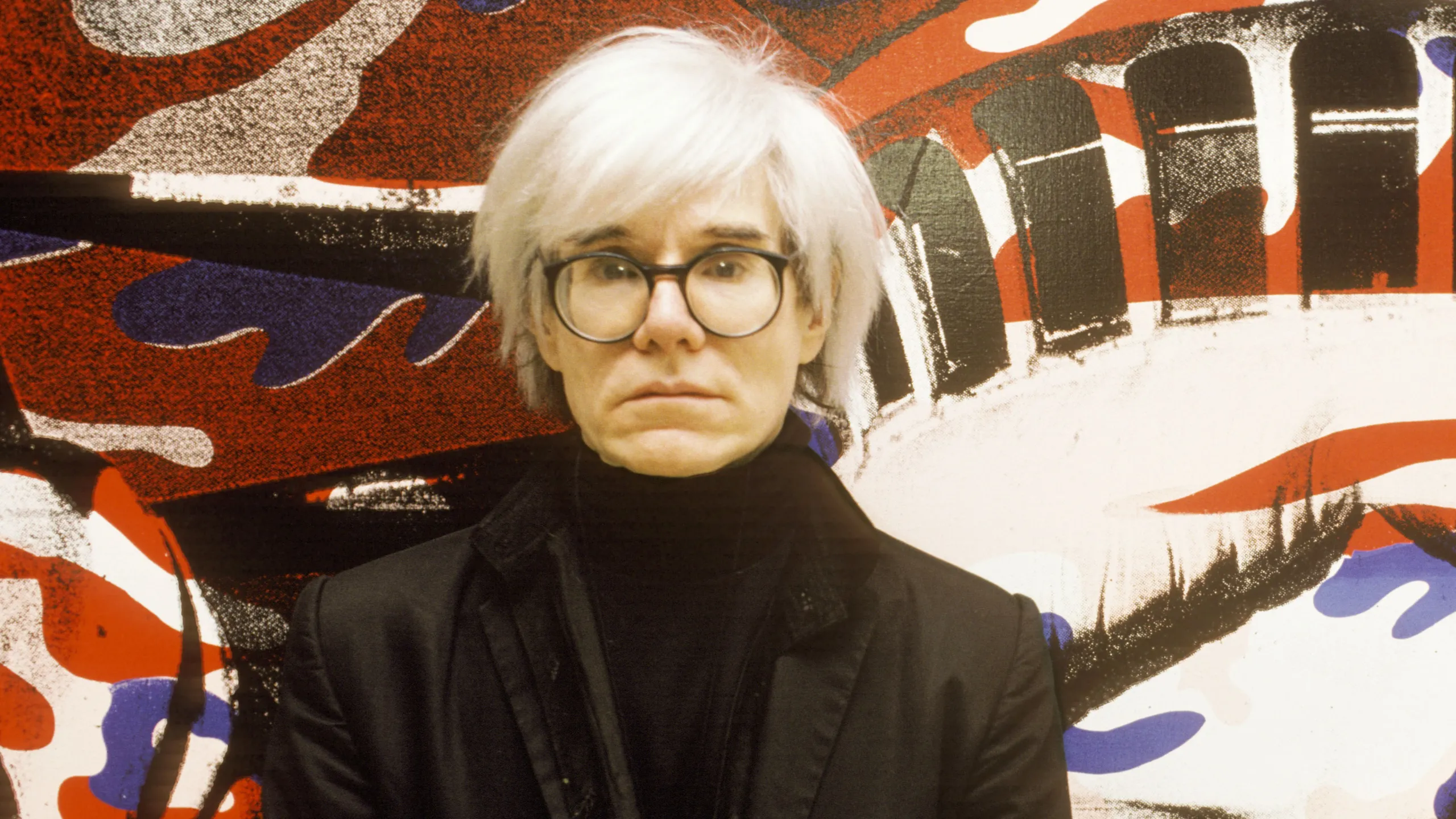
Andy Warhol (August 6, 1928, Pittsburgh, USA – February 22, 1987, New York, USA) was an American artist and one of the reigning idols of Pop Art. Born in Pittsburgh, he spent most of his life in New York. Warhol staked everything on reproducible, universally familiar images: canned soup, a Coca-Cola bottle, photographs of celebrities and famous politicians. Besides painting, he practiced photography, directed and shot films, produced the rock band the Velvet Underground, and published Interview magazine. He survived an assassination attempt and clinical death.
What sets Warhol's art apart: he was among the first to use silkscreen printing as a way of making pictures. His portraits are idealized, iconized images without flaws, colored in bright hues. At the Factory, his studio, several dozen identical works could be produced in a single day — he put Pop Art on the assembly line. The pictures were often the fruit of collective labor, which makes it impossible to establish the precise authorship of each one.
Warhol's famous works: the Marilyn Diptych, "Eight Elvises," "One Hundred Dollar Bills," "One Hundred Cans of Campbell's Soup," "Mao," "Red Lenin."
Warhol kept repeating one enigmatic phrase: "I want to be a machine." He had a special love for technical devices of every kind. He worked on his pictures amid a constant stream of information, with the television and the record player running at once. At various points in his life he meticulously recorded every remotely significant event with a dictaphone, a Polaroid camera, or a video camera. Even the most trivial moments Warhol tried to capture one way or another, hoping in these memories frozen in time to immortalize himself.
Andy's favorite film was The Creation of the Humanoids (1962), whose plot recalls the famous Blade Runner. Its central idea was the complete transfer of a person's personality and memories into the body of a robot, granting an endlessly long life. Perhaps that was exactly Andy Warhol's deepest dream: to "become a machine" and so become immortal?
A tribute to the past
In February 1987, soon after Warhol's death, his assistants, lawyers, and relatives opened up his apartment and found an enormous storehouse behind the door. Among countless boxes of wigs, clothes, shoes, and audio recordings, only one work by Warhol turned up — a small portrait of Mao. Shoes, incidentally, were one of the artist's fetishes: for decades he not only kept his own but collected women's shoes as well. It was, apparently, a private reminder of where his career had begun: in his first New York years he drew advertising illustrations for the shoe brand I. Miller.
At first New York meant a nearly destitute existence, at times sharing lodgings with a dozen other people and hordes of cockroaches. Among the legends Warhol told about himself was the story of bringing his portfolio to the offices of Harper's Bazaar. When the editor opened the folder, a cockroach crawled out of it onto her desk. Had that woman been slightly more squeamish, had she not taken pity on the young artist, his career might have gone another way entirely.
Every Sunday morning began with church, a Warhola family tradition rooted in the Pittsburgh years. In the church the future artist attended as a boy, his eyes were held by the many icons. In New York, the icons turned into his pictures. His brightly colored portraits of the new age's heroes — Marilyn Monroe, Elvis Presley, James Dean — became in time as popular as the actors and musicians themselves. Warhol chose phenomena of mass culture unerringly (a Coca-Cola bottle, a soup can, even dollar bills) and turned them into new phenomena of mass culture.
After the Sunday service Andy would feed the pigeons in the park and then head for the flea market. He wandered the rows for hours, examining every trinket that caught his eye, and always left loaded with purchases. He dreamed of one day buying some knickknack that years later would be worth millions. A few of these things found their way into his work, but most simply stayed in his apartment. Some of the vintage odds and ends he even packed into his famous "time capsules" — boxes of miscellaneous objects, audio recordings, receipts, postcards, and product labels, a kind of message to the future.
Family values
From childhood Andy was deeply attached to his mother. Julia was constantly at his side when illness kept him in bed. As soon as Warhol had settled in New York for good and begun earning decently, he brought his mother to live in his apartment. His many friends and visitors sometimes mistook Julia, bustling from room to room with a broom, for his housekeeper. In all her years in America she never really mastered English, so she spoke little, and with a fearsome accent. Busy as he always was, his mother remained a vital part of Andy's life. Just as in his childhood, she went on feeding him Campbell's soup from the can for lunch, kept the house clean, and looked after her son. Rumor had it she even had a hand in his art: it was Julia who put Andy Warhol's famous signature on his canvases.
Not that Warhol's relations with his family were cloudless. As a boy Andy hated school and was an outcast among his peers — sickly and withdrawn. His peculiar appearance did nothing for his confidence. His skin was very pale and broke out in blotches at the least sun, and his large nose, owing to vascular trouble, was perpetually red. At home he was affectionately teased as the red-nosed one. Which is why in New York, the moment he had earned enough money, the first thing Warhol did was have plastic surgery.
He also began going bald quite young, and so took to wigs, which became a kind of trademark. Andy ordered them from the same maker every time, then often "reworked" them himself, trimming and dyeing. He once explained why he never appeared in public without one: that way people always noticed the wig first, not him. It also let him feel like a man belonging to no era, living outside time. Over his New York years he amassed more than fifty wigs. Late in life he began treating them as works of art, and even made a series of photographs with them.
These experiments on his own appearance were a form of camouflage, a rescue from painful shyness. For the same reason he kept himself constantly surrounded by people (it was said of Andy that he had an uncanny gift for gathering the most beautiful people in New York around him). He preferred to move through the streets with an entourage, since that made it easier to hide. In a crowd of friends or admirers he felt less vulnerable; he could not be broken so long as he was not alone.
Life and death
Warhol's greatest passion (after collecting everything under the sun) was parties. He used to say that if New York threw a party for the opening of a public toilet, he would be first through the door. No even faintly significant event in the life of the Big Apple happened without him. Rumor claimed he attended some parties himself while dispatching doubles in wigs and dark glasses to others held at the same hour. In this way the artist could be present in several places at once, and no one could say with certainty where the real Warhol had been.
And Andy's main party, of course, was his Factory. The studio became a mecca for outsiders of every stripe. The rich and famous did not much interest him; he was far more taken with transvestites, addicts, and failed actors. Life at the Factory never stopped for a minute. People drank and took drugs there, had sex and heart-to-heart talks; there too Warhol's pictures were churned out and his films were shot. The artist himself joined in far from all the amusements of his motley retinue, but like an indulgent parent he magnanimously let his "children" do whatever entered their heads in the huge silver-walled room.
When Valerie Solanas first appeared at the Factory, she could not understand why all these idlers sat in the studio for days on end, ready to fly at one another's throats for the attention of the magnificent Andy. Valerie — a radical feminist and man-hater, raped by her father as a child, who had lived in a shack on the banks of the Hudson, who not long before had been forced to sell herself, who had nearly died after a back-street abortion — was plainly out of place among the lazy, devil-may-care bohemian crowd. Yet she and Warhol evidently saw something in each other and began to associate (Andy even cast her in two of his films), though the artist kept her at a certain distance, a little wary of her forcefulness and her radical pronouncements on the injustice of the world's order.
Solanas handed Warhol her script, titled "Up Your Ass," and demanded he make a film of it. After the first few paragraphs Andy agreed, then quickly thought better of it: "The title seemed wonderful to me, and I was in a good-natured mood, so I agreed to produce it, but the play was so dark..." He duly forgot his promise — everyone and his brother, after all, dragged scripts to the Factory. Warhol soon tired of Solanas herself too, especially after she published her manifesto "SCUM" (the Society for Cutting Up Men) and began turning up at the studio trying to sell a few copies.
There are several versions of when and how the final rupture between Solanas and Warhol came about. By one account, the cause was the ill-fated script, whose only existing copy Andy lost. By another, it was a fatal coincidence: Valerie's target was the publisher Maurice Girodias, but on June 3, 1968, he simply was not in, and she set off for the recently relocated Factory instead. She fired at Warhol three times, and at least one bullet found its mark (here too the witnesses' accounts diverge). Then Solanas calmly walked out of the building and surrendered to the first policeman she met, saying: "The police are looking for me. I shot Andy Warhol. He had too much control over my life." (Some journalists, inclined to excess drama, added that she had first found time to buy an ice cream cone.)
While Andy lay bleeding on the studio floor, assistants and friends fussed around him. At one point he started to giggle and said: "Don't make me laugh. It hurts too much." The paramedics who arrived recorded clinical death (Warhol later said he had heard himself pronounced dead). The operation lasted five hours; the doctors did everything possible to repair his mangled internal organs and keep him alive.
An unexpected finale
After the shooting Andy grew even more afraid of people, women above all. He stopped casting them in his films, replacing them with transvestites. Guards appeared at the Factory; the studio no longer admitted all comers. Warhol declined to press charges against Solanas, and she got off with a three-year sentence, one year of it spent in a psychiatric hospital.
For Andy a new phase of life began, bound still more tightly to the theme of death. His film career declined slowly but inexorably. In the early 1970s he returned to painting, mostly portraits: the faces of transvestites hung beside a Mao Zedong in bright colors, a photograph of Arnold Schwarzenegger beside a communist-scarlet Lenin, Dracula beside Sigmund Freud. One has the impression that Andy was trying, with maniacal persistence, to fix in his work as many moments of surrounding reality as he could — to preserve them forever, to can them, as he canned his time capsules. A frequent subject of his pictures in this period is the skull, the eternal reminder of death and mortality. In 1978 he created the monumental abstract series Shadows: 102 enormous works stretching from floor to ceiling, leaving the viewer utterly baffled in the vain attempt to make out where in the pictures the light is and where, in fact, the shadow.
In the 1980s Warhol returned to the ornamental — turning, in a sense, to his own past and humanity's. He painted shoes again, the shoes with which his career had once begun. He began copying fragments of famous pictures by da Vinci, Botticelli, and Munch, coloring them in his own manner, duplicating them, turning them into patterns. In the artist's last years these colored ornaments dissolve into the abstract forms of his "camouflage" series. Andy had found a new way of hiding — in art — from the people around him and from reality itself.
Sickly since childhood, Warhol hated hospitals, all the more after the shooting, and went to doctors only in extremity. In 1987, however, the doctors insisted on another operation: because of the old wound, his gallbladder had begun to fail. He refused to tell anyone he was going under the knife, and checked into a New York hospital under the name Bob Roberts. The operation was simple and went without complications — but then something went wrong. The autopsy showed a pulmonary edema; Andy suffocated around five in the morning on February 22. The idol of Pop Art, who had surrounded himself with people all his life, died utterly alone.