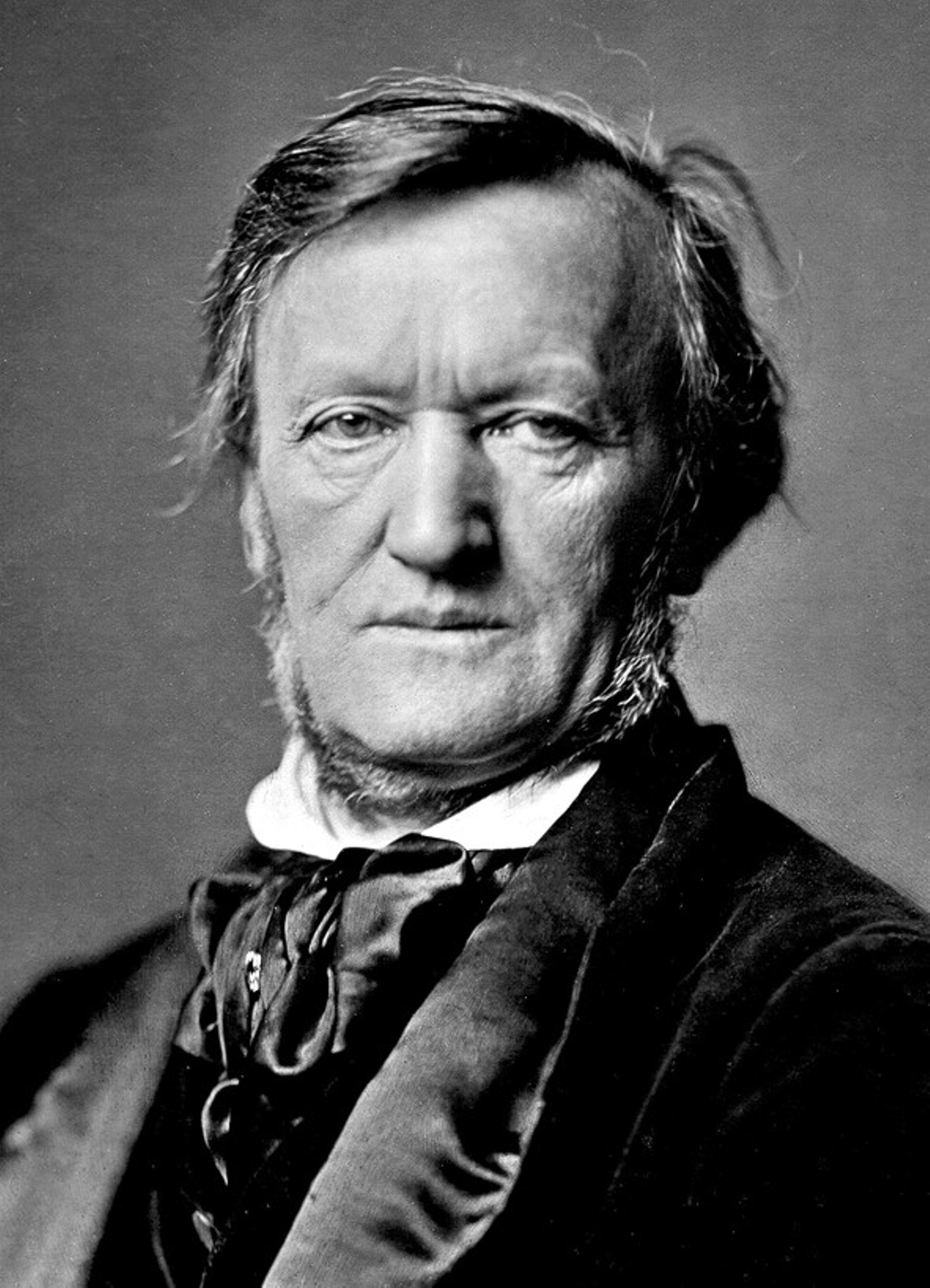
Richard Wagner (1813–1883) was a German composer and reformer of opera, among the most influential and most contested figures of the nineteenth century. The son of a Leipzig official, he fell early under the spell of Beethoven and Shakespeare, passed through years of wandering among German and Swiss theatres, fled Dresden after the revolution of 1849, and spent more than a decade in exile — during which he formulated the idea of the Gesamtkunstwerk, the "total work of art": a spectacle in which poetry, music, stage design and acting fuse into a single breath.
That vision took flesh in the tetralogy The Ring of the Nibelung — Das Rheingold, Die Walkuere, Siegfried, Goetterdaemmerung — on which Wagner laboured for roughly a quarter of a century. To perform it whole, he built his own festival theatre at Bayreuth, with an orchestra pit sunk beneath the stage, a darkened auditorium and unbroken dramatic time. These innovations became the foundation of the modern theatre as such. Alongside the Ring he wrote The Flying Dutchman, Tannhaeuser, Lohengrin, Tristan and Isolde, Die Meistersinger and Parsifal.
Wagner pushed Romantic harmony to its outer limit: the celebrated "Tristan chord" opens the door onto the twentieth century. He also introduced the system of leitmotifs — short musical themes attached to a character, an emotion or an object — and taught composition to think in long dramatic arcs.
The man himself remains fiercely disputed: his polemical journalism and antisemitic essays are a heavy part of the inheritance. But as a musician he set the course of European opera and of the philosophy of art for a hundred years to come. After Wagner it became impossible to write music as though he had never existed.