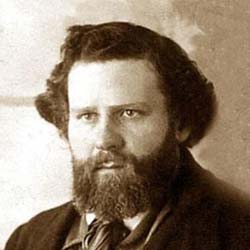
Maximilian Voloshin was born in 1877 in Kyiv, grew up in Moscow, and lived for long stretches in Paris — studying painting in the studios, reading theosophy and medieval mysticism, meeting the French Symbolists. In Paris he understood that what mattered most to him was not technique but the ability to see behind the surface of things their hidden composition. From 1903 the center of his life became Koktebel: the Eastern Crimea, where rocky hills run down into the sea and the air smells of wormwood. Here he built a house with his own hands — an addition at a time — until by the 1910s something had come out of it that resembled a ship run aground in the coastal sand.
The Poet's House, as it came to be called, drew everyone who meant anything in the culture of the Silver Age. Marina Tsvetaeva first came here as a young girl: by local tradition Voloshin asked her to find a heart-shaped pebble — and here too she met Sergei Efron. Osip Mandelstam, Andrei Bely, artists and philosophers of every persuasion — the house was open to all. In the 1910s summer in Koktebel became an informal congress of Russian culture: people met, read poems aloud, and argued on the flat roof.
The revolution tore this space apart. By 1918 most of those who had come to Koktebel found themselves on opposite sides of the civil war or had left the country. Voloshin neither left nor joined the Reds or the Whites. He stayed in his house by the sea and began to write poems about the war as a common catastrophe, in which victors and vanquished were one people killing itself out of two different convictions. In his verse both armies shout one and the same thing: whoever is not with us is against us. The Reds saw in this White propaganda. The Whites, Red. Voloshin argued with neither.
In Koktebel he sheltered people from execution: those hunted by the Reds and those hunted by the Whites — without distinction. Not as a political gesture, but as a practice: if someone was brought to him whom others meant to kill, he did not give them up. Of this he spoke openly, and it was precisely his openness, it seems, that was his protection. To kill Voloshin for harboring someone would have meant admitting that one was killing for the refusal to hand over a doomed man. Neither Reds nor Whites went that far.
From the very first years of Soviet power the house continued to function as an open refuge for creative people — Voloshin received guests just as he had before the revolution. In his will he left it to the Writers' Union on the condition that the house remain open to all. This continued the same logic: a place where no one is asked "whose side are you on."
In the last years of his life Voloshin wrote almost no poems — he painted watercolors. His Crimean landscapes are recognizable at once: ochre and lilac hills, the sea like a flat silvery glow, scorched grass. In them there is something of the flatness of icon painting — and at the same time something of the French Impressionism he had seen in Paris. Over a few years he created hundreds of watercolors and gave them away to his guests.
Voloshin died in Koktebel in 1932 — before the Great Terror, before the war. His house survived the occupation, Soviet power, and several changes of authority over the Crimea. Now there is a museum and a retreat for writers there. In summer it is still lived in by those who write.