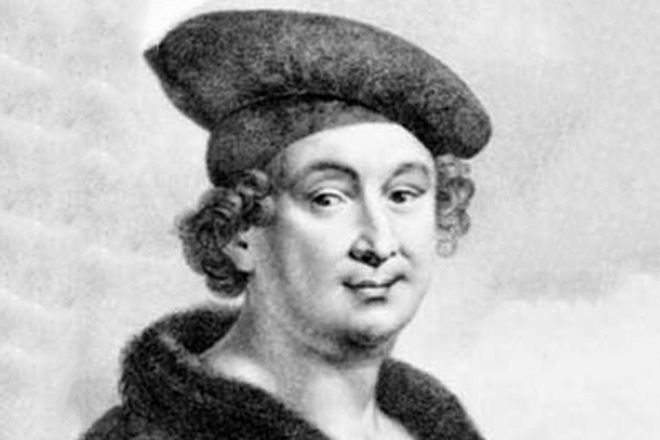
Francois Villon was a French poet of the waning Middle Ages — a vivid, contradictory figure whose verse proved deeply meaningful both to his contemporaries and to later generations.
For all the fame and importance his work holds in world poetry, little is known about his life, and the biographical details vary from one source to another. His fate is bound up with Paris, on whose outskirts he was born; various sources give April 1431 or 1432 as the date of his birth.
His family name may in fact have been de Loges or de Montcorbier. His mother came from Berry; his father died early, leaving her a widow with a small child. Nothing else is known of the father.
The orphaned family was rescued from destitution by a relative, Guillaume de Villon, chaplain and priest of the church of Saint-Benoit. Francois said the priest became more than a father to him, taking upon himself the whole care of the boy's upbringing. He received not only a roof over his head but love, guardianship, and an education that in those days was open only to the wealthy.
The chaplain took Francois in, fed and clothed him, taught him a range of subjects — mathematics, language, Latin — and gave him his own surname. In return the boy helped in the church and sang in the choir.
At twelve, Francois Villon entered the school attached to the faculty of arts at the Paris Sorbonne. In 1449 he took his bachelor's degree, and three years later the degrees of licentiate and master of arts.
Even with such an education, Villon could hold no high office and had no place in the upper reaches of Parisian society; his prospects were limited to work as a clerk or a schoolmaster. To reach the level of learning the medieval universities demanded, one had to study in the faculty of law and earn a doctorate in canon law — a course of roughly thirty years.
During his Sorbonne years Francois was a frequent guest at the house of Robert d'Estouteville, a high-ranking Paris official, where poets gathered and held poetic contests for their hosts' amusement. In their honor Villon composed a wedding song, the "Ballade of the Newly-Wed Provost," working into it an acrostic that spelled out the name of Estouteville's wife.
Villon's poetry is inseparable from his troubled life. All his verse reflects real situations and his real responses to them; it is considered philosophical and realistic. Set beside Renaissance poetry, with its romantic imagery, blossoming gardens, singing birds, and arrows of love, Villon's ballads stand out for their pain, their blood and tears, the true feelings of ordinary people — a naked realism.
At the same time the poet reached for irony and even sarcasm when speaking of his life and its reversals, and in some works for the grotesque, for deliberately exaggerated images. In his verse one sees a living man, with his own sins and failings, sufferings and dreams, who idealizes neither himself nor anyone else.
Ilya Ehrenburg, Osip Mandelstam, and Nikolai Rubtsov held Villon's talent in deep regard, though many centuries lay between them and him.
Villon was known in Paris and in France not only as a poet but as a man who loved to carouse, to rob, to defy authority, and to brawl. Even before finishing his studies at the Sorbonne he joined his classmates in pranks, about which he wrote a satirical novel in verse that has not survived; in 1461 it was mentioned in the "Great Testament."
The unruly students contrived to steal a stone block that stood beside the house of a respected Parisian lady. She took the matter to court, accusing the scholars of theft, and had a new stone set in its place. The indignant young men stole the second block as well, and soon both stones stood on Sorbonne grounds.
Those responsible were detained and were to be brought to trial, but the university's lawyers came to their defense, and in the end the students prevailed. The pranksters were acquitted — it was the judicial officials who ended up in trouble.
In 1455 Villon was caught up in another notorious incident, this one involving a killing. A quarrel broke out between the poet and a young priest over a woman. The drunken priest started the fight, and Francois, defending himself, dealt him a knife wound. The wound proved fatal; the priest died some time later, though not before forgiving and absolving Villon.
Francois twice petitioned for pardon, but to avoid arrest he left Paris. The decision proved ruinous: without means of support, he fell in with brigands. In 1456, having received his pardon, Villon returned to Paris.
That same year the outlaw-poet and his accomplices robbed the College of Navarre. The gang stole 500 gold coins and split them evenly. Villon planned to travel to Anjou to see Duke Rene of Anjou, having long dreamed of becoming court poet to a powerful aristocrat. But fortune failed him in Anjou, and a year later the circumstances of the robbery came to light, so that Villon had to keep away from Paris to escape execution.
Before fleeing the city, the wayward poet wrote the "Little Testament," in which, in a jesting vein, he bequeathed to his friends trifling objects and images — his empty purse, the signboard of one of the taverns. According to some accounts, the cause of his flight was an unrequited love for Catherine de Vaucelles, who had spurned him with an insulting refusal.
Francois spent the following years roaming across France, joining the band of the Coquillards. In this period he wrote seven ballads in thieves' cant which can no longer be deciphered.
Under Charles of Orleans, himself a renowned poet, Villon wrote the famous "Ballade of the Poetry Contest at Blois." The duke had organized a competition on the set theme "I die of thirst beside the fountain." The poems were meant to be light and playful, but Francois produced a genuine masterpiece — deep, ironic, and philosophical.
Villon was imprisoned twice after this, in Orleans and in Meung-sur-Loire, awaiting sentence, but was freed by amnesties declared on the arrival of royalty. In 1461 the poet returned to Paris, where he lived in hiding among his friends. In this period he wrote the celebrated "Great Testament," which included a cycle of ballads: "The Testament," "The Epitaph," the "Ballade of the Ladies of Times Past," the "Ballade of Sayings" ("I know…"), and "The Prayer" — this last a profoundly tragic poem in which, without a trace of irony, the poet voices the entreaty of his mother, whom he considered the finest woman on earth.
In 1462 Villon was again arrested and imprisoned. Thanks to a petition for clemency and the pleas of his friends, the death sentence was commuted to a ten-year banishment from Paris. While awaiting the decision, Francois composed the "Ballade of the Hanged Men."
After 1463 Francois Villon vanished. No one knows when or how he died. It is known only that he died in exile, before his ballads were published in 1491.