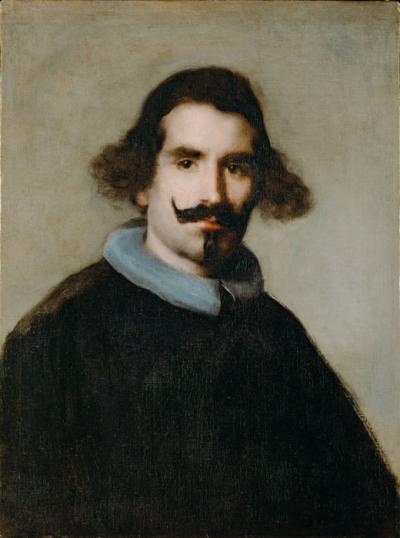
Diego Velázquez — in full, Diego Rodríguez de Silva y Velázquez (6 June 1599, Seville — 6 August 1660, Madrid) — was a Spanish painter, court artist and close friend of King Philip IV.
The hallmarks of his art: the devices of Baroque painting — vivid contrasting colors, sharp chiaroscuro, expressive poses; a precision, psychological as much as visual, and a realism and naturalness in his portraits; and an afterlife as a source of inspiration for the Romantics, the Impressionists, and such innovators as Picasso and Dalí. Among his famous paintings: "Las Meninas," "The Spinners," "Venus at Her Mirror," "Portrait of the Infanta Margarita," "Breakfast."
People today say: "Philip IV? A Habsburg? Oh, the one Velázquez painted! You remember — lanky, red-haired, with the jutting lower lip." The seventeenth century ran the chain of associations strictly the other way around: "Velázquez? Ah, the king's chamberlain and chief steward. The one who also paints his portraits, with children and household, for the Alcázar and the Buen Retiro!"
Who is right? Both. Had there been no Velázquez, by the twenty-first century Philip IV would be remembered only by historians and by Pyrenean patriots nostalgic for the days when Spain owned half the world. But the reverse is also true: had fortune not brought Velázquez to the court of Philip IV — that advanced Spanish forerunner of the Sun King, who reigned for forty-four years and one hundred and seventy days in precisely this brilliant era — Velázquez himself might have remained a painter of genre and religious scenes. Talented, but one among many.
Instead, the two of them met in Madrid. And so a political golden age became the golden age of Spanish painting. The second proved more durable than the first.
Diego Rodríguez de Silva y Velázquez came into the world in a rich and celebrated city — not Madrid, but the capital of Andalusia, Seville. He came from a poor Jewish family of migrants from Portugal. His father was Juan Rodríguez de Silva; his mother, Jerónima Velázquez. Officially Diego bore the double surname, but the history of art has kept him under his mother's family name.
The first things Velázquez painted were bodegones — everyday scenes set in a tavern or an eating-house, in a cellar or a kitchen. Wine is drunk merrily; arguments break out; someone strums a guitar; the mugs come together again. An old cook fries eggs while a young one pounds spices and garlic in a mortar. Someone once observed that in Velázquez's bodegones the still lifes matter more than the portraits. His people are beautiful but seem frozen, while the things — the clay jugs, the glazed cups, the brass mortars, the herrings and onions — appear positively alive.
At that time the influence of Caravaggio was spreading across Europe like a forest fire: just as swift, and leaving behind it a spectacle dominated by black and brown, with no bright color left at all. Spain lay squarely in the blast zone. Velázquez's work of the Seville period stands unmistakably under Caravaggio's spell — in the somberness of its palette with its sharp contrasts of light and shade, and in its preference for scenes not merely ordinary but pointedly lowly, shocking in their coarseness and simplicity.
Not everyone was prepared to accept such art. Velázquez was reproached for an insufficiently elevated cast of mind. He answered: "I would rather be first in coarse subjects than second in refined ones." His conviction in his own rightness was disarming.
Francisco Pacheco, his teacher, drew up a testimonial for his graduate after six years of study: "Well-bred, educated and elegant, he possesses many moral virtues, a strong character and an original way of thinking." The panegyric seems to have hypnotized the worthy Pacheco most of all, for he promptly married the nineteen-year-old Velázquez to his own daughter, Juana Miranda, who was not yet sixteen.
A year later a daughter, Francisca, was born to the Velázquez household. Two years after that came Ignacia, who would not live to the age of three. Francisca, some twenty years on, would mirror her mother's fate: her husband would be a pupil of Velázquez, the painter Juan Bautista del Mazo.
In that same year, 1618, when Diego and Juana Miranda were wed, the good-hearted intellectual Pacheco was summoned to Madrid to censor painting on behalf of the Holy Inquisition. He naturally did his best to bring his promising son-in-law to the capital as well. It proved difficult, and succeeded only in 1623, when old connections came into play: at court Pacheco met a fellow Sevillian and friend of his youth who was now the second man in the state after the king — the Count of Olivares. The favorite and first minister of Philip IV, Gaspar de Guzmán, Count of Olivares, had a reputation as an outstanding reformer — he had, for instance, all but stamped out prostitution and corruption. It was he who brought Velázquez into the palace.
In Madrid Velázquez began straight away with portraits of the great: the royal chaplain Juan de Fonseca, the celebrated poet Luis de Góngora, and his patron Olivares. He painted so well that the king took notice. His very first trial portrait of Philip IV — now lost — earned him the title of pintor de cámara, court painter, endowed with the sole and exclusive right to paint the monarch. Without delay, taking his wife and daughters, Velázquez moved into the palace.
Here one is tempted to philosophize. What was this? How did a twenty-four-year-old painter, without visible effort or strain, quite simply and at the first attempt, become the king's personal artist? Philip IV was a refined and educated man, receptive to art, and Velázquez was almost supernaturally gifted. All true. But even that does not seem cause enough.
Velázquez's studio was located within the royal apartments themselves. Two people held keys to it — the painter and the king. Inside stood a special royal chair. The monarch who governed half the world would stand meekly at attention for hours when the artist wished to capture some particularly ceremonial pose. In Velázquez's absence, Philip would unlock the studio with his own key, settle into the chair, gaze at the unfinished portraits and sink into agreeable reverie. He had, it seems, found himself a friend — someone he could trust without reserve, and who would turn his weaknesses into strength.
The Spanish philosopher and sociologist José Ortega y Gasset would observe that virtually the whole of Velázquez's legacy, with not many exceptions, consists of portraits of the king himself and his immediate circle: his wives (Philip was married twice) and children, his ministers and ladies-in-waiting, his jesters and dwarfs, his horses and dogs.
Velázquez did not long remain a mere court painter. For what is a painter? Simply an artisan! Very soon Philip conferred higher offices upon him: first chamberlain, then overseer of all works in the royal apartments, and later still chief steward — the highest rung of the court hierarchy. Toward the end of his life Velázquez would receive the rank of grand marshal of the court as well. No painter in all of history, perhaps, has made a more dizzying career at court.
At the end of the 1620s, Rubens arrived in Madrid from Antwerp — the greatest figure in the art world of his day. He had come to paint the Spanish royal family, though his principal mission was diplomatic. The young Velázquez was presented to him, and Rubens persuaded him that, to broaden his horizons and enrich the royal collection, he must go to Italy.
In 1629, accompanied by the Spanish commander-in-chief, the royal chamberlain Velázquez visited Genoa and Milan, Venice and Rome. The Italians, of course, saw in him not a painter but an official. The envoy of Tuscany instructed his subordinates: "With a Spaniard one must be neither too amiable nor disrespectful: either is an affront to him." An atmosphere of suspicion and mutual distrust pursued Velázquez across Italy; in places he was even taken for a Spanish spy.
For all these reasons his first Italian journey can hardly be called a pleasant one. Its single stroke of fortune was his encounter with the works of the Renaissance titans. Of them all, Velázquez preferred Titian; Titian's images of Charles V he took as the model of the monarchic portrait. After Italy his palette changed markedly: Velázquez at last moved away from the traditional Andalusian tenebroso, and light, resonant colors — dazzling yellow, bright blue — appear in his pictures almost for the first time. "I am a recruit in Titian's army," he said of himself.
Returning to Madrid, Velázquez learned, with emotion and joy, that during his absence Philip IV had allowed no one else to paint him. He set to work with redoubled enthusiasm. All the more so since the king now had his long-awaited heir — Baltasar Carlos, Velázquez's future favorite — which meant that within ten years portraits of the boy would have to be dispatched to every European capital, with an eye to promising dynastic alliances.
Philip's first wife, Isabella of Bourbon, could not abide Velázquez — he was the creature of the hated Olivares, who had effectively usurped political power in the country — and so Velázquez painted her hardly at all. His friend the king, on the other hand, he painted a great deal. Only Velázquez could take that face disfigured by inbreeding — the knobby forehead, the deep-set eyes, and the hereditary mark of all the Habsburgs, the jutting lower lip — and make it noble and refinedly handsome. Scholars have calculated that of nearly forty portraits of the monarch, all but three or four are in three-quarter view — the angle most flattering to the king's difficult face.
In 1649 Velázquez traveled to Italy again, to bring back works by Veronese and Tintoretto for the royal palace. He was nearly fifty, and for at least twenty of those years he had been the first painter of his homeland. But Italy, which fancied itself the cradle of art — indeed of civilization itself — did not care: Velázquez was little known there. And here, unexpectedly, his ambition — all but atrophied over the long years of his Spanish preeminence — flared up. In a single week Velázquez painted a portrait of the servant who accompanied him, Juan de Pareja, and sent the model, together with the portrait, on a tour of the residences of the Roman nobility. Such creative promotion did not go unnoticed: the Italians are haughty, but great art — even Spanish art! — will always find an echo in their sensitive hearts.
Velázquez's fame reached Rome. He was invited to paint the Pope himself. The portrait of Innocent X, with its scarlet cape and legendarily heavy gaze, would become one of the Spanish master's most celebrated works.
Meanwhile Philip IV, troubled by his beloved artist's long absence, sent dispatch after dispatch to Italy: where was his Velázquez, why did he tarry? And Velázquez, abandoning the prospect of conquering Rome once and for all, returned to Madrid. Documents found comparatively recently have shed light on the reason for his delay: a love affair. After Velázquez had left for home, a son, Antonio, was born to him in Italy. His only overtly erotic painting, "Venus at Her Mirror," was likewise painted in Rome: in Spain the Inquisition would simply never have permitted such liberties.
Velázquez's whole life and art were bound in the closest way to the Spanish royal family. Not only Philip IV but his elder children, Baltasar Carlos and Maria Theresa (the future queen of France), his second wife Mariana of Austria, and their children Margarita and Felipe Próspero — all regarded the painter as one of their own. He was their chronicler, the annalist of their family and state history, and he was also the manager of many affairs of the first importance — an utterly irreplaceable man. So Velázquez had grounds — though the audacity of it was unprecedented — for inscribing his own person into the family circle of royalty in "Las Meninas."
The health of the sixty-one-year-old artist was broken by the preparations for a grand dynastic marriage: the daughter of Philip IV was betrothed to the king of France, Louis XIV. On the Spanish side, the whole immensely complicated business of preparation was directed by the chief royal steward and grand marshal — Velázquez. Suddenly he felt so ill that he was forced to return to Madrid. Mortal exhaustion did not seem an entirely convincing explanation for the illness. On 6 August 1660, after a week's agony, Velázquez was gone. He died in the presence of the king. Philip IV could not allow his favorite to depart into eternity without a royal — and a friend's — blessing.