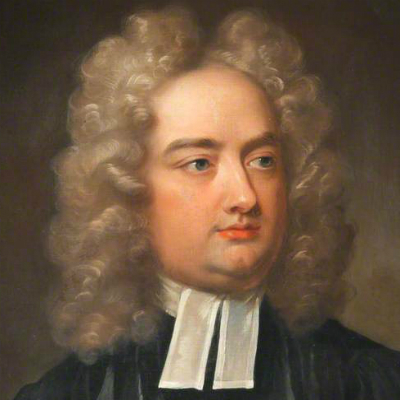
The sharp pen of Jonathan Swift, the Irish-English philosopher and satirist, caused an uproar in his own lifetime. To his contemporaries he was the author of pamphlets steeped in irony; to the world he is the author of Gulliver's Travels. Swift published under pseudonyms or under no name at all, yet readers unfailingly knew him by his style.
Childhood and Youth
The future writer was born in Dublin on 30 November 1667, two months after the death of his father, a minor court official, whose name — Jonathan — the boy inherited. The widow was left with two children and no means of support, and the newborn proved a sickly child with a congenital ailment.
After struggling for a time, his mother gave Jonathan into the care of her late husband's prosperous brother, Godwin Swift, a man of good standing in the legal profession.
The boy was sent to Kilkenny, the best school in Ireland, and found the years there hard: the free but poor life was over, and the school's discipline was strict. At fourteen he entered Trinity College, Dublin, and left it with a bachelor's degree and a settled aversion to formal learning.
Literature
His writing life began with a forced move to England: his uncle was ruined, and civil war had broken out at home. Swift now had to earn his own bread, and through his mother's connections he became secretary to the wealthy diplomat William Temple — with the run of his employer's considerable library.
Temple's house drew prominent men and figures of the literary world, and their company, too, helped prepare the ground for Swift's talent. The young poet — for it was with verse and short essays that he entered literature — later helped his benefactor write his memoirs.
Twice he went back to Ireland. In 1694, having taken his master's degree at Oxford, he was ordained in the Anglican Church and became priest of a small village parish; a little later he continued his service at St Patrick's Cathedral in Dublin. All the while he was writing vivid, biting political pamphlets on the questions of the day.
The duties of a priest soon wearied him, and he returned to England. There he produced a run of poems along with two parables, "The Battle of the Books" and "A Tale of a Tub." The latter became enormously popular — the public loved it, and the church condemned it severely, though Swift had not meant to attack religion at all; he was parodying pride.
Tellingly, he had no wish to advertise his authorship: everything appeared anonymously, and he never abandoned the habit. Everyone around him, of course, knew perfectly well who had written these satirical books, poems, and squibs.
His satirical gift reached full flower in the 1710s. Appointed Dean of St Patrick's, Swift gained financial independence and could give himself to writing in peace. His poems, pamphlets, and articles filled with anger at the social injustice reigning around him, with criticism of power and of religion. From 1720 the central theme of his work was the autonomy of Ireland, which the English were mercilessly trying to ruin.
Popular adoration came with the anonymous "Drapier's Letters," printed in runs of many thousands, which urged the Irish to refuse English money and buy no goods made in Britain. The wave of indignation rose so high that London was forced to replace the viceroy, who had offered a reward to anyone who would name the Letters' author.
The search for culprits came to nothing, and England had to make economic concessions. Swift was raised to the rank of national hero; all Dublin was hung with his portraits. Soon there was another scandal, this time over his savage pronouncements on poverty: the writer advised a government incapable of feeding the rising generation to sell its children for meat and hides.
He sat down to his most famous work, the travels of Gulliver, in the early 1720s. The first two books of this fantastic narrative, mocking human vice and the imperfections of society, appeared in 1726; a year later readers received two more. The ship's surgeon Gulliver studies the manners and customs of the lands of the Lilliputians, of the giants, and of the rational horses; he finds himself on a flying island, in a realm of sorcerers, among immortal men, and even in Japan — closed in those days to Europeans.
The tetralogy was a resounding success, in time becoming a classic of literature and an inspiration to dozens of filmmakers.
Personal Life
Swift's personal life looks strange enough. He was romantically bound to two women who bore the same name — Esther.
In his years with Temple he met, in the household, a servant's eight-year-old daughter, Esther Johnson. Fifteen years' difference in age did not prevent a friendship: Jonathan became the girl's mentor and teacher — he called her Stella — and, in time, her beloved. When they were apart, the author of Gulliver wrote her tender, heartfelt letters every day; after his death they became the book Journal to Stella.
When her mother died, the orphaned Esther moved to Ireland and settled in the house of the man she loved, though to the world she was no more than the writer's ward. Biographers suppose the pair may even have married in 1716, but the fact has never received official confirmation.
The other woman linked with Swift, from 1707, was Esther Vanhomrigh — an orphan who owed to Jonathan the nickname Vanessa. To her, too, he dedicated touching, sorrowful letters.
Vanessa died of tuberculosis in 1723; five years later Stella was gone. Swift took the loss of both women hard, and the two tragedies undermined his health, physical and mental alike. Yet a long stretch of life still lay ahead of him.
Death
For several years before the end Swift suffered from mental illness, complaining in letters to friends of low spirits and an all-consuming grief. The disorder progressed; in 1742 he suffered a stroke and was left wholly incapacitated — unable to move, his speech gone — and a guardian was appointed for him. The satirist died in his homeland in October 1745.
He had prepared for death as early as 1731, in "Verses on the Death of Dr. Swift," a poem that set out his credo: to cure mankind's corruption with pitiless laughter. In 1740 he wrote the epitaph later carved on his gravestone, and he left nearly all his savings for the building of a hospital for the mentally ill. Soon after his death St Patrick's Hospital for Imbeciles was built — and its doors are open to this day.