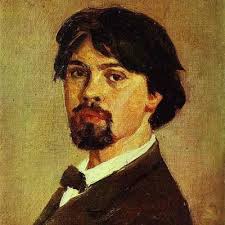
Vasily Ivanovich Surikov (January 12 [24], 1848, Krasnoyarsk – March 6 [19], 1916, Moscow) was a Russian painter, a master of the historical canvas. His pictures brought the vanished epochs of Russian history back to life. A subtle colourist and a superb builder of compositions — his friends actually nicknamed him “the composer” — he became one of the central figures of Russian painting, and for more than twenty-five years belonged to the Society of Travelling Art Exhibitions.
The hallmarks of his art are a polyphonic, always meticulously calculated composition; a virtuoso ability to paint a throng of people in which every figure remains an individual; a refined feeling for colour and a carefully considered palette; and a constant turning to Russian history, the recreation of historical situations. His most famous paintings are The Morning of the Streltsy Execution, Boyarynya Morozova, Menshikov in Beryozovo and The Taking of a Snow Town.
Surikov knew how to say no. He declined the study trip to Europe at the Academy’s expense (offered him, admittedly, not straight after graduation but six months later), preferring to work on the murals of the Cathedral of Christ the Saviour. Europe was not going anywhere; first Surikov wanted financial independence — which began when Pavel Tretyakov bought The Morning of the Streltsy Execution for eight thousand roubles, an enormous sum for the time. Three times he refused to teach at the Academy of Arts and the Moscow School of Painting, Sculpture and Architecture. And there is a story that when Leo Tolstoy took to calling on his dying wife to “talk about death,” Surikov threw him down the stairs.
Born in Krasnoyarsk, Surikov was all his life exceedingly proud of his descent from old Cossack families. A cousin of his paternal grandfather, Alexander Stepanovich Surikov (1794–1854), had been ataman of the Yenisei Cossack regiment; one of the islands on the Yenisei was named in his honour. The painter’s mother, Praskovya Fyodorovna Torgoshina, likewise came of Cossack stock. His father, Ivan Vasilievich Surikov, served as a collegiate registrar and died early — little Vasya was only eleven — leaving the family in straitened circumstances. An active part in his further education was taken by the Yenisei governor Pavel Zamyatin and the Siberian gold-mining magnate Pyotr Kuznetsov, who recognised the worth of the boy’s pictures and took upon himself all the costs of his study and lodging in St Petersburg.
Surikov arrived in St Petersburg at the beginning of 1869. He failed to enter the Academy at his first attempt, but the young man did not lose heart and began attending the drawing school of the Society for the Encouragement of Artists. That autumn he became an external student at the Academy of Arts, and a year later was enrolled as a full student, joining Pavel Chistyakov’s class. The Academy’s authorities marked his talent more than once — four times he was awarded a silver medal, with cash prizes besides. The Large Gold Medal, however, kept eluding him, and the study trip abroad he later declined himself.
His first major undertaking on completing his studies was not a painting but the frescoes in the Cathedral of Christ the Saviour. The commission also settled where he belonged geographically: Surikov stayed in Moscow, a city genuinely close to his heart, and there his most celebrated pictures were painted. There too he found his one love: his wife, Elizaveta Share, bore him two daughters (the elder would later marry the painter Pyotr Konchalovsky). Her premature death was a true tragedy for Surikov; for two years he did not pick up a brush, and only a journey to his native Krasnoyarsk restored his lost inspiration — The Taking of a Snow Town is like a photograph of his own carefree childhood.
Music exerted a great influence on his work, in both the literal and the figurative sense. Already at the Academy he had been given that most musical of nicknames, “the composer,” for the masterly composition of his pictures. Surikov loved opera and played the guitar; among the few portraits he painted are those of his friend and music teacher, the guitarist Fyodor Peletsky.
Back in Moscow, Surikov went on working steadily. In 1881 he became a member of the Society of Travelling Art Exhibitions, showing his famous canvases at the Society’s exhibitions — among them Menshikov in Beryozovo, which Pavel Tretyakov acquired for his collection. With the proceeds Surikov at last visited Europe, seeing the museums of Italy and France, Germany and Austria.
On his return he set to work on Boyarynya Morozova, which the critics received with anything but unanimity. There followed the historical canvases Yermak’s Conquest of Siberia, Suvorov Crossing the Alps and Stepan Razin. In 1893 the artistic community gave his labours their due: he was made a full member of the St Petersburg Academy of Arts. In 1907 Surikov left the Peredvizhniki and joined the ranks of the Union of Russian Artists.
Some years later, with Surikov’s direct participation, a school of drawing was opened in his beloved Krasnoyarsk. There, in the city of his youth, he painted several works recording the sights of Krasnoyarsk and the splendid Yenisei.
The artist died of heart disease in 1916. Vasily Surikov is buried in Moscow’s Vagankovo cemetery, beside his wife.