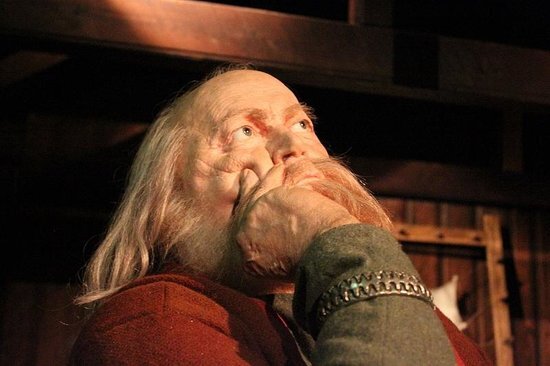
Snorri Sturluson (1178, Hvammur – 23 September 1241, Reykholt) was an Icelandic skald, prose writer, historian, and politician. He is best known as the author of the Prose Edda, or Younger Edda, comprising the Gylfaginning ("The Deluding of Gylfi"), which sets out the stories of Norse mythology, the Skaldskaparmal ("The Language of Poetry"), and the Hattatal ("List of Meters"). He is generally accepted as the author of the Heimskringla ("The Circle of the World"), though some scholars dispute the attribution; it is a vast compilation of sagas devoted to the Norwegian kings, from legendary times down to 1177. Egil's Saga and the Separate Saga of St. Olaf are also ascribed to him. Beyond his writing, Snorri was a public man: born into the noble Sturlung clan, he took an active part in Icelandic affairs and was twice elected lawspeaker of the Althing.
Snorri belonged to the rich and powerful Sturlung family. He was born around 1178 to Sturla Thordarson of Hvammur and Gudny Bodvarsdottir, and had two elder brothers, Thord Sturluson and Sighvat Sturluson. From the age of three or four he was raised at Oddi in the household of Jon Loftsson, a kinsman of the Norwegian kings. The arrangement had a curious origin: during a lawsuit between Snorri's father Sturla and Pall Solvason, Pall's wife lunged at Sturla with a knife, meaning, as she said, to make him resemble his hero Odin — that is, one-eyed — though she managed only to slash his cheek. Since the compensation due would have beggared Pall, Loftsson offered instead to take Snorri's upbringing upon himself. Snorri thus acquired an education and connections he could never have had at home: Jon Loftsson was grandson both of a Norwegian king and of the famous scholar Saemund, and under his roof Snorri absorbed real learning. He never returned to his parents' house. Sturla Thordarson died in 1183, and Snorri's mother Gudny squandered his share of the inheritance.
Jon Loftsson died in 1197, and in 1199 Snorri married Herdis Bersadottir, receiving from her father the rich farm of Borg. The couple lived there four years and had several children. In the end Herdis wearied of Snorri's constant infidelities, and when he moved in 1206 to the estate of Reykholt, she stayed at Borg. At Reykholt Snorri had more children by other women. He quickly won renown as a poet and, at the same time, as a jurist, and in 1215 was elected lawspeaker of the Althing.
In the summer of 1218 Snorri left Iceland for Norway, where he was received by King Hakon IV and the regent, Jarl Skuli Bardarson, with whom he spent the winter as a guest. King and jarl presented him with a ship, in which he sailed to Sweden, and he wrote verses in their praise. In 1219 he met the Swedish lawspeaker Eskil Magnusson and his wife Kristina, from whom he probably gathered material on the early history of Sweden. Snorri's own interests lay first of all in history and culture, but the Norwegian court valued him as a politician. He received the title of royal cupbearer (skutilsveinn): Hakon and Skuli were no doubt counting on his support in the Althing when the question of Iceland's union with Norway came to be discussed. In 1220 Snorri returned to Iceland, and in 1222 he became lawspeaker once more, holding the office until 1232. In the Althing he spoke as a partisan of the Norwegian king, which turned many powerful chieftains against him.
From 1224 Snorri lived with Hallveig Ormsdottir, a wealthy widow and granddaughter of Jon Loftsson, and together they raised his children, of whom five reached adulthood. Many chieftains thought it intolerable that Snorri should be at once a courtier of the Norwegian king and a member of the Althing; Snorri, for his part, wished to consolidate his influence in Iceland and use it to deliver the country into the king's hands. In 1222 he tried to marry Solveig, another granddaughter of Jon Loftsson, but was forestalled by his rival and nephew Sturla Sighvatsson. The affair led to internecine clashes: Snorri raised an army under another nephew, Bodvar Thordarson, and his first son Oraekja, but on the eve of battle with his brother Sighvat and Sighvat's son Sturla Sighvatsson he offered a truce. Sighvat and Sturla attacked Snorri and drove him into the fjords of western Iceland. Hakon IV tried to intervene, inviting the chieftains to negotiate in Norway; Sighvat, understanding what this threatened for the chieftains, began urging his opponents to accept the king's offer. Sturla took Oraekja prisoner, luring him to Reykholt on the pretext of negotiations, together with Thorleif Thordarson, Snorri's cousin, who had come to support him but had quarreled over questions of command.
In 1237 Snorri resolved to sail again to Norway. On this second visit he stayed once more with Jarl Skuli, whose influence was by then waning; in 1240 Skuli Bardarson was killed by Hakon's partisans. In 1239 the king had forbidden all Icelanders to leave the country, but Snorri disobeyed. In 1241 Gissur Thorvaldsson, an enemy of the Sturlungs, obtained the king's leave to seize Snorri and bring him to Norway to answer for his defiance. On 21 September five of Gissur's men broke into Reykholt and, having forced the priest Arnbjorn to reveal that Snorri was hiding in the cellar, cut him down and burned the farmstead.
Snorri's fame rests above all on the Prose Edda, a kind of guidebook to the mythological tradition for poets. The Gylfaginning draws on the same sources that underlie the Poetic Edda — among them the poems known to us as the Voluspa, the Grimnismal, and the Vafthrudnismal. In the Skaldskaparmal Snorri explains the poetic devices of the tradition — the kennings in particular — bringing in a wealth of mythological stories to elucidate them. The Hattatal, finally, is a catalogue of skaldic verses chosen as specimens of the various meters. The Gylfaginning is notable, too, for Snorri's euhemeristic account of the origin of the Norse pantheon: he takes the Aesir to be deified chieftains and heroes. Among the other works ascribed to him are the Heimskringla, Egil's Saga, and the Separate Saga of St. Olaf.