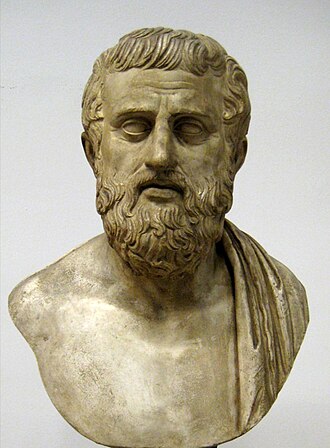
Sophocles was born around 496 BC at Colonus, on the outskirts of Athens — native ground he would later celebrate in the tragedy Oedipus at Colonus. His parents were people of means, and they gave their son an excellent education.
By some accounts Sophocles was a cheerful, sociable man. In 480 BC he was chosen to lead the chorus at the public festival after the battle of Salamis. He was twice elected strategos, and once a member of the board that administered the treasury of the allied league — a trust owed in large part to the impression his tragedy Antigone made on the Greeks when it was staged in 441 BC. During the war with the island of Samos he shared command of the fleet with his friend Pericles; another close friend was the historian Herodotus.
The work of his life was writing tragedies for the Athenian theater, and he counts among the foremost of the ancient tragedians, his art still holding audiences millennia later. The works that have come down to us are Antigone, Oedipus at Colonus, Electra, The Women of Trachis, Oedipus the King, Philoctetes, The Trackers, and Ajax. Aristophanes of Byzantium, the noted critic of the age, reports that Sophocles wrote more than a hundred tragedies. In 469 BC he won the first of a whole series of victories in the competitions with other tragedians; no one ever surpassed him.
He changed the rules of the ancient stage: he enlarged the number of actors, cut back the part of the chorus, and improved the scenery and the masks. In his works Sophocles attends not to outward events but to the emotions of his characters. The plots of his tragedies are, as a rule, easy to guess; but instead of the era's stock figures, each displaying the general traits of one vice or another, Sophocles draws real people — they err, they waver, they make mistakes, they even commit crimes.
Sophocles died in 406 BC in Athens, where after his death the citizens venerated him as a hero.
Among his sayings: Time is a kind god. There is no worse enemy than bad advice. Silence lends women a grace that becomes them. The sweetest life is the absence of thought. Anything may happen, if a god applies his art. What are we, we humans? Phantoms, an impalpable shadow. Youth grazes in happy fields; neither blaze of sun, nor rain, nor wind troubles it; ever playful among pleasures, the maiden leads her life. Any mortal who rages at his own faults and applies a remedy worse than the ill is a physician who does not understand the disease. The wages of a thief's gain are ruin, not happiness.