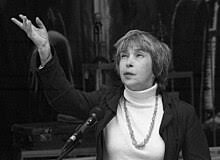
Elena Shvarts was born in 1948 in Leningrad. Her mother, Dina Shvarts, was head of the literary department of the Bolshoi Drama Theatre and the closest associate of the director Georgy Tovstonogov; she spent nearly forty years at the theatre. The daughter grew up in theatrical Leningrad, amid talk of stage direction, actors, and productions. But the path she chose led in the opposite direction from the official stage — into the underground, into samizdat, into poems that were published nowhere.
Soviet law against "social parasitism" required an official place of employment. It was under this very article that Brodsky was convicted in 1964 — a poet with no work record was declared a parasite and sentenced to forced labor. Shvarts worked as a typist, a laboratory assistant, took on odd jobs — anything to stay within the law. Her real work did not figure in any Soviet document: the poems she wrote were never carried to official journals and officially did not exist.
In the 1970s she became part of Leningrad's "second culture" — the unofficial literary space where texts were read in private apartments, copied by hand, and circulated in samizdat. This was a milieu without publishers, without fees, without a public platform — but with an audience that read differently from the readers of Soviet journals. Around her were poets, artists, and philosophers whom official culture ignored or persecuted. The circle held together not by ideology but by intensity: a shared understanding that a text is not a product but something more.
Her poems are about the body as a sacred text. Not the body as a metaphor for the social or the political, but the body in the literal sense: pain, illness, physical suffering — in her poetics these are a means of knowing God. She created images of invented nuns and holy ascetics, trying on their fates as masks through which to speak of her own inner experience. Orthodox mysticism and a sharp, sometimes coarse physicality do not contradict each other in her work: one feeds the other, and it was precisely this combination that made her poems unlike anything else in Russian poetry of the twentieth century. She was read as a revelation — and at the same time as a very strange thing.
Western publications came before Soviet ones. In the 1970s and 1980s her texts were printed in émigré journals and in editions in the West — before a Russian reader could buy her book in a shop. This was the typical fate of the poets of the "second culture": first recognition in emigration, then — after 1990 — official recognition at home. But the order mattered: she took shape and wrote her most important work in conditions of invisibility, without an audience, without criticism, without any need to explain her choice to anyone.
After perestroika she began to be published in Russia, was included in anthologies, and critics began to write about her. Recognition came — and it proved hard to separate from the Soviet system against which she had existed: it was precisely against the background of that system that her figure acquired meaning. In May 2010 Elena Shvarts died in Petersburg of cancer. She was in her sixty-second year.
Her central paradox is that the closed space became a condition rather than an obstacle. It was invisibility that gave her the freedom to write in a way that could not be written: about the body and God without Soviet conventions, without a Western pseudo-avant-garde pose, without regard for an audience that did not exist. When the audience finally appeared, it turned out that this was exactly the voice — dense, strange, recognizable from the first line — that had been missing.