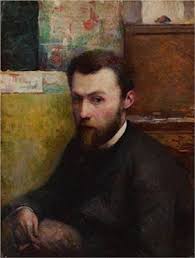
Georges-Pierre Seurat was born on December 2, 1859, in Paris, into a well-to-do family: his father, a native of Champagne, served in the legal profession, and his mother was a Parisian. He studied at the École des Beaux-Arts, then completed his compulsory military service at Brest, and in 1880 returned to the capital to devote himself entirely to painting.
The starting point for his method was the work of the Impressionists, who were already breaking color into separate strokes, unmixed on the palette, in order to achieve the effect of vibrating light. Seurat resolved to carry this idea to its limit and to give it the rigor of an almost scientific calculation: he covered the canvas with the tiniest dots of pure, unmixed pigment, counting on the viewer's perception to blend the neighboring colors at a distance — a method that he and his associates called divisionism, and which later received a more common name, pointillism.
He worked slowly, and not at all in the manner in which the artist's creative impulse is usually imagined: first small oil studies on the spot, then drawings in black crayon, where form was built through the contrast of light and shadow without a single contour line, and only then the canvas itself, covered with dots week after week.
The chief result of this method was the painting "A Sunday Afternoon on the Island of La Grande Jatte" — an enormous canvas, worked on over several years, with figures of Parisians resting on the bank of the Seine, rendered in millions of separate colored dots. Work on such canvases required not impulse but months of methodical, almost mechanical labor: before laying on the final layer of dots, Seurat made dozens of preparatory studies and drawings, working out the composition in advance.
Together with Paul Signac, Seurat became one of the founders of Neo-Impressionism — a movement that subordinated the free, emotional manner of the Impressionists to a strict system: color to form, light and shadow to the law of complementary colors. For the artists of his generation, accustomed to trusting the hand and the instant impression, this was almost a provocation: painting as an exact science, and not only as immediate feeling.
It was precisely this methodical work, drawn out over time, that was fated to be cut off suddenly. Seurat died in Paris on March 29, 1891, two months short of his thirty-second birthday; the cause of death the doctors did not establish with certainty — meningitis, pneumonia, and infective endocarditis were named, but diphtheria is considered the most probable. Two weeks after his father, his small son died of the same illness.
In not quite ten years of independent work Seurat managed to create a method that did not die with him: pointillism was taken up and developed by other artists, and the very idea — that color can be built as a calculation, and not only as an impulse — became one of the bridges between Impressionism and the painting of the twentieth century.
In this fate there is a sharp contrast that is hard not to notice: an artist who devoted his life to methodical labor drawn out over time — thousands of measured dots on a single canvas — was himself deprived of time in the most literal sense. He did not live to see his method disperse through the studios of a whole generation of artists; everything we know of the mature Seurat fits into the incomplete decade between his return from the army and his sudden death.