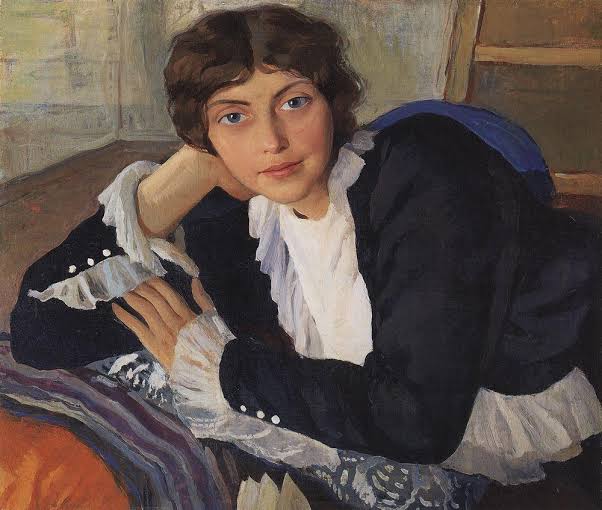
Zinaida Yevgenyevna Serebriakova (28 November (10 December) 1884, village of Neskuchnoye — at various times part of the Kursk and Kharkov provinces of the Russian Empire — 19 September 1967, Paris, France) was a Ukrainian and Russian painter, a member of the World of Art society, who emigrated to Paris after the revolution. She is counted among the Neoclassicists.
The hallmarks of her art are simplicity and elegance of line, restraint, plasticity, clarity. She painted in an age teeming with avant-garde movements, yet none of them claimed her; her work stands apart. Especially striking in her legacy are the many self-portraits, the portraits of children, the nudes, and the scenes of peasant life, which in her hands take on a mythic quality, rising from the everyday to the plane of being itself.
Among her best-known paintings: At the Dressing Table. Self-Portrait; Bather; At Breakfast; House of Cards; Bleaching Linen.
Serebriakova was fated to live two lives. In the first she is the child of an artistic dynasty, a happy, loved and loving wife, the mother of adored children, and a gifted painter who entered Russian art with a self-portrait before a mirror in which happiness, love, contentment, freshness and the joy of life seem gathered into one. The second life belongs to a widow parted from her children, wearing herself out for a crust of bread, at home nowhere in a foreign land and stripped of her homeland, torn by anxiety and consumed by hopeless longing.
Zinaida Serebriakova's happy life
That Zinaida Lanceray would draw was ordained — if not by fate, then certainly by family. Her father, Yevgeny Lanceray, was a well-known Petersburg sculptor; her mother, born Yekaterina Benois, was the sister of Alexandre Benois. Zina was the youngest child; she was not yet two when her father died of consumption. From the estate of Neskuchnoye (then in the Kursk province of the Russian Empire, now the Kharkov region of Ukraine) her mother moved with the children to Petersburg, to her parents' house.
Beside her sociable, high-spirited brothers and sisters Zina seemed shy and withdrawn — apparently the only one of the children to take after her father rather than the cheerful, gregarious Benois side. She attended the gymnasium, went with her mother to art exhibitions and theatre premieres, and of course drew — in that family it could hardly be otherwise. The one thing that troubled her mother was the girl's frail health: of all the children she was the sickliest.
At eighteen Zinusha, as her family called her, went with her mother to Italy to recover her health. Alexandre Benois — "Uncle Shura" to Zina — soon joined them, and treated the ladies to magnificent tours of art and culture; on the way home they routed themselves through Vienna expressly for the museums. Back in Petersburg, on "Uncle Shura's" advice, Zinaida attended the studio of Osip Braz, a noted portraitist and academician of the Imperial Academy of Arts. The grand formal portrait Braz so loved left her cold, and she never afterwards had a good word for that stage of her training. But the hours spent in the Hermitage, where she went almost daily, she counted as very important.
Besides the joy of painting, one other great joy lit the young woman's life: love. The family spent its summers at Neskuchnoye, where their relatives the Serebriakovs lived on the neighbouring estate. Boris, her first cousin, she had known since childhood, and in time friendship grew into love. They resolved to marry, though not at once: the parents were willing, but the Church objected on account of the couple's kinship. Three hundred roubles, however, and an appeal to a third priest after two refusals, settled the matter. In 1905 they were wed. A very handsome pair — tall, upright, spirited, in love, a little idealistic. A very happy life seemed to lie before them. And they had it, though not for as long as they had dreamed.
Soon after the wedding the young couple left for Paris. Zinaida was expecting her first child and polishing her craft at the Academie de la Grande Chaumiere (once again on Benois's advice). She feasted with delight on Monet and Manet and Sisley, was enraptured by Degas — and carried that love through her whole life, entering into dialogue with him through her series of ballerinas.
From her marriage until the revolution Serebriakova was happier than she would ever be again. Their life ran simply, calmly, joyfully: winters in Petersburg, the warm months at Neskuchnoye. They took little part in society amusements; Zinaida's world revolved around her children, her dearly loved husband, and painting. Even walking with the children she invariably carried a sketchbook.
In 1910, at the exhibition of the Union of Russian Artists in Petersburg, Zinaida Serebriakova astonished not only the public but her own family, "Uncle Shura" included. Her self-portrait At the Dressing Table caused a sensation. Such freshness, such sincerity and youthful joy radiated from the picture that no one was left in any doubt: a new painter had appeared in Russia. Her style was defined as Neoclassicism.
By 1913 the Serebriakovs had four children: the elder boys, Zhenya and Sasha, and the girls, Tata and Katya. Zinaida loved the estate at Neskuchnoye deeply — she even preferred to give birth to her children there, over her mother's anxieties. At Neskuchnoye she led a plain life, wore wide skirts and light blouses, and drew in every free minute: the children, her husband, the peasants, the landscape.
She and Boris got on well with the peasants. If Boris discovered that someone had made off with a wheel or a pickling tub from the yard, he would chide the culprit gently: "Why didn't you ask? I'd have given it to you anyway." And when the fateful shot rang out from the Aurora, Zinaida, smiling, sincerely rejoiced for the peasants on the estate: "Well, Nikitishna, congratulations — you're no mere peasant woman now, you're a citizen!"
And the shot rang out
After the revolution nearly everyone in Russia faced changes. But in Serebriakova's case "changes" is not the word: there is a before and an after, two different lives. Happiness stayed in the one before the shot. Boris was arrested; the house at Neskuchnoye was burned — their own peasants gave warning, and the Serebriakovs got away to Kharkov in time. Released from custody, Boris died of typhus in his wife's arms, leaving her with four children in the "people's state" then under construction.
In Kharkov Zinaida took a post at the archaeological institute, making sketches of archaeological finds, and ached to escape the fog into which her recently happy life had turned. "Pitiful, helpless and alone. She says her life is over, and lives only in her past" — so contemporaries described their meetings with her. Yet she had no leisure to sink into grief: her children and her mother had to be fed. The peasants' help was a great support — from time to time they brought lard, grain, carrots; the carrots were brewed into a tea to keep warm.
Only in December 1920 did she manage to move to Petrograd. Things eased a little. The children went to school, her paintings appeared in exhibitions, and portrait commissions came now and then. But life was still lived at the edge of survival. It is remarkable that however hard her circumstances, her paintings remained for the most part light and joyful — though the early ones were made from an overflow of happiness, and in the later ones she was fleeing a grim reality.
Alexandre Benois obtained for his niece a free pass to the Mariinsky Theatre, where her daughter Tatyana was training, and there Zinaida painted her lovely ballerinas. In 1923 her works were shown at an exhibition of Russian artists in the United States. She cleared five hundred dollars, but the money could not mend the holes in the family budget. Zinaida resolved to go to Paris to improve their finances.
The cage snaps shut
Tatyana Serebriakova recalled that she was twelve when her mother left. The trip was to be a short one, but Tata was terribly frightened — as if she sensed that they would not see each other again for thirty-six years.
Despite Benois's assurances, no golden rain fell on Serebriakova in Paris. For one thing, the fashion was for the avant-garde, whose values she did not share in the least, holding to a classical approach to painting; for another, she managed her affairs most awkwardly and had no idea how to "circulate" — the residue of a happy woman's life, lived for her family and her art. How unlike this Paris, peopled with emigres, was the city she had set out for after her wedding, with her husband and her mother, carrying her eldest son!
The painter Konstantin Somov, who helped her more than once in Paris, reported: "She is so pitiful, unhappy, helpless; everyone wrongs her." Reserved in life, she left no direct followers in art. Contemporaries mention the artist's difficult character — but the circumstances of her life must be weighed. The money she had planned to earn within a year did not come. "No one understands how insanely hard it is to start without a kopeck. And time passes, and I am still struggling in the same place," she wrote to her mother in despair. She missed her children acutely. Before long she managed to bring Katya over, and in 1927 Sasha came too. And then the iron curtain fell.
Serebriakova dared not return, because two of her children were in Paris, and she would not risk taking them to the USSR, where they might be declared "enemies of the people." Yet in Paris she could not enter fully into the new life, because half her heart remained behind — with Zhenya, Tanya and her mother, whom the government refused to let out of the country.
At the slightest opportunity she sent them money, though even that seldom succeeded. In 1933 her mother died of hunger in the Soviet Union.
The brightest event of this "life after life" was probably her travels in Morocco. The Belgian baron de Brouwer, having seen her pictures at an exhibition, offered to pay for the journeys on condition that he might keep whichever of the paintings made there he liked. Zinaida travelled through Morocco in 1928 and 1932. She later wrote to her daughter Tatyana: "Altogether, thirty-four years of life here have been nothing but bustle, nerves and despair... And how is an artist to create without 'joyful excitement'? Only that one month spent in Morocco in 1928, and then a month and a half there again, seized me entirely with their immediate, living beauty..."
Only in the Khrushchev thaw, in 1960, was Tatyana able to come to her mother, followed a few years later by her son Yevgeny. Six years on they organised her exhibition in Moscow. The success was deafening. But Serebriakova herself did not venture the journey to the USSR. Age was telling; and to return to a place where one was once very happy, knowing that those places no longer exist, is not within everyone's strength.