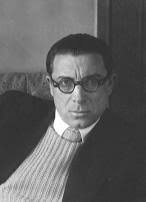
Ilya Lvovich Selvinsky (1899–1968; in the 1920s he wrote under the pseudonym Elliy-Karl Selvinsky, and the double name Ilya-Karl appears in some of his official documents) was a Russian Soviet writer of Krymchak descent — poet, playwright, and a representative of the Constructivist movement in literature.
Selvinsky was born on 11 (24) October 1899 in Simferopol, into a Krymchak family. His grandfather, Elya (Eliogu) Shelevinsky, had been a cantonist in the Phanagoria Regiment; his father, Leiba Elshaelovich (Lev Ilyich) Selevinsky, fought in the Russo-Turkish War of 1877 and afterward dealt in furs and pelts. His mother was Nadezhda Piastro. As Selvinsky himself put it in his autobiography of 1967, his father "was a furrier and then, having gone bankrupt, became a fur-dresser."
The future writer studied at the elementary school in Yevpatoria and, from 1915 to 1919, at the gymnasium. He began publishing in 1915, in the newspaper Yevpatoriyskie Novosti among other places.
In the years of the revolution he took part in the revolutionary movement, and during the Civil War he fought in the ranks of the Red Army. He passed through a string of trades — stevedore, artist's model, reporter, circus wrestler, and more.
In 1923 Selvinsky graduated from the Faculty of Social Sciences of the First Moscow State University. He was the de facto leader of the Constructivist group. His first collection of poems appeared in 1926; in the late twenties he wrote experimental epic poems, and in the early thirties, avant-garde verse dramas.
Between 1927 and 1930 he carried on a sharp polemic with Mayakovsky. In 1930 he came forward with statements of repentance — and at the same time, as his autobiography records, went "to work as a welder at the electrical plant."
In 1933–34, as a correspondent for Pravda, he joined the expedition led by Otto Schmidt aboard the steamer Chelyuskin, and traveled with the Chukchi by dogsled across the ice of the Arctic Ocean and the tundra to Cape Dezhnev.
From 1937 he wrote historical dramas in verse. He joined the Communist Party in 1941, and from 1941 to 1945 served at the front in the Red Army, first with the rank of battalion commissar, then of lieutenant colonel; he suffered two concussions and one severe wound near Bataysk.
In the 1950s he prepared new versions of his works of the 1920s.
Selvinsky died on 22 March 1968 in Moscow. He is buried in the Novodevichy Cemetery.
Lyric poetry
"The Gymnasium Muse," a cycle of poems; Records, a collection of verse (1926); "Declaration of the Rights of the Poet" (1930); "The Electrical Plant Gazette," poems (1931); "Pacific Poems"; "Foreign Parts"; the war poems, among them "Homeland," "Who Are We?," "I Saw It!," "On Leninism," "Adzhi-Mushkai," and "Fascism" (1941); Crimea, the Caucasus, the Kuban, a collection (1947).
Long poems and novels in verse
Youth, a crown of sonnets (1920); Ulyalayevshchina, a narrative poem (1923–24, published 1927; reworked in 1956); Notes of a Poet, a verse tale incorporating the collection The Silken Moon (1927); Pushtorg, a novel in verse (1927–28, published 1929); Chelyuskiniana, a poem (1937–38); the second version of Ulyalayevshchina (1956); Arctic, a novel (1960); The Three Bogatyrs, a compendium of the Russian epic songs.
Plays
Commander of the Second Army, a tragedy in verse (1928); Pao-Pao, a drama (1932); Umka the Polar Bear (1933); Knight Johann, a tragedy in verse (1937); Babek (He Who Bears an Eagle on His Shoulder), a tragedy in verse (1941); the dramatic trilogy Russia — The Livonian War, in verse (1941–44), From Poltava to Gangut (1949), and The Great Kirill (1957); General Brusilov (1943); Reading Faust, a tragedy (1947); A Man Above His Fate, a play about Lenin (1962); The Swan Princess, a lyric tragedy (1968); The Tushino Camp.
Prose
The Constructivist's Code (1928); Features of My Life, an autobiographical manuscript (1959); The Studio of Verse, studies in the theory of verse (1962); O My Youth!, an autobiographical novel (published 1966).