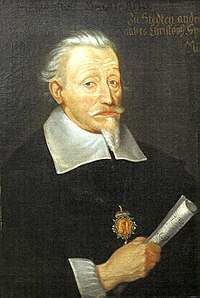
Heinrich Schütz (1585–1672) was the greatest German composer of the early Baroque, the link between Renaissance polyphony and the age of Bach. As a young man he studied in Venice with Giovanni Gabrieli and later knew Claudio Monteverdi; those two influences — Venetian polychoral splendor and Italian expressive declamation — marked his style for life.
Nearly all his life Schütz served as Kapellmeister to the Saxon electors in Dresden. His era coincided with the Thirty Years' War: a ruined Germany, emptied chapels, a shortage of singers — and it is astonishing that precisely in these conditions he created music of immense spiritual concentration. Schütz deliberately taught himself to write "poor" — for small forces, sometimes for just a few voices and basso continuo — and it is there that his most piercing music was born.
His principal works include the collection Psalms of David, the Symphoniae sacrae, three unaccompanied Passions (after Matthew, Luke, and John), The Seven Words of Jesus Christ on the Cross, and the late Musikalische Exequien — the first requiem in the German language. He also wrote the first German opera, Dafne, whose music is lost.
Schütz's is music in which the word comes first: every inflection rises from the breathing of the biblical text. He builds his many-voiced works so that separate choirs call to one another across the hall, as though answering from opposite sides of the church — a device he brought home from San Marco and made the norm of German sacred music. To listen to him is to hear the stillness and concentration of the German spiritual tradition long before Johann Sebastian Bach carried it forward and brought it to completion.