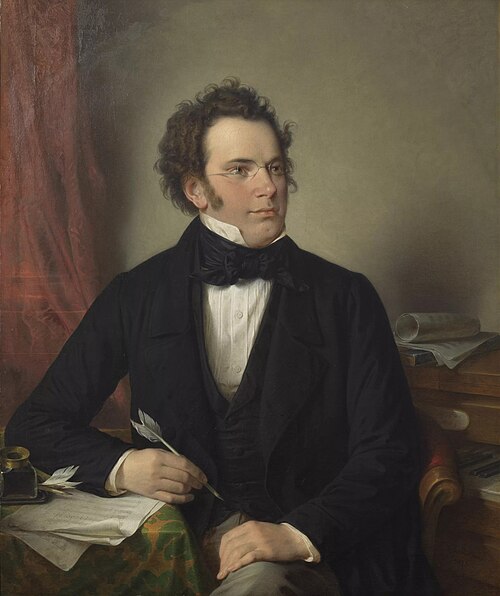
Franz Schubert (1797–1828), the Austrian Romantic composer, lived only thirty-one years and left behind a legacy that could by itself fill a long biography. The son of a Viennese schoolteacher, he sang briefly as a chorister in the imperial court chapel, gave up schoolteaching at eighteen, and lived almost as a bohemian: with friends, in other people's lodgings, on modest fees and the help of acquaintances. His friends held "Schubertiades" at home — evenings at which he played and sang his newest works.
Schubert's great discovery was the German art song, the Lied. He wrote some six hundred songs and brought the union of poem and music to a degree of unity unknown before him. The cycles Die schone Mullerin (The Fair Maid of the Mill), Winterreise (Winter Journey), and Schwanengesang (Swan Song) are guidebooks to the young Romantic soul: the road, love, solitude, nature, death. "Erlkonig" (The Erl-King), the "Serenade," "Ave Maria," and "Die Forelle" (The Trout) became songs everyone knows.
The instrumental side matters no less. The Eighth, "Unfinished" Symphony in B minor; the grand "Great" Symphony in C major; the "Trout" Piano Quintet; the String Quintet in C major; the last three piano sonatas; the Impromptus and the Moments musicaux — all composed within a handful of years.
Schubert wrote as though he knew time was short: his late music unfolds in long songs where sorrow is never far from tenderness. His favorite texts were poems by Goethe, Schiller, Muller, and Heine; through his music, German Romantic poetry sounded for the first time as though the poem itself were the melody.
To listen to him is to learn to hear the silence between phrases — the silence in which Romantic feeling lives.