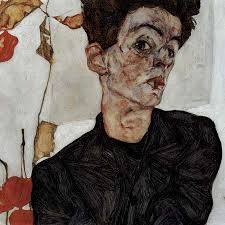
Egon Schiele (12 June 1890, Tulln an der Donau – 31 October 1918, Vienna) was an Austrian Expressionist painter, the best-loved and most gifted pupil of Gustav Klimt.
Schiele's erotic, unsparing drawings and paintings are hard to call sensual or languorous. The broken lines of arms and legs, the mask-like faces, the parched naked bodies speak of suffering and the precariousness of life rather than of love and desire. Even his landscapes — deserted streets, empty fields — hold loneliness and a ringing silence.
Among his best-known works: The Lovers, The Family, Houses with Colourful Laundry, Young Mother, Portrait of Wally, Self-Portrait with Chinese Lantern Plant, and his many other self-portraits.
Had Egon Schiele ever seen a psychotherapist, his case file might have run several times thicker than the story of his life and outweighed his criminal record. The notorious "Viennese pornographer" never had the chance to grow wise and sensible; life did not grant him years enough to sound the depths of mature themes and images — to burn through the scandalous sexuality and settle down in earnest to landscape and the other "grown-up" genres. Schiele lived only twenty-eight years and truly painted for barely ten, yet he became one of the boldest and most vivid figures in twentieth-century art — whatever the diagnoses his countryman Sigmund Freud might have handed him.
The stockbroker Paul Gauguin, for comparison, was twenty-eight when he first sent a perfectly academic landscape to the Paris Salon, with another ten years of living and working ahead of him before he found a style of his own. And Vincent van Gogh, the failed art dealer and pastor, was twenty-eight when he had only just enrolled at the Royal Academy of Fine Arts — which he soon abandoned.
Too few joys
Schiele, by contrast, knew from childhood that he was an artist. His only model, his open air and his inspiration in those years was the railway — its signals, its intricate mechanisms, its smoke and its power. Egon and his two sisters were born and raised in the little Austrian town of Tulln, where their father was master of a major railway station. The town was so small that it had no school of its own, and it remains so small even now that its chief distinctions are a mention in the Nibelungenlied and the honour of being the birthplace of the Austrian painter Egon Schiele.
Beyond drawing, little interested the young Egon. He made no friends, showed not the slightest interest in lessons or learning, and at every school promptly earned the unspoken title of "difficult" pupil — while his parents earned a sheaf of angry notes from the teachers. He failed his lyceum examinations without regret, repeated a year, and with impenetrable indifference to everything else went on doing the one thing he cared about: drawing. He loved his father dearly, and he held a lifelong grudge against his mother for wearing her mourning too lightly and for loving him, Egon, in entirely the wrong way. His father's madness, the result of syphilis, did not weaken the son's love; it only made that love obsessive and painful. Grown and successful, he still returned to the places his father had cherished, travelled his father's routes, and found peace nowhere.
Too much talent
Schiele's gift was so unmistakable that it inspired something close to dread. He became the youngest student at the Academy of Fine Arts — only sixteen when Professor Griepenkerl admitted him to his class (the same professor who, a year later, would turn away the eighteen-year-old Adolf Hitler). When, a few years into his studies, the young artist carried his drawings in trembling hands to Gustav Klimt, the master said just one thing: "There is talent in them. Even too much."
Talent was Schiele's chief moral compass and his justification. His biographers hold that he was thrown out of the Academy for trying to know his models as closely — as intimately — as possible. "Only that way can I truly feel them," was how Egon explained his many liaisons to his teacher. To avert a scandal it was decided to be rid of the young genius, and after three years of study he was expelled.
Left without his guardian's money and without commissions from the Secession's craft workshops, Schiele did not hesitate to put his rare gift to producing explicit pictures — a profitable and much-demanded trade at the time. Soon he could rent a flat with a studio and work toward his first major exhibition, arranged by Klimt in 1909 at a Vienna gallery. The provocatively gifted nineteen-year-old "pornographer" found himself in enviable company: his pictures hung beside works by Klimt himself, by Vincent van Gogh and by Edvard Munch. By the outbreak of the First World War Schiele was famous, exhibiting every year — with the Blue Rider, the Cologne Sonderbund, the Vienna and International Secessions. After Klimt's death in 1918 he became the leading painter of Austria, dreaming of a painting school of his own and a new association of artists.
Women too close
Egon Schiele was a short, fragile, nervous man-child with great pain in his eyes. He loved being photographed and took it very seriously, arranging his hands and thinking through his poses. Yet the charges of narcissism and exhibitionism that every other biographical sketch now hastens to lay on him shatter against his dozens of complex self-portraits. In them Schiele is testing himself, not admiring himself. He appears as martyr, freak, poet, hermit, husband, lover — never as a pretty boy.
For all this bent toward self-laceration and self-analysis, so many women passed through his studio and his bed that no one troubles even to count them. His painter friends recalled that teenage girls were always living in his house — hiding there from beatings at home, sleeping, bathing, mending their clothes, and posing, while they were at it, for the latest picture. But two women were different: Wally Neuzil, his model and first love, and Edith Harms, his wife and his last.
Wally was seventeen when she ceased to be Klimt's model and became Schiele's favourite one. For several years she posed for Egon in brightly coloured stockings and trailed after him through small towns in search of seclusion. The small towns had no use for their love: neighbours peered through the windows and deplored the immorality of it. In one such town Schiele was arrested for corrupting a minor and keeping indecent drawings; one of his pictures was ceremonially burned, and instead of the twenty years' prison he had faced, he was held for three days and released.
When Edith Harms, the daughter of a locksmith, entered his life, Schiele could think of nothing better than to hand Wally a farewell letter together with a proposal of annual summer trips for two, for their amusement. Wally could think of nothing better than to go off and work as a Red Cross nurse — and to die there a few years later.
Almost the whole history of Edith and Egon's married life is the history of his war. Schiele was called up four days after the wedding and returned to his young wife only a few months before his death. Edith died pregnant, in the terrible epidemic of Spanish influenza that swept all of Europe. Egon outlived her by three days.