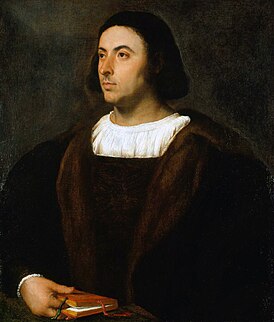
Sannazaro was born in Naples in 1458; his father died around 1462, and the boy spent his adolescence in Nocera Inferiore and San Cipriano Picentino. The rural atmosphere of those places would later grace his poetry. He grew close to the humanist Giovanni Pontano and belonged to Pontano's academy, within whose walls he took the literary name Actius Syncerus.
For many years he served the sovereigns of the Aragonese house with devotion. In 1483–1485 he twice accompanied Alfonso II on incursions into the Papal States. He quickly won a reputation as a poet and became a court poet. After the death of his principal patron, Alfonso II, in 1495, he received from Federigo, in 1499, the villa of Mergellina near Naples. When Federigo lost his crown, Sannazaro followed him into exile in France in 1501, returning after Federigo's death at Plessis-les-Tours in 1504. The poet passed his last years in Naples, where he died in 1530.
As a court poet he wrote farces and comic monologues to amuse courtly society, together with love lyrics in the manner of Petrarch.
His romance Arcadia, written in prosimetrum, was begun in the 1480s and finished around 1489. It was published in Venice in 1504, and again there, heavily revised, in 1524. Sannazaro drew his inspiration from the ancient authors of the pastoral tradition — the Latin poets Virgil and Calpurnius, and the Greek Idylls of Theocritus. At the center of the narrative stands a poet suffering for love ("Sincero"), who leaves the city — in this case Naples — to live amid the serenity and simplicity of Arcadia. There, in the countryside, he sets out on his wanderings, listening to the shepherds' songs of love and sorrow.
In 1526 Sannazaro published a Latin epic, De partu Virginis (On the Virgin Birth), whose style and language reveal the influence of Virgil. Though the poem is modest in scale — some 1,500 verses — he labored over it for more than twenty years. Today De partu Virginis is regarded as a model of the Renaissance's devotional-religious verse and an outstanding monument of Latin poetry in its own right.