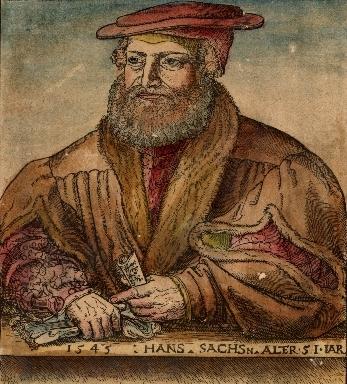
Hans Sachs was a German poet, Meistersinger, and playwright, a champion and popularizer of the Reformation; his work stands as one of the great monuments of burgher town culture in the age of the Renaissance. Born in Nuremberg in 1494 to a tailor's family, he attended the Latin school, apprenticed as a shoemaker from 1509 to 1511, and then spent five years as a wandering journeyman. In the course of those travels he found himself at Innsbruck, at the court of Emperor Maximilian I, and it was apparently there that he resolved to learn the art of Meistergesang. He began his training in Munich under Leonhard Nunnenbeck, and from 1520 settled in Nuremberg, where he became a master shoemaker and, at the same time, an active member — and for a time the head — of the Meistersinger guild.
In 1519 he married the seventeen-year-old Kunigunde Kreutzer, who died in 1560; the following year he married again, a young widow named Barbara Harscher. The first marriage gave him seven children, none of whom outlived him. From the outset he backed the Reformation in Martin Luther's form. Between 1523 and 1526 he issued dialogue pamphlets expounding the main points of Luther's teaching, and these brought him his first fame — and a ban on literary activity, which forced him back to earning his bread as a shoemaker. In 1529 Nuremberg declared itself a Protestant city and the ban was lifted. By mid-century Hans Sachs was among the most widely read authors in Germany, and his works were being staged. In 1558 he began publishing his own writings, and thereafter turned out a steady stream of new Schwänke, Fastnachtspiele, dramas, poems, and prose dialogues.
More than 6,000 poems are attributed to him — astonishing, considering that he made his living not by literature but at the cobbler's bench. The range is remarkably wide: among the songs are sacred pieces and secular ones, and the same material often recurs in several versions. In "In Praise of the City of Nuremberg" Sachs describes the burgher life he knew, recording the number and condition of the city's streets and buildings, the trades of its craftsmen, and its fairs. His Schwänke and Fastnachtspiele belong to the Nuremberg tradition; he also wrote comedies and tragedies on subjects drawn from antiquity, the Middle Ages, and the Bible, often didactic or satirical in cast. The best known of his farces are "The Schoolboy in Paradise" and "The Peddler's Basket." He is also credited with thirteen surviving model melodies, or "master tones" (Meistertöne), to which — by the principle of contrafactum — not only his own verses but those of many other Meistersingers were sung.
After several centuries of neglect, Sachs's legacy was rediscovered in the 1770s by Wieland and by Goethe, who marked the two-hundredth anniversary of the poet's death with a long poem, "Hans Sachs's Poetic Mission" (1776). The colorful figure of the Nuremberg shoemaker-poet was later brought back to life on the operatic stage by V. Jírovec, by A. Lortzing (Hans Sachs, 1834), and by R. Wagner (The Mastersingers of Nuremberg, 1868).