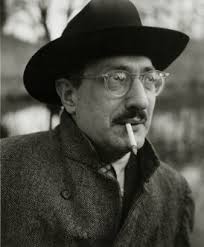
Mark Rothko (born Markus Yakovlevich Rotkovich; September 25, 1903, Dvinsk, Vitebsk Governorate — now Daugavpils, Latvia; died February 25, 1970, New York) was an American painter from a family of Russian Jews, one of the “holy trinity” of Abstract Expressionism alongside Jackson Pollock and Willem de Kooning. Despite phenomenal success in his own lifetime, he was tormented by depression and by his dependence on tobacco and alcohol; at the height of his career he slit his wrists, having first taken a massive dose of antidepressants for good measure. He is remembered as one of the founders of color field painting.
His art followed a long arc: beginning with relatively traditional painting, he fell under the influence of the European Surrealists and turned to abstract scenes drawn from Greek myth. In time he abandoned representational form altogether, concentrating on color — on its power to carry emotion across the canvas and act directly on the viewer. By the early 1950s he had found his signature manner: ragged rectangular forms floating on a field of color. Demand for the work grew rapidly, lifting Rothko into the ranks of the ten highest-paid artists of his day. Among his best-known paintings: “Orange, Red, Yellow,” “Red on Maroon,” “Entrance to Subway,” “White Center (Yellow, Pink and Lavender on Rose),” “No. 10,” and “No. 61 (Rust and Blue).”
Markus Rotkovich grew up in a multilingual household where Russian and Yiddish were spoken; soon he would have to master a third language, English, in which he would speak for the rest of his life. His father, a pharmacist, was determined to give his children the best possible education. Though Jewish families traditionally placed great weight on religious upbringing, Yakov was drawn to Marxist ideals and preferred to school his four children in politics and economics — very likely the foundation of the painter’s later uneasy relations with big capital and the financial magnates who would buy his canvases for extravagant sums.
Fearing that his elder sons would be conscripted into the tsar’s army, the father took them to the United States; the mother, Markus, and his younger sister followed. The reunion was brief: a few months later Yakov died of cancer — the first in a chain of blows that would batter the sensitive, emotional artist all his life. His father’s death briefly deepened the boy’s ties to religion (he was the only child in the family to attend cheder and study Hebrew and Talmud; the others had an ordinary schooling). But after spending about a year in the local synagogue mourning his father, he swore never to set foot there again.
Yakov’s intellectual investment bore fruit. In his American school Markus jumped from the third grade straight to the fifth, graduated with honors, and won a scholarship covering his first year at Yale. When the money ran out he worked as a messenger and a waiter to pay his way. But to the revolutionary-minded student his alma mater looked like a haven of snobs and racists; by the end of his second year he had dropped out, returning only forty-six years later — to receive an honorary doctorate.
It is hard to imagine any fate for Rothko other than painting, but the artist, with his taste for drama, liked to recall the moment when chance made him “born as an artist”: in 1923, visiting a friend at the Art Students League of New York, he found him drawing from a live model. Markus first took painting lessons at the Parsons school of design under Arshile Gorky, the American avant-gardist of Armenian descent; a closer understanding came with Max Weber, a Jewish immigrant likewise from the Russian Empire. To survive while studying he took whatever work he could find — a laundry, drawing maps for Bible illustrations, teaching drawing to children. In 1932 he met his future wife, Edith Sachar, a jewelry designer whose parents came from Kiev. Within five years they had separated; the relationship resumed some months later but remained strained.
The chief source of the young artist’s fears and mounting anxiety in the late 1930s was the swift rise of Nazi ideas in Europe. Worried that it might become the pretext for a sudden deportation of Jews from the United States, he applied for American citizenship in 1938; in 1940, with antisemitism rising, he took a further precaution and shortened his name to the now familiar Mark Rothko. In the same period he pursued Surrealism in his own interpretation, drawing on religious subjects and ancient myth, and on the ideas of Nietzsche, Freud, and Jung.
The tragedies of the Second World War seem to have left irreversible marks on the artist’s fragile psyche. His dream — never to be realized — was to paint a cycle of canvases for a museum dedicated to the Holocaust. Throughout his life he sought to express in his work the depth of despair and horror before what humanity had shown itself capable of. In the early 1950s Rothko traveled through Europe with his second wife, Mell Beistle, a middle-class Protestant nineteen years his junior. The Medici Library in Florence, built to Michelangelo’s design, and the originals of his favorite painters — Rembrandt, Turner, Matisse — would feed his imagination for years to come. But the turning point came in New York, where at the Museum of Modern Art Rothko stood transfixed for hours before Matisse’s “Red Studio.” “When you look at that picture, you become that color, you become totally saturated with it,” he explained. The overwhelming force of color set off his experiments with fields of color (critics also called them “multiforms”), and gradually the signature manner crystallized with which Rothko wrote his name into the history of American abstract painting.
Rothko never set out to make work that would sit prettily in living rooms and sell briskly. Yet almost against his will he fitted the moment. The fashion for carefree Pop Art in the 1950s and the psychedelic revolution of the 1960s created a booming demand for his bright, at times acid-hued canvases. His fees shot up like mushrooms after rain; Rockefeller bought one of his paintings, and galleries competed for the right to mount his one-man shows.
All of this led Rothko — a man who lived for art alone — to doubt his very right to call himself an artist. From a bright, glowing palette he turned to ever darker tones, and finally to a range of gray and black. In 1964 he moved into a studio with no natural light at all, gave up oil paint, which had allowed him his luminous, translucent effects, and began to work in acrylic. His second marriage was coming apart at the seams, as was his health, worn down by heavy doses of alcohol and nicotine. In 1968 he was diagnosed with an aortic aneurysm, but in defiance of his doctors he had no intention of giving up his habits; the one concession he managed was to husband his strength and work on much smaller canvases. He had always preferred large formats, explaining that the viewer should find himself literally inside the picture.
Depression swallowed him in the end. On February 25, 1970, his assistant Oliver Steindecker arrived at the studio to find Rothko lying unconscious on the kitchen floor. Beside him was the razor with which he had opened his veins, under the influence of a large quantity of antidepressants. Rothko’s life is one of the most striking instances of a restless artistic soul that neither universal recognition nor the many zeros on collectors’ checks could reconcile to the world — and, as so often happens, his tragic life and death have only gone on adding to those zeros ever since.