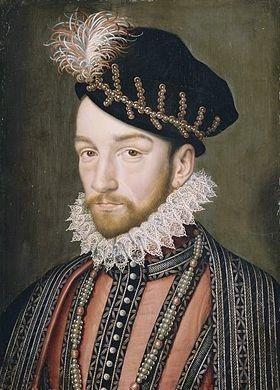
Pierre de Ronsard was born in 1524 in the Vendômois, a provincial region in the Loire valley. His aristocratic family opened doors at court: he became a page and for several years accompanied diplomatic missions — to Scotland, to Germany. Around 1540 a sudden illness left him deaf in one ear. A diplomatic career, which demanded good health and courtly agility, was closed to him. Ronsard turned to poetry — an occupation that requires no sharpness of hearing, but requires everything else.
In 1547, at one of the Paris colleges, he met Joachim du Bellay. They became allies, and two years later published a manifesto: The Defence and Illustration of the French Language (1549). The thesis was simple and audacious: French is in no way inferior to Greek and Latin — it has simply not yet been cultivated by poets of sufficient stature. The group that formed around this manifesto called itself the Pléiade, after the constellation. It set out to close that gap itself.
Ronsard's first collection, the Odes (1550), was an open challenge: he imitated Pindar and Horace — but did not translate them, writing instead new odes in French on their model. In 1552 came the Amours — a cycle of sonnets written for Cassandre Salviati, daughter of a Florentine banker, whom Ronsard had seen at a court ball in 1545. She married another man. He wrote a hundred and eighty-two sonnets. The cycle appeared under the title Amours de Cassandre and made him famous.
At court Ronsard became the official poet — first to Henri II, then to François II, then to Charles IX. The last idolized him, granting him pensions, abbeys and time to work. During the wars of religion — Catholics against Huguenots — Ronsard wrote his Discourses on the Miseries of These Times (1562–1563), taking the side of the king and the Catholic Church. The Protestants answered with pamphlets. Ronsard answered the pamphlets with verse. The poetic voice in political polemic — that too was he.
In 1578, when he was fifty-four, Ronsard published the Sonnets pour Hélène — a cycle written for Hélène de Surgères, a lady-in-waiting to Catherine de' Medici. Among them was the sonnet that would later be quoted more than all the rest: Quand vous serez bien vieille — "When you are very old." The speaker addresses a young woman: when you are old and spinning by candlelight, you will remember Ronsard's verse and regret that you spurned him. The poem is not a compliment but a threat. And that is exactly what makes it flawless.
Ronsard died in December 1585 at the priory of Saint-Cosme near Tours, where he had withdrawn from Paris because of illness. He was sixty. Soon came the age of classicism — Boileau declared Ronsard outmoded. The nineteenth century rehabilitated him: the Romantics discovered in him a free voice, unbound by rules. Today he reads as a poet who once proved that a language is capable of anything — one need only not be afraid to demand too much of it.