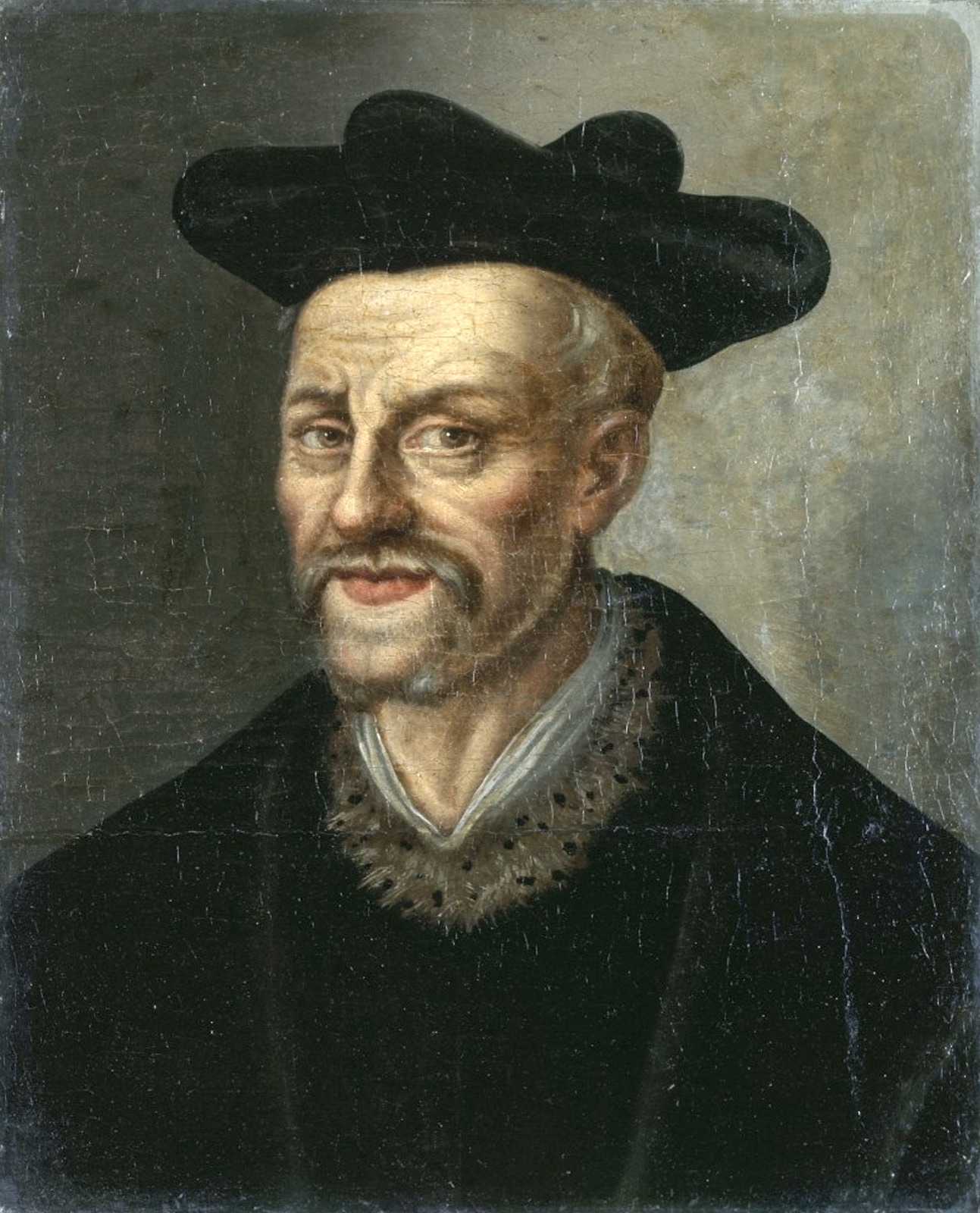
Francois Rabelais was a French writer, one of the greatest humanist satirists of the European Renaissance and the author of "Gargantua and Pantagruel." He was born in Chinon, in Touraine; the exact date is unknown, with sources placing it in 1483 or in 1494. He was presumably the son of a tavern-keeper (some say an apothecary who also dealt in drink), though by other accounts his father was a lawyer. He lost his mother in earliest childhood — or, as other reports have it, was rejected by her very early and given over to a monastery, a circumstance by which some biographers, with no small stretch, explain the absence of purity, ideality, and tenderness in his work.
Straight from the tavern world in which he spent his first ten years, Rabelais was placed by his father as a pupil in the Franciscan monastery of Seuilly, then in the monastery of La Baumette, and then, again as a pupil, in the Cordelier abbey at Fontenay-le-Comte. An account survives that in the course of these moves he met among his fellow pupils a young man who would later serve as the model for one of the most striking figures in his novel, the monk Jean des Entommeures. Not educated enough to devote himself to one of the "liberal professions," Rabelais took monastic vows — prompted, among other things, by the prospect that a measure of material security would let him pursue the humanist learning which then, at the height of the French Renaissance, held the most prominent place in the nation's intellectual life.
The monastic life — above all that of the Franciscan order — to which Rabelais consigned himself at twenty-five stood in sharp contradiction to his nature, hostile as it was to every mystical extreme and to the ascetic mortification of the flesh. The friars were forbidden to pursue learning or to read any books but theological ones; the inquisitive Rabelais would not submit to the rule, secretly studying Latin and Greek and reading the philosophers and poets. His distaste for monasticism was deepened by the ignorance, fanaticism, idleness, and dissipation of the monks among whom he had to live — men who were already supplying him with precious material for his future satires. All the more zealously did he pursue his beloved studies, in a circle of like-minded companions and through contact with leading figures of the Renaissance, Bude among them. When the monks' displeasure — fed in no small part by his mockery of them — turned into persecution, Rabelais fled. He soon returned, but within a year he left the Franciscan order for good and went over to the Benedictines.
He never entered a monastery again. As a simple priest he lived at the court of Geoffroy d'Estissac, Bishop of Maillezais, a man of learning and Epicurean tastes who gathered many French humanists around him. It was very probably at this time that Rabelais began his dealings with Erasmus of Rotterdam, for whom he always felt the deepest reverence, calling him his "father," even his "mother." The patronage of the bishop, and of the du Bellay brothers — men of high position who played a significant part in the education of the age — allowed Rabelais to take up botany and medicine without being weighed down by his clerical duties. In 1530, still a priest, he entered the medical faculty of the University of Montpellier, where the future Nostradamus also studied. There he gave public lectures on medicine, expounding the "Aphorisms" of Hippocrates and Galen's "Ars parva"; he published some learned works of no great merit, along with the almanacs then in fashion; and he practiced as a physician, though he officially received his doctorate in medicine only much later.
He carried on the same work in Lyon, where he moved from Montpellier — and there he also set foot on the path that would bring him immortal fame. In 1532 or 1533 the first two books of his famous novel appeared in their first version, unsigned for fear of persecution, under the pseudonym Alcofribas Nasier — an anagram of his name — and under the title "Grandes et inestimables chroniques du grand et enorme geant Gargantua."
An important event in his life, almost simultaneous with the publication of the first books of "Gargantua," was a journey to Rome as secretary to du Bellay. It enriched him with observations that fed the satirist in him, whose lash fell above all on the corrupt Catholic clergy. On a second journey to Rome, under Pope Paul III, Rabelais — by courting cardinals and other influential persons — obtained the Pope's forgiveness for his many transgressions, his flight from the monastery among them, and somewhat improved his material circumstances. Even so, persecution by the clergy and the parlement, which went as far as the burning of his books, forced him, despite the protection of King Francis I, to move from place to place, to endure every kind of hardship, and to tremble constantly for his safety — the more so as violence and executions fell without cease upon his best friends and fellow spirits.
At last, in 1551, he received the parish of Meudon, a small place near Paris, where he brought out the fourth book of "Pantagruel." The anathemas of the Sorbonne continued with undiminished force, but powerful protection — that of Diane de Poitiers among others — allowed the author a relatively quiet existence until his death. He died in Paris in 1553.
His biographers surround his death with the same legendary details that embellished his whole life, though some of them are more or less confirmed by fairly reliable testimony. Such is the story that shortly before dying he asked to be dressed in the habit of a Benedictine monk and, when asked why, answered with a pun: "Beati qui moriuntur in Domino" — blessed are they who die in the Lord, or in a domino costume. Or his reply to the messenger sent by Cardinal Chatillon to inquire after his health: "Dis a monseigneur en quelle galante humeur tu me vois: je vais querir un grand peut-etre" — tell his eminence in what merry humor you find me: I am off in search of the great Perhaps. Or the words he is said to have uttered with a laugh a few minutes before his death: "Tirez le rideau, la farce est jouee" — draw the curtain, the farce is played out.
The most remarkable writer of his age, Rabelais is also its most faithful and living reflection; standing beside the greatest satirists, he holds an honorable place among philosophers and educators. He is entirely a man of his time, a man of the Renaissance in his sympathies and attachments, in his wandering, almost vagrant life, in the sheer range of his knowledge and pursuits. Humanist, physician, jurist, philologist, archaeologist, naturalist, theologian — in all these spheres he is "the most valiant interlocutor at the banquet of the human mind." All the intellectual, moral, and social ferment of his age is caught in his two great novels. His weapon is laughter — gigantic laughter, often monstrous, like his heroes. "To the terrible social malady raging everywhere, he prescribed enormous doses of laughter."
The satirical novel itself runs to five books and tells of two good-natured giants, gluttons both, father and son. It ridicules a host of human vices and spares neither the state nor the church of the author's day, mocking on the one hand the endless pretensions of the church and on the other the ignorance and idleness of the monks, and vividly exposing all the failings of the Catholic clergy that provoked mass protest in the age of the Reformation.