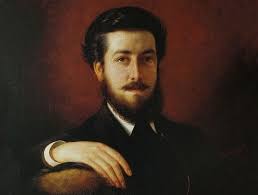
Vasily Pukirev was born in 1832 into a peasant family in the Tula village of Luzhniki. He received his elementary education at a parish school, briefly apprenticed with an icon painter, and then entered the Moscow School of Painting, Sculpture, and Architecture, where he studied for more than ten years — from 1847 to 1858 — under Sergei Zaryanko.
In 1862 he painted the work that secured him a place in the history of Russian art — "The Unequal Marriage": a young girl forcibly given in marriage to a wealthy old man. The subject was not an abstract one — a year earlier the Holy Synod had issued a special decree condemning marriages with a great difference in age. Shown at the Academy of Arts exhibition in 1863, the painting caused a sensation and earned Pukirev the title of professor.
The composition is arranged so that the viewer cannot look away from the faces: the bride stands with downcast eyes and an extinguished candle in her hand, the groom — a gaunt old man with decorations on his chest — looks at her almost without expression, while witnesses to the rite crowd around, some of them visibly discomfited by what is happening. Today the painting hangs in the Tretyakov Gallery and remains one of the most recognizable works of nineteenth-century Russian painting on the theme of social inequality. The painting's success came at a time when writers and artists were turning ever more often to the theme of marriages of convenience and the powerlessness of women within the patriarchal family — and "The Unequal Marriage" became, perhaps, the most recognizable pictorial statement on this theme.
Rumor soon spread that the subject was autobiographical: at the right edge of the canvas stands a man with folded arms, in whom many recognized the artist himself — allegedly the best man at the wedding of his own unrealized beloved. Pukirev's friend, the painter Sergei Gribkov, maintained that the painting told precisely the author's own personal drama; various names have been proposed for the presumed bride, among them Praskovya Varentsova, said to have been given in marriage to an elderly prince. None of these versions has been documented — but the legend has proven tenacious precisely because the pain on the canvas looks too real to be pure invention.
The success of "The Unequal Marriage" was not to be repeated. Pukirev taught at his alma mater from 1861 to 1873, but his subsequent paintings were received far more coolly by the public and the critics, while his health was increasingly affected by a nervous disorder.
In 1873 he was forced to give up teaching. In 1879 his colleagues secured him a modest pension, but it was not enough to live on, and Pukirev earned his bread by painting icons and illustrating books.
He died in 1890 in Moscow, in poverty and almost forgotten by contemporaries who, not long before, had argued about his painting in the capital's salons — he was buried at Vagankovo Cemetery.
Between the triumph of 1863 and the lonely death thirty years later lies the entire fate of an artist remembered for a single painting — but what a painting: "The Unequal Marriage" still looks out at the viewer through the eyes of a girl married against her will, and of a man with folded arms whose face was never conclusively named.