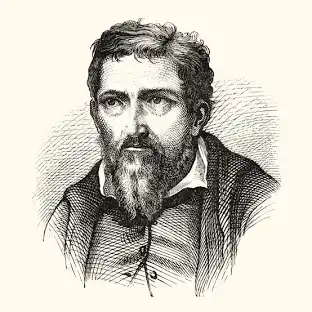
Pontormo — his real name was Jacopo Carucci (May 24, 1494, Pontormo, now a suburb of Empoli — January 2, 1557, Florence) — was an Italian painter of the Florentine school and one of the founders of Mannerism.
Orphaned of his father at ten, Pontormo went to Florence, where he would spend the whole of his life. Born into the family of the painter B. Carucci, he studied under Piero di Cosimo and then, chiefly, in the workshop of Andrea del Sarto (from 1512), alongside Rosso Fiorentino, with whom he collaborated in his early years. His first works bear the imprint of Leonardo da Vinci and Sarto — as in the lunette fresco at the Medici villa at Poggio a Caiano — while later his art was profoundly marked by his encounter with the engravings of Dürer. Gradually Pontormo drew away from the Renaissance tradition.
His first significant work, the frescoes in the church of Santissima Annunziata in Florence (1514–1516), is still conceived in Sarto's harmonious, flowing manner, though with greater emotional charge. The altar cycle on the story of Joseph in Egypt (c. 1515–1518; part of it now in the National Gallery, London), by contrast, is full of anxious, agitated figures. Pontormo's personal style — refined, graceful draftsmanship and a cool palette — emerges vividly in the pastoral-allegorical decorations of the Medici villa at Poggio a Caiano (1519–1521). In the Passion frescoes at the Certosa (the Carthusian monastery) of Val d'Ema at Galluzzo (1523–1527), the influence of the Northern Renaissance — of Dürer's prints — is unmistakable.
The altarpieces of the 1520s are wholly Mannerist: Christ at Emmaus (1525, Uffizi, Florence); the Madonna with Saint Joseph and John the Baptist (Hermitage, St. Petersburg); the Visitation (church of San Michele, Carmignano, 1528–1530); and above all the famous Entombment (1526–1528, church of Santa Felicita, Florence), "strange and new" in manner, as Vasari put it. They live by nervous flares and contrasts of color and light, by a deliberately unreal pairing of the observed world with speculative symbolism (the triangular All-Seeing Eye in the Emmaus picture), by quivering lines that seem to dematerialize figures and draperies. In this period he also executed several compositions after cartoons by Michelangelo — among these mostly lost works is a Venus and Cupid (Galleria dell'Accademia, Florence) — and the great master's influence tells equally in Pontormo's independent paintings (The Ten Thousand Martyrs, or The Martyrdom of Saint Maurice and His Soldiers, 1529–1530, Palazzo Pitti, Florence).
Pontormo was also an outstanding portraitist, with a sharp eye for the inner life of his sitters, whom he typically shows withdrawn and solitary against an impenetrably dark ground (Cosimo the Elder, late 1510s, Uffizi; A Young Man, 1525, Villa Guinigi Museum, Lucca; Young Man with a Halberd, Getty Museum, Malibu, California; and others). The best of his late frescoes — notably those in the choir of San Lorenzo (1546–1556) — have not survived and are known only through preparatory drawings. A brilliant draftsman, he left a substantial body of graphic work. In his final years he lived ever more like a recluse, shut away in his studio.
Pontormo died in Florence on January 2, 1557.