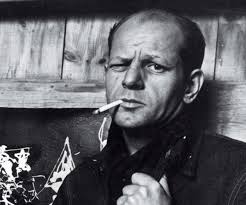
Jackson Pollock (Paul Jackson Pollock; January 28, 1912, Cody, USA — August 11, 1956, Springs, USA) was an American painter who won fame for his canvases in the style of Abstract Expressionism. A difficult, prickly man, he struggled with alcoholism all his life. In 1930 he settled in New York, where he came to know many figures of the cultural world, among them Peggy Guggenheim, who made him her protégé. In the mid-1940s Pollock and his wife moved to Long Island, and it was there that he painted the pictures that brought him wealth and worldwide renown.
What defines Pollock's art: in the late 1940s he began working in his unique "drip" technique (also called "splattering"). He would spread the canvas on the floor and move around it, pouring and flinging paint with brushes and whatever came to hand.
Among his celebrated paintings: Number 5, Autumn Rhythm, Mural, The Deep, Blue Poles.
"Every good painter paints what he is," Pollock once said. Look at his canvases with that remark in mind and it seems obvious that pure chaos reigned in the artist's soul. Look more closely, though, and the chaos begins to seem inscrutably ordered — even harmonious.
Abstract Expressionism, to which Pollock's most famous works belong, arose after the Second World War as an anarchic, rebellious, even nihilistic movement. The revolutionary splatter technique he invented (his early work had shown the influence of the Mexicans Diego Rivera and José Clemente Orozco) inspired many contemporaries and followers to throw off the canons of the fine arts, to step outside the frame — often outside the bounds of decency — and to voice their artistic vision in unexpected ways.
What if God was one of us?
Famous artists are forgiven a great deal. Talent turns them into a caste apart, presumed immune to human weakness — and where weaknesses do exist, the public looks away with an indulgent smile. Yet Jackson Pollock, for all his gifts, was a perfectly ordinary man. And, truth be told, far from the most agreeable one.
A gloomy, unsociable character, alcoholic and prone to depression all his life, he had none of the proverbial "inner core." With a cigarette never out of his mouth and a bottle never out of his hand, Pollock made life hard for those closest to him, staged scandals and drunken rampages, and was often left without a cent. The terrible but theatrical closing stroke of his life was the car crash that killed the 44-year-old painter — who had drunk heavily before taking the wheel — together with one of his passengers.
Pollock left behind dozens of paintings, many in his unique drip technique; the Long Island house where most of them were made, later turned into a museum; and two women who loved him. His mistress, Ruth Kligman, was the sole survivor of that crash and made a name for herself on her memoir of the affair. His wife, Lee Krasner, might fairly be called a survivor of another kind — of fifteen years with Jackson.
A rebel in New York
Jackson and Lee first met at a party in 1936 — a meeting Pollock can hardly have remembered, since he was blind drunk. At twenty-four the young painter was already a confirmed alcoholic. The youngest of the five sons of LeRoy and Stella Pollock, he had gotten on badly with people since childhood. Withdrawn, unsociable, given to fits of rage, the boy was expelled from school twice for constant quarrels and fights. His character bore the stamp of the family's endless moves across America in search of work, of a domineering mother left to raise five boys, and of rare encounters with a father forever away at one job or another. By the time Jackson moved to New York in 1930, at eighteen, he was already reaching for the bottle fairly often.
In 1941 Pollock and Krasner were properly introduced. It is hard to say what drew this young, independent woman — with far more experience of art and a far greater store of knowledge — to a morose alcoholic playing the part of a swaggering cowboy. But Lee later admitted she fell in love with him on the spot. Before long they were living together, and for years Krasner was the chief champion of Pollock's work, his guardian and his secretary. Through her he met much of New York's creative elite, including the famous gallerist Peggy Guggenheim, who first showed a Pollock painting to the public (Stenographic Figure, 1943), commissioned a large-scale canvas for her house, and mounted several solo exhibitions of his work.
Though critics and public alike spoke warmly of his work, no one hurried to buy it. Jackson went through several agents, none of whom got anywhere. So it went until the artist arrived at his personal drip technique, which brought him worldwide fame. Until then Pollock was chronically short of money, and under his contract every unsold painting became Peggy Guggenheim's property at the end of the year.
A discovery
In 1945 Jackson and Lee married and decided to leave New York, settling in a small house at Springs, on Long Island. The painter fitted out a studio in the barn, where he worked until his death; Krasner's studio occupied a room in the house itself, though after Pollock's death she moved it into that same barn.
Away from New York, Jackson all but stopped drinking; life at a distance from the endless parties and drinking companions did him good — so much so that for two years he did not touch the bottle at all. In those years he painted more and more, constantly honing and refining his technique. He made no sketches, set no canvas on an easel, and eventually gave up brushes altogether, making his paintings with improvised tools alone. He preferred to nail the canvas to the wall or spread it on the floor: "On the floor I am more at ease. I feel nearer, more a part of the painting, since this way I can walk around it, work from the four sides and literally be in the painting."
Journalists and art writers still often sin against the truth, straining to make Pollock as singular as possible and claiming that he hit upon the drip technique almost by accident. In fact his way of painting was the fruit of long experiment. He took to working with canvases spread only on the floor; he thinned his paint so that it would flow freely, soaking into the canvas or setting on its surface in thick spatters according to its consistency. Witnesses described him circling the canvas as if in a dance, pouring paint straight from the can and flinging it, working with not just his hands but his whole body. Writing about Pollock in Esquire, Kurt Vonnegut observed that he simply went on fiddling with his drippers and trowels, covering canvas with paint — giving it all his time and all his money, with no one advising or prompting him, curious as a child to see whether anything interesting would come of it in the end.
The devil in the details
Unlike many artists, Pollock needed no stimulant in order to paint; alcohol was only ever an obstacle to the work. Perhaps that is why his two years of complete sobriety proved his most productive. To this period belong the famous canvases Number 5 (1948), Autumn Rhythm (1950), Lavender Mist (1950), and Number 1 (1950).
The technique he invented caused a genuine sensation. By 1952 his paintings had at last begun to sell well, thanks in large part to the shrewd management of his agent Sidney Janis. And at just that moment Jackson went back to the bottle and to his old ways. He painted less with every passing year, yet still produced several astonishing canvases: the menacing Blue Poles (1952), the vertiginous Convergence (1952), and the mesmerizing The Deep (1953).
Despite all Lee Krasner's efforts, Jackson was pulled ever deeper into a spiral of depression, generously fed by drink. The marriage began to come apart, and Pollock's last attempt — whether to wreck his life once and for all or somehow to mend it — was an affair with the young painter Ruth Kligman. Either way, it came to no good. Krasner left him and went traveling in Europe, while the artist set about tormenting his new lover, who could barely endure his drunken outbursts. On August 11, 1956, Jackson picked up the bottle for the last time. The car carrying him, Ruth, and her friend Edith slammed into a tree at high speed and overturned; Kligman survived only because she was thrown clear.
Everyone who knew Jackson Pollock well agreed on one thing: all his life he wrestled with his own demons. Perhaps, in the end, they won. Or perhaps the fatal crash was his only way of defeating them.