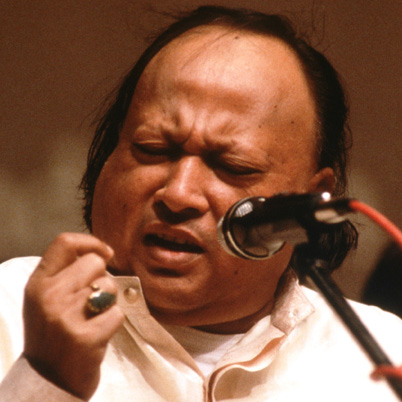
Nusrat Fateh Ali Khan (1948–1997) was a Pakistani singer and the greatest master of qawwali, the Sufi devotional music of South Asia. He was born in Faisalabad into a family in which the qawwali tradition had been handed down for six hundred years: his father, Fateh Ali Khan, was a celebrated singer, and Nusrat trained under him from childhood, and later under his uncles.
Qawwali is not a concert but a form of dhikr, the prayerful remembrance of God. An ensemble of lead singer, chorus, harmonium, and tabla takes a short poetic text — usually verses by Persian, Urdu, or Punjabi poets on love for God and the Prophet — and spins it out into an hour or more of unbroken ascent. Nusrat was endowed with a phenomenal voice: a three-octave range, faultless intonation, the ability to hold the highest notes at full power and to shift into lightning sargam improvisations. His performances could draw an entire hall into the shared state of prayer for which qawwali exists.
In the second half of his life Nusrat moved beyond the tradition: he recorded with Peter Gabriel on the Real World label, worked with Michael Brook, Eddie Vedder, and other Western musicians, and wrote music for the films The Last Temptation of Christ and Dead Man Walking. These projects made qawwali audible across the world without breaking its Sufi core.
His live concerts could run for hours on end, and listeners would enter the state the Sufis themselves call hal — a particular presence. Since Nusrat's death the tradition has been carried on by his nephew Rahat Fateh Ali Khan, and the family school of qawwali remains one of the most vital religious-musical practices in the modern world.
To listen to Nusrat is to understand that prayer can be a voice — and a voice a path to God.