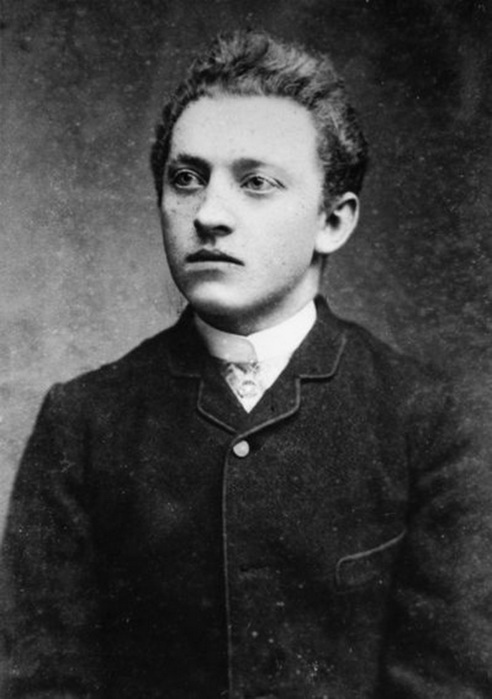
Emil Nolde, born Hans Emil Hansen (7 August 1867, Nolde, Prussia – 13 April 1956, Seebüll, West Germany), was a German Expressionist painter and a member of the celebrated artists' group Die Brücke ("The Bridge").
What sets Nolde's art apart: his mystical, fantastical, melancholy world exists in extreme, terrifying, strained states. The forms are grotesque, the colors pushed to the limit of contrast and saturation, and through the rents in ordinary reality crawl phantasmagoric creatures with horns, paws, and carnival grimaces. Even his watercolor landscapes Nolde strips of transparency, loading them with dense layers of anxious color: high, menacing skies and heavy, massed sea waves.
Among Nolde's best-known paintings: "The Last Supper," "Death in the Desert," "Papuan Children," "Multicolored Sky over the Marsh," "The Crucifixion of Christ," "Women and Pierrot."
Nolde was born a peasant. Generation after generation, his forebears had lived on the family farm on the border of Germany and Denmark: they began working in early childhood, spoke the local dialect, attended the Protestant church, were devout, and knew little of any other kind of life. He had no ambition to become an intellectual and would never receive an academic education — but he left the farm the moment he could.
At seventeen he went to Schleswig, to a school of arts and crafts, where he learned to carve wood and to draw a little, decorated furniture, and even restored church altars. He moved from town to town, learning piecemeal, though the money for study barely stretched; he worked piecemeal too, and quickly dropped each job in search of new openings. Unexpected success overtook Nolde — then still Emil Hansen — in Switzerland, where he devised and, on borrowed money, printed a series of postcards: drawings of the famous mountains, each one a giant come to life, smiling or scowling, a toothless crone or a sly beauty. Then came Munich, a year in Paris, an infatuation with Manet and Impressionism, and utter bewilderment about what to do next. The decisive event for Nolde was his encounter with the artists of Die Brücke — though he stayed with them only a year.
The farmer's son from Nolde saw more countries, lands, and peoples than most of his contemporaries could so much as list without stumbling. In 1913 he set out for New Guinea, then a German colony, as part of an expedition, traveling through Russia, Japan, China, and many Asian countries and islands — and brought home more than eighty paintings. He took the name Nolde for two — for himself and for his wife, the actress Ada Vilstrup, who shared with him long years of poverty, illness, and wandering, and then of recognition and fame. He lived a strange life, never settling anywhere for long, trading bouts of alcoholic and narcotic frenzy for frenzies of spiritual searching and religious revelation.
Nolde did not call himself an Expressionist and made fun of the journalists' term. He always insisted: I am simply a German painter. That mystical, mythological, emotional bond with the land, with history, with a cultural field of energy was his source of strength and self-definition. When the National Socialists came to power, Nolde felt that the dawn of his ideas and his greatest hopes was at hand. He was closely acquainted with Heinrich Himmler and made no effort to accommodate himself to the new regime — he simply believed that his work would at last be wanted, that he and Germany's new rulers spoke the same language: the language of national greatness. He was wrong. His painting cycle "The Life of Christ" became one of the centerpieces of the "Degenerate Art" exhibition; around a thousand of his works were destroyed, removed from museums, confiscated. Nolde invoked his membership in the National Socialist party, wrote letters to Himmler, believed everything would change. But in 1941 he was expelled from the academy of arts and the Reich Chamber of Visual Arts and forbidden to hold any post connected with the fine arts.
Until the war's end Nolde painted watercolor landscapes and flowers and buried them in his own garden — he would later call the cycle "Unpainted Pictures." Only after the war and the fall of the regime did every kind of award and medal come his way; he built, to his own design, a house with a large studio and a hall for his paintings. The Expressionist Nolde, the former farmer Hansen, lived a life remarkably long for his generation: he died at home in Seebüll at the age of eighty-nine.