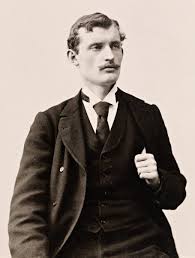
Edvard Munch (12 December 1863, Løten, Hedmark – 23 January 1944, Ekely, near Oslo) was a Norwegian painter whose anxious, northern, doom-laden, prophetic sense of the world became the very foundation of his style — Expressionism.
For most of his life Munch worked on a great cycle "about love, life and death," which he called The Frieze of Life. It contains all his most famous and defining works. Tragic, nervous, fatalistic, full of forebodings both warranted and inexplicable, his paintings are built on harsh contrasts of colour, sharpness of form, and an inexorable rhythm of composition.
Among his best-known paintings: The Scream, Vampire, Girls on the Bridge, Madonna, The Four Ages of Life.
Munch was a man of the north: complicated and contradictory in character, frail in health, acutely sensitive to every shift of nature and weather. Only there, in the north, could Expressionism have been born — passionate, nervous, deep, a standing rebuke to the light Impressionism of the south.
He had his oddities. He hated painting fingers, women's breasts, ears and nails; he disliked flowers in his room and could not bear to watch them wither; in the simplest acts of his friends he detected the scheming of enemies. Sickly, suspicious, irritable — and yet a marvellous storyteller with a sharp sense of humour, a fixture at the gatherings of the artistic elite of Oslo, Berlin and Paris.
He was a strikingly handsome man, but in his self-portraits he mercilessly added years and wrinkles, staring out of the canvas hard and never smiling.
Young women lost their heads, irretrievably, over the imposing Viking looks and the enigmatic modesty that went with them; Munch himself fled the women who in any case passed only briefly through his life. Sometimes he fled quite literally — once rising without a word and simply changing to another train in the middle of a honeymoon.
The critics showed him no mercy; the mockery of his methods and of individual pictures was venomous and inventive. And yet he was, in his way, a genuinely lucky man: he sold his first paintings at eighteen and became the first Norwegian artist to be given a solo exhibition in Oslo — at just twenty-six.
Like a true Norwegian he was inwardly bound to the sea, and held that the sea ought to be visible from any point in a city; yet when he finally settled on his own estate at Ekely, he ringed his open-air studio with a four-metre fence.
The oddities of his character and conduct were expressions of inner freedom, of an art sincere and unbound by canon. "We should stop painting women knitting and men reading. I will paint people who breathe, feel, love and suffer. People should be filled with the sacredness of it and take off their hats before the pictures, as in church," Munch dreamed. And so it is — they take off their hats.
The fear of life
In the centre of Oslo, on the house on Pilestredet where Munch spent his childhood, an entire brick wall carries one of the most remarkable reproductions of The Scream — black paint on raw brick. It is all fitting and exactly right: the source of Munch's restless, nervous sense of the world lies here, in childhood.
Once the house had been a happy one: his father told wonderful stories, his mother was alive. Edvard was five when she died — and when his father stopped inventing tales and began reading the Bible. Nine years later his fifteen-year-old sister Sophie died too. Illness and fear were the two strongest, most durable sensations of his childhood — and of all the life that followed.
From 1879 Edvard dutifully studied engineering, but a single year was enough to show him that he wanted to be a painter. One of the most important women in his life was his aunt Karen: it was she who gave him his first drawing lessons and who talked his displeased father, the military doctor Christian Munch, into giving the young man a chance at his dream.
The birth of love
And then real life began — light, intoxicating, free. By 1881 Edvard was studying at the Royal School of Drawing, selling his first pictures and sharing a studio with friends in the very centre of Oslo; a few years later a state scholarship took him to France to continue his studies. The scholarships kept coming, one after another, letting the young artist live by turns in Nice, Norway, Berlin and Paris and paint his first scandalous, brilliant canvases: The Sick Child, The Day After.
Each of these pictures drew torrents of venom and indignation from the critics: "…those are not hands but fish in shrimp sauce"; "…how long will Munch's drunken prostitutes be allowed to sleep it off in the National Gallery" — and more in the same vein.
His first solo exhibition in Berlin, in 1892, likewise opened to scandal and swiftly closed. But with each new scandal came recognition and respect — from fellow painters, from literary friends, from famous and wealthy connoisseurs of art.
The flowering and fading of love
In Berlin in 1891 Munch began his most important, most difficult and most ambiguous work, The Frieze of Life, which would occupy him for thirty years. Into this symphony of life, death, fear, love and pleasure went all his most celebrated paintings — The Scream, Madonna, Ashes and dozens more — and in 1903, at the gallery of the Berlin Secession, they appeared for the first time in the sequence he had conceived.
Munch threw himself happily into the bohemian gatherings of writers and artists. He brought the red-haired beauty Dagny Juel into the literary circle at the Black Piglet; she would long remain his muse and the model for his most sensual pictures, before becoming the wife of his friend Przybyszewski. And he sank into his most tormenting, sweetest and longest affair, with the beautiful Tulla Larsen — an affair that ended with Tulla's attempt on her own life and a bullet through Munch's finger.
Sickly and impressionable from birth, plagued by loneliness and a mania of persecution, the artist could not withstand the double ordeal of alcohol and people, and in 1908 he entered hospital after a nervous breakdown.
Death
From 1913 came the genuinely successful years — which made him neither happy nor calm. Parting with his pictures was hard: the good ones he sold with pain, the failures with despair. Prices for his work rose year by year, and he could easily have become a millionaire. He was invited to decorate the assembly hall of the University of Oslo, the city hall, the theatre, to design sets for Ibsen's plays; exhibitions called him to Paris, Vienna, Prague, Munich, Dresden, Copenhagen, to England and even to America.
But Edvard Munch died in 1944 alone, in his own house, in a city occupied by the Germans — the same Germans who, once in power, had fastidiously rid themselves of his canvases, selling them out of German museums into private collections.