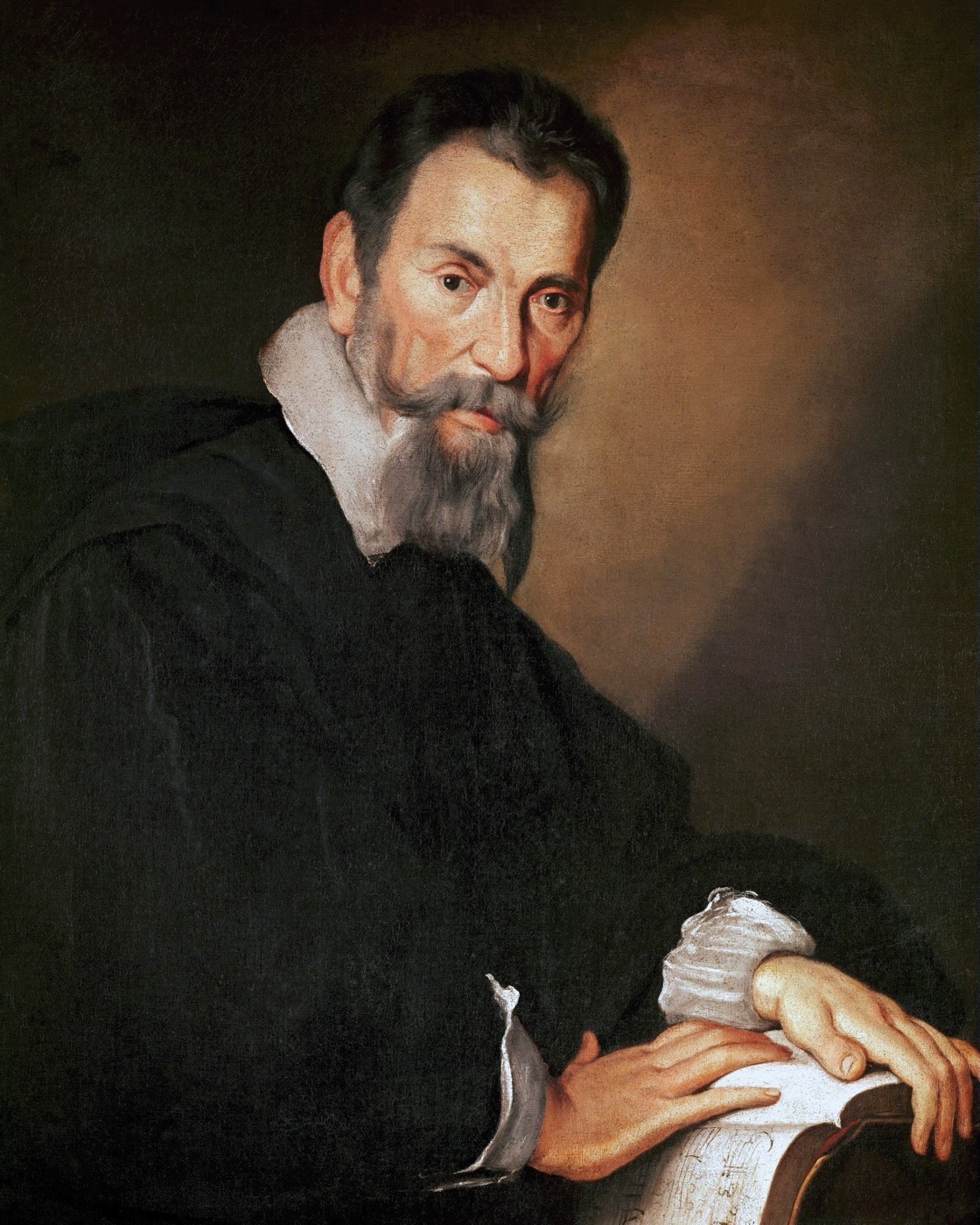
Claudio Monteverdi (1567–1643) stands precisely on the fault line between two eras. Behind him lies the Renaissance, with its strict, balanced polyphony in which no voice dared step forward; ahead lies the Baroque, in which music suddenly wished not to adorn the word but to suffer along with it. He was born in Cremona, in his youth published his first books of madrigals, in the 1590s entered the service of Duke Vincenzo Gonzaga in Mantua, and from 1613 until his death was maestro di cappella of St. Mark's Basilica in Venice — the most prestigious musical post in Italy.
It was Monteverdi who brought the Italian madrigal to its peak. In the six books printed during his lifetime he step by step renounces strict Renaissance counterpoint — the very thing that for his contemporaries was embodied in Giovanni Palestrina — in favor of what the composer himself called the "seconda pratica," the "second practice." Here the rules yield to the expressiveness of the word: if the text speaks of pain, the music is permitted to be harsh. His madrigal Cruda Amarilli from the Fifth Book became a textbook flashpoint of the dispute with the old school — the very boundary beyond which the new art begins.
To Monteverdi's name is also linked the birth of opera as a fully fledged genre. Orfeo (1607) is the first opera to enter the world repertoire firmly and to remain in it to this day. The singer Orpheus descends into the underworld to bring back his dead wife — and for the first time music takes upon itself the whole weight of that grief, rather than merely accompanying the plot. His late masterpieces, The Return of Ulysses and The Coronation of Poppea of the 1640s, go further still: in them one can already see psychologically precise, living characters and a mature orchestral texture.
But perhaps the most astonishing thing is that Monteverdi carried out the same revolution in the church. His Vespro della Beata Vergine of 1610, the grandiose Vespers of the Blessed Virgin for soloists, choir, and orchestra, remains to this day one of the summits of Western religious music. Here prayer sounds not remotely and otherworldly but with human trembling: rapture, longing, hope — all that lives in a soul standing before God. The Renaissance taught music to express living feeling — and Monteverdi brought that feeling right beneath the vaults of the temple.
He left a whole school behind him. Venetian opera was taken up by his pupils Cavalli and Cesti; the genre itself spread across all of Europe. And Orfeo and Poppea were returned to the stage in the twentieth century by conductors of the early-music movement — Nikolaus Harnoncourt, William Christie, René Jacobs — and it turned out that music four centuries old sounds astonishingly contemporary.
Today it is impossible to imagine either opera or the European secular song without Monteverdi. But the main thing about him is not the list of firsts. To listen to Monteverdi is to hear the moment when, for the first time, the individual human being sounded so distinctly in music: with his joy, his jealousy, and his prayer. The very moment when sound learned to be alive.