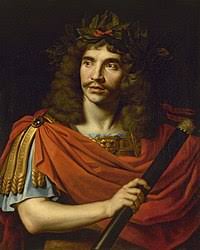
Jean-Baptiste was born in Paris to Jean Poquelin — a royal upholsterer and decorator carrying on the family trade — and Marie Cressé, daughter of a prosperous bourgeois. His mother died when he was ten, and the boy grew up with a father who saw in him the heir to his craft. He was well educated, graduating from the prestigious Jesuit college of Clermont, where he acquired a thorough command of Latin, and he is thought to have spent some time studying law at Orléans. All of this promised splendid prospects: he could have become a comfortable bourgeois without much effort. Instead, at twenty-one, he chose the theatre. In June 1643 he left his social class and his family and, together with Madeleine Béjart, founded the Illustre Théâtre. The new venture went bankrupt in 1645, and Jean-Baptiste was imprisoned for its debts — though not for long; historians still argue over who paid for his release, his father or the lover of one of the actresses in the troupe. It is to this period that the stage name Molière belongs, possibly invented to spare his father the disgrace of an actor in the family, the profession being despised in the society of the day.
After his release Molière and Madeleine took to giving performances in the provinces, travelling from town to town and village to village. That life lasted twelve years, and it ended in success: the troupe won the patronage of Philippe d'Orléans. Molière and his company returned to Paris in 1658 and performed before the king — Corneille's tragedy Nicomède and a farce of Molière's own, The Doctor in Love, a play now considered lost. The performance succeeded, and the troupe was granted the title of Troupe de Monsieur, the king's brother. Together with an Italian comedy company, it was given the Petit-Bourbon theatre, where on 18 November 1659 the public saw the comedy The Affected Ladies. That play opens Molière's Parisian period, and it is remembered too for having so stung the ladies of the day that it was banned for two weeks — after which it ran with redoubled success.
Molière's fame grew steadily, and with it both his admirers and his enemies. Despite his own passion for tragedy, it was his farces that made his name — usually one-act pieces given after the tragedy. To perfect his comic technique he asked his colleague Tiberio Fiorelli, the creator of Scaramouche, to teach him the secrets of the craft; his next play, Sganarelle, or The Imaginary Cuckold, owed its existence to those lessons. In 1662 the troupe and their Italian colleagues moved to the Palais-Royal. That same year Molière married Armande, whose origins remain uncertain: she is generally held to have been Madeleine's sister, though it is also possible that she was Madeleine's illegitimate daughter by the Duke of Modena. Both the marriage and the play he brought out at the same time, The School for Wives, provoked a wave of criticism and attack. The hostility never subsided for the rest of his life: he was accused of excessive realism and of irreverence, even of having married his own daughter. Many former friends turned away, but the king remained favourable, granting Molière a pension and consenting to stand godfather to the first son of Molière and Armande. His later career was one long entanglement of attacks — from the church, from the medical profession, from high society — and of royal protection against them. Many plays were banned; many had to be rewritten before they could be staged.
Madeleine Béjart died in 1672, and Molière's grief at the loss, together with his failing health, told on his work: he wrote less, though this period produced such masterpieces as Scapin's Deceits, The Learned Ladies and The Imaginary Invalid. With that last play his death is bound up. He suffered from pulmonary tuberculosis, possibly the legacy of his youthful imprisonment. During a performance in which he himself was acting, he was seized by a fit of coughing and haemorrhage. The king urged him to stop and rest, but Molière refused and went on playing; another attack followed, and he died a few hours later at home. Actors were forbidden burial in consecrated ground, and the same prohibition fell on Molière; thanks to the king he was buried after all, but at night, and in the part of the cemetery reserved for unbaptized children. In 1792 his remains were moved to the Museum of French Monuments, and in 1817 they were reinterred at Père Lachaise in Paris.
The plays that survive include The Jealousy of Le Barbouillé, a farce (1653); The Flying Doctor, a farce (1653); The Scatterbrain, or Everything Amiss, a verse comedy (1655); The Amorous Quarrel (1656); The Affected Ladies (1659); Sganarelle, or The Imaginary Cuckold (1660); Don Garcia of Navarre, or The Jealous Prince (1661); The School for Husbands (1661); The Bores (1661); The School for Wives (1662); The Critique of the School for Wives (1663); The Versailles Impromptu (1663); The Forced Marriage, a farce (1664); The Princess of Elis, a gallant comedy (1664); Tartuffe, or The Impostor (1664); Don Juan, or The Stone Feast (1665); Love Is the Doctor (1665); The Misanthrope (1666); The Doctor in Spite of Himself; and others.
In 1808 the Odéon theatre in Paris staged Alexandre Duval's farce La Tapisserie, presumed to be a reworking of a Molière farce, Le Casaque. Duval is thought to have destroyed the Molière original, or his copy of it, to conceal the obvious borrowing, changing the characters' names — though their temperaments and behaviour remained suspiciously Molièresque. The playwright Guyot de Saix attempted to restore the source, and in 1911 presented the farce under its original title at the Folies-Dramatiques. On 7 November 1919 the journal Comœdia published an article by Pierre Louÿs, "Molière — a Creation of Corneille." Comparing Molière's Amphitryon with Pierre Corneille's Agésilas, he concluded that Molière had merely signed texts composed by Corneille. Though Louÿs was himself a hoaxer, the idea — known today as the Molière-Corneille affair — spread widely, taken up in such works as Henri Poulaille's Corneille Behind the Mask of Molière (1957), Molière, or The Imaginary Author by the lawyers Hippolyte Wouters and Christine de Ville de Goyet (1990), and Denis Boissier's The Molière Affair: The Great Literary Hoax (2004), among others.