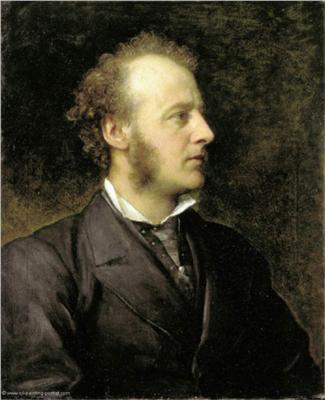
He was born in 1829 in Southampton, and at eleven he entered the Royal Academy — the youngest student in its entire history. His talent was obvious to everyone; Millais could have made a calm, smooth, successful career. Instead, at twenty, he and two friends declared war on the whole of English painting. In 1848 they founded the Pre-Raphaelite Brotherhood — and proclaimed: back to nature, to the Middle Ages, to truth. No idealized forms, no studio convention. Paint everything from life, down to the last leaf.
This sounds like a program of technique. In fact it was a program of faith. The Pre-Raphaelites wanted to give things back their authenticity — to give the saint back his weight, his dust, his splinter-pricked hands. If the Word became flesh, then flesh cannot be painted beautifully and approximately: it must be painted as it is.
Hence Millais's most audacious early work — Christ in the House of His Parents. He painted the Holy Family not in gold and not in radiance, but in a real carpenter's workshop: shavings on the floor, calloused hands, a boy with a bleeding palm. The public was outraged — it seemed blasphemous to show the Savior so earthly, so ordinary. But this was precisely the truth of the Incarnation: God enters not a stage set but a living, vulnerable human life.
Millais carried the same merciless honesty into Ophelia (1851–1852). A woman lies in the water, slowly sinking, and her face is calm. The grass, the flowers, the riverside thickets are rendered with a botanist's precision: Millais spent months painting the Hogsmill river, several hours a day. The model, Elizabeth Siddal, lay in a bath of water; the water grew cold, she fell ill — and he went on. That is how this faith in nature worked: to the end, without concessions, almost cruelly.
And then something happened. He married Effie Gray — the former wife of Ruskin, the critic who had once defended the Pre-Raphaelites — and she left her husband for him. Millais became famous, began to receive large commissions. He started painting portraits of wealthy people and sentimental scenes of children. His Bubbles — a sweet boy with a soap bubble — was turned into an advertisement for Pears soap. The hand was the same, flawless; what had vanished was the very thing for which the hand had once taken up the brush.
The Pre-Raphaelites condemned him. William Holman Hunt, the most stubborn and faithful of the Brotherhood, did not speak to him for years. For them this was not a betrayal of the craft — it was a betrayal of that first vow about truth with which everything had begun in 1848.
Millais died in 1896 — President of the Royal Academy, crowned with all the honors of the very establishment he had risen against in his youth. The youngest and the most talented traveled the whole road: from a boy with a bleeding palm in a carpenter's workshop to a glossy bubble on an advertising poster. And in that distance lies the whole drama of an artist to whom truth was once given, and who then learned to do without it.