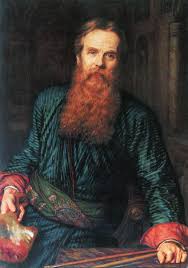
He was the most stubborn of the Pre-Raphaelites. While Millais turned into a portraitist of the bourgeoisie and Rossetti into a dreamer, Hunt went on believing in the program — the very one it had all begun with: truth, nature, detail. He did not betray it in his youth, nor on the threshold of blindness.
William Holman Hunt was born in London in 1827 and was admitted to the Royal Academy only on his second attempt. In 1848, together with Millais and Rossetti, he founded the "Pre-Raphaelite Brotherhood" — a small conspiracy of young artists against the smooth, sugared painting of their age. Their slogan was short and almost defiant: truth, nature, detail. For most it remained a youthful gesture. For Hunt it became a rule for life.
His method was literal to the point of obstinacy. In the painting "The Light of the World," Christ stands at a locked door with a lantern and knocks. Hunt painted that door from life, at night, by the real light of a lantern, rather than inventing it at his desk. He did not want to imagine the light — he wanted to see it. The work became the most widely reproduced Christian image of the Victorian era: it was known in homes where not a single other artist's name was known.
In pursuit of authenticity he went farther than anyone in his circle. Hunt painted "The Scapegoat" not in a London studio but in Jordan, on the shore of the Dead Sea, where the white goat stands upon a dead salt waste. The landscape nearly killed the artist himself: he fell gravely ill, and his goat died. Then Hunt found another, painted it white and finished the picture. Such was the price of a single detail that the viewer might not even notice.
Twice he traveled to Palestine — not for impressions, but for fact. His logic was iron and almost naïve: if a painting depicts Jerusalem, the artist was obliged to have seen Jerusalem with his own eyes. He painted a religious scene the way others paint from a living model — from the life of the Holy Land, under its real sun. The Gospel event ceased to be an icon of the imagination and became something that happened in a particular place.
At the end of his life Hunt went nearly blind. He dictated his autobiography — and in it described every detail of his paintings with the same care with which he had once painted them: an artist who had lost his sight went on seeing his canvases down to the last brushstroke. He died in 1910.
"The Light of the World" is kept at Keble College, Oxford, and still raises the same question it did in the artist's lifetime: art or illustration? That dispute is perhaps the truest monument to Hunt — a man who set out to paint the invisible as honestly as one paints a door and a goat, and did not retreat even when it nearly cost him his life.